KS3 Geography › Rocks, weathering and soil

KS3 Geography › Rocks, weathering and soil
These are the points the worksheet questions are built around.
Planet Earth is around 4.6 billion years old. To make sense of that, geologists divide Earth's past into sections and arrange them along a single timeline called the geological timescale. Strangely, its sections are nowhere near equal: some stretch across billions of years, while others cover only a few thousand.
One way to grasp the scale is to compress Earth's history into a single 24-hour day. Earth forms at midnight as a ball of molten rock under constant bombardment from space debris. By roughly 4am the first living things have appeared in the oceans, but they are microscopic single cells and stay that way for hours. Nothing visible exists until about 9pm, when the oceans suddenly fill with animals. Dinosaurs appear at around quarter to eleven and are gone by twenty to midnight, and modern humans only arrive in the final six seconds. For most of the day very little changes, and then nearly everything is packed into the last three hours.
Just as people split time into years, months, days and hours, geologists use four main sizes of division. The largest is the eon, which lasts from hundreds of millions to billions of years. Each eon is made up of eras, which last tens to hundreds of millions of years. Each era is divided into periods, each lasting millions of years. The smallest of the four is the epoch, a slice of a period that lasts from thousands to millions of years. They fit together like boxes inside boxes.
The reason the boxes are different sizes is that geologists do not mark the boundaries at regular intervals. Instead, they place a boundary wherever the rocks show that something enormous happened. Rock builds up in layers, and the fossils trapped inside work like a diary of Earth's past. When the fossils change suddenly, because whole groups of living things disappear or new ones appear, a line is drawn. Big shifts in climate and moving continents can also mark one.
This explains why the first four billion years, nearly ninety percent of Earth's history, are split into just three eons. The Hadean was a violent time of volcanoes and meteorite strikes, when the first crust formed. During the Archean, simple life such as bacteria first appeared in the oceans. In the Proterozoic, oxygen built up in the air and the first life made of many cells developed. Together these three eons are often known as the Precambrian. They have so few divisions because tiny, soft-bodied creatures hardly ever leave fossils, so the rocks have little to show. Around 540 million years ago, however, the rocks suddenly become full of fossils. This marks the beginning of the current eon, the Phanerozoic, a name meaning visible life. More fossils mean more changes to detect, and so more divisions.
The Phanerozoic is divided into three eras, and their names tell the story of life on Earth. Paleozoic means ancient life, Mesozoic means middle life and Cenozoic means new life. In the Paleozoic, the seas filled with creatures such as trilobites, armoured animals related to modern crabs and insects. The first fish and forests appeared, and the land came together into one supercontinent called Pangaea. The era ended 252 million years ago with the Great Dying, when massive volcanic eruptions changed the climate and wiped out at least eight in every ten species living in the sea.
Many people assume the asteroid that killed the dinosaurs caused the biggest extinction, but the Great Dying was larger still, making it the biggest mass extinction known. During the Mesozoic, dinosaurs dominated and Pangaea gradually split apart. Then, 66 million years ago, an asteroid struck the area that is now Mexico, and around three quarters of all species died out, including the dinosaurs. That event closed the Mesozoic and opened the Cenozoic, the age of mammals.
Today, Earth sits in the Phanerozoic eon and the Cenozoic era. The current period is the Quaternary, which began 2.58 million years ago and is known for its ice ages, when vast ice sheets grew and shrank again and again. The current epoch is the Holocene, which started around 11,700 years ago when the last ice age ended and the climate became steady. That stable climate allowed people to begin farming and to build towns and cities. The two are easily confused: the Quaternary is the period, and the Holocene is the smaller epoch inside it. On the 24-hour clock, the entire Holocene lasts only about a fifth of a second, so every pyramid, city and invention fits inside that tiny fraction of the day.
Some scientists argue that humans have already started a new epoch, the Anthropocene, meaning the human epoch. They argue people have changed the planet as much as any natural disaster. Burning fossil fuels is warming the climate, plastic is collecting in the mud at the bottom of lakes and seas, concrete cities cover huge areas of land, and species are disappearing far faster than normal. All of this would show up in future rock layers. Some even proposed a clear starting point in the 1950s, when nuclear bomb tests left radioactive traces in lake mud across the world. In 2024, however, the scientists responsible for the official timescale voted against adding the Anthropocene, at least for now. Some felt the evidence was not yet strong enough and others disagreed about when it should start, so the Holocene remains the official epoch while the debate continues.
In short: the geological timescale divides Earth's 4.6-billion-year history into eons, eras, periods and epochs, from biggest to smallest. The divisions are uneven because the lines are drawn where the rocks record a huge change, not at equal gaps. Earth is now in the Quaternary period and the Holocene epoch, though some scientists believe humans have already begun the Anthropocene.
These are the words that appear as key term cards in the video — worth knowing cold before the test.
Short clips from this lesson. Good for a quick refresh before a test.
Revising for a test? Key terms, objectives and quiz questions on one printable page.
The 3 questions from the video, one at a time. See if you caught them.
1. Which is the largest division of geological time?
Why: An eon is the biggest box, lasting hundreds of millions to billions of years.
2. Which of these is NOT an era?
Why: The Jurassic is a period, a smaller box that sits inside the Mesozoic era.
3. Which mass extinction wiped out the most species?
Why: The Great Dying, 252 million years ago, wiped out more species than the dinosaur asteroid.
Score: 0 out of 3 —
Want more practice? Try the 60-second Quiz Challenge →
One page with a full answer key. Enough to check the lesson landed, and to see how the questions are written before you buy anything.
Get the free worksheet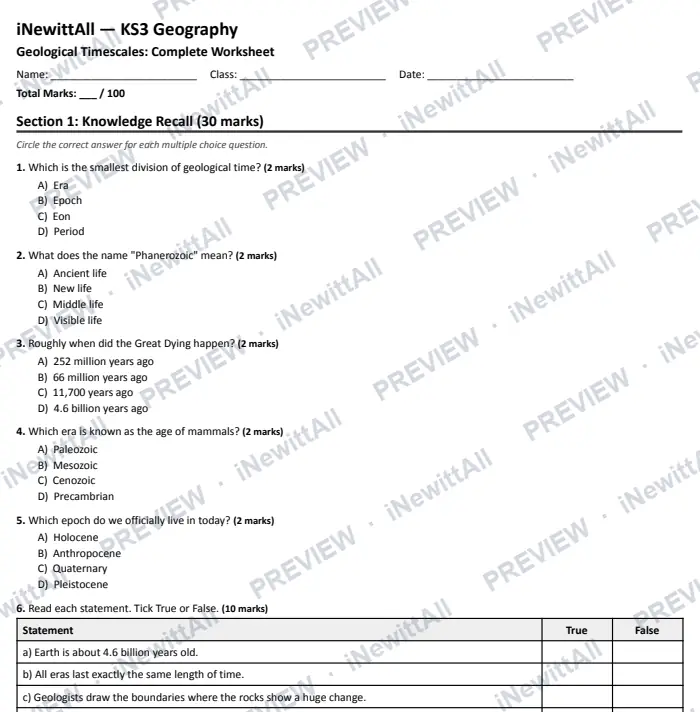
The top of page 1. The answer key is included when you buy.
£5 £6
The full worksheet and the extension pack together, with both answer keys.
Instant download with full answer keys. Print as many copies as your class needs.
£3
£3
£5 £6
Tick it off to track your progress. It's saved on this device. See my revision →
Students watch the video and do the quiz. They get a result card to paste back to you, showing their first try and best score.
This lesson's quiz questions on one sheet, with the answer key on page 2.
The quiz in big text for your classroom screen, one question at a time. Or build a 5-question Do Now starter from lessons your class has already done.
You're welcome to embed the video and link these resources in Google Classroom, Stile, Canvas, Compass or any other school platform. No need to ask.
Everything here is written to the KS3 curriculum for students aged 11–14. Print freely for the classes you teach.
No spam, unsubscribe anytime. You must be 13 or over to sign up.