KS3 Geography › Anthropocene

KS3 Geography › Anthropocene
These are the points the worksheet questions are built around.
Earth is around 4.5 billion years old, and geologists break that history into blocks: eons (the largest), which split into eras, which split into periods, which split into epochs (and epochs split into even smaller ages). If that entire history were squeezed into a single day, humans wouldn't appear until the last few seconds before midnight.
Right now, we officially live in an epoch called the Holocene, which began about 12,000 years ago when the last ice age ended. The Holocene has been remarkably stable — warm and calm — and that stability is exactly what allowed humans to build farms, towns, and civilisations. However, a growing number of scientists believe that stable chapter has already ended, and that humans have pushed Earth into a new epoch entirely: the Anthropocene.
The name comes from the ancient Greek word "anthropos," meaning human, so Anthropocene roughly means "the human age." It's a proposed epoch in which one species — us — has become the most powerful force shaping the planet, a role that, for almost all of Earth's history, belonged to nature: volcanoes, ice ages, shifting continents, and asteroids.
Scientists disagree on exactly when this new epoch began, with two main candidates. The first is the Industrial Revolution, in the late 1700s, when factories first appeared and humans began burning coal on a massive scale, pumping unprecedented amounts of carbon dioxide into the atmosphere — a rise still detectable in ancient ice today. The second is the 1950s, known as the Great Acceleration: in the decades following World War II, human population surged, factories boomed, plastic flooded the world, and countries tested nuclear weapons, scattering radioactive particles across the planet at almost exactly the same moment — creating an unusually clear, universal marker in the rock.
Importantly, the Anthropocene isn't about when humans first appeared — our species has existed for around 300,000 years, but for most of that time we left barely a mark. It's about when humans became powerful enough to reshape the entire planet.
Evidence for this new age is visible everywhere: cities spreading rapidly, a warming climate bringing more extreme weather, species vanishing so fast some scientists call it a sixth mass extinction, straightened rivers, flattened forests, and pollution reaching every corner of the planet, from ocean trenches to mountain peaks. To officially confirm a new epoch, though, scientists need one single, permanent signal locked into the rock — and the radioactive particles from 1950s nuclear testing might be exactly that.
Despite all this evidence, the Anthropocene is not yet an official part of the geological timescale. Scientists are still debating what exactly should count as the Anthropocene, when it truly began, and whether it deserves official recognition at all — since a geological epoch is normally expected to last thousands or millions of years, and some argue it's simply too soon to draw the line. In fact, a group of scientists recently voted against making it official, at least for now.
In short: many scientists believe human activity has become powerful enough to end the stable Holocene epoch and begin a new one, the Anthropocene, with the Industrial Revolution and the 1950s Great Acceleration as the two leading candidates for its start. The evidence — climate change, mass extinction, pollution, and radioactive fallout — is real and visible, even though the Anthropocene itself remains an unofficial, actively debated proposal rather than a confirmed chapter of Earth's history.
These are the words that appear as key term cards in the video — worth knowing cold before the test.
Short clips from this lesson. Good for a quick refresh before a test.
Swipe sideways to see more →
Revising for a test? Key terms, objectives and quiz questions on one printable page.
The 3 questions from the video, one at a time. See if you caught them.
1. Which of these is the smallest unit of geological time?
Why: Geological time goes from eons to eras, then periods, then epochs (epochs are split into even smaller ages). The Anthropocene has been suggested as a new epoch.
2. Which of these is NOT a main proposed start date for the Anthropocene?
Why: The two main proposed start dates are the Industrial Revolution and the Great Acceleration of the 1950s. The end of the last ice age was when the Holocene began.
3. True or false — the Anthropocene is now an official geological epoch?
Why: It is not official. Scientists voted against making it official for now, because they still disagree about it.
Score: 0 out of 3 —
Want more practice? Try the 60-second Quiz Challenge →
One page with a full answer key. Enough to check the lesson landed, and to see how the questions are written before you buy anything.
Get the free worksheet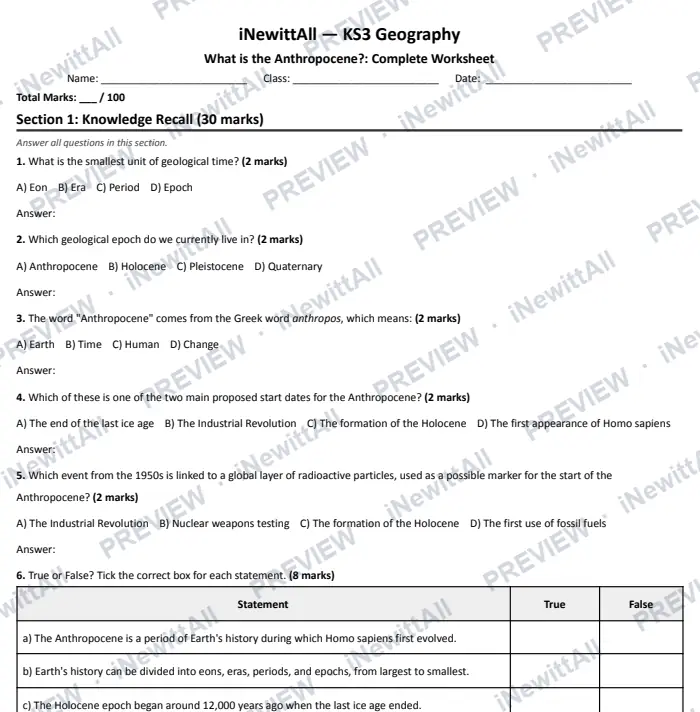
The top of page 1. The answer key is included when you buy.
£5 £6
The full worksheet and the extension pack together, with both answer keys.
Instant download with full answer keys. Print as many copies as your class needs.
£3
£3
£5 £6
Tick it off to track your progress. It's saved on this device. See my revision →
Students watch the video and do the quiz. They get a result card to paste back to you, showing their first try and best score.
This lesson's quiz questions on one sheet, with the answer key on page 2.
The quiz in big text for your classroom screen, one question at a time. Or build a 5-question Do Now starter from lessons your class has already done.
You're welcome to embed the video and link these resources in Google Classroom, Stile, Canvas, Compass or any other school platform. No need to ask.
Everything here is written to the KS3 curriculum for students aged 11–14. Print freely for the classes you teach.
More in this unit: Anthropocene
No spam, unsubscribe anytime. You must be 13 or over to sign up.