KS3 Geography › Tectonic hazards

KS3 Geography › Tectonic hazards
These are the points the worksheet questions are built around.
We actually know more about the surface of the moon than the inside of our own planet. Earth is made up of four main layers: the inner core, outer core, mantle, and crust — each with its own make-up and its own state, solid or liquid. A simple way to picture the structure is like a loaf of bread, with the crust on the outside, or like an apple, with the core in the middle.
The deepest hole humans have ever drilled is the Kola borehole in Russia, reaching 12.3 kilometres down. That sounds impressive, but the centre of the Earth is over 6,000 kilometres deep, so humans have barely scratched the surface. Since nobody has ever been down there, scientists work out what Earth's interior is like using seismic waves — vibrations from earthquakes that ripple through the entire planet. Detectors around the world pick up these waves, and because some types of seismic wave can't travel through liquid, comparing how the waves are felt in different places tells scientists which layers are solid and which are liquid.
At the very centre is the inner core, made of iron and nickel. Despite reaching an estimated 5,500°C — comparable to the surface of the sun — it's solid, because of the immense pressure from all the layers above pressing down on it, squashing it into an extremely dense solid form.
Moving outward, the outer core is also extremely hot, hot enough to melt rock, but because there isn't quite enough pressure at that depth, it remains liquid metal rather than being forced solid. Temperature generally decreases the further out from the centre you go.
The mantle is Earth's thickest layer, at 2,900 kilometres, made mostly of rock rich in silicon, oxygen, iron and magnesium. Despite common misconceptions, the mantle is mostly solid rock — only around 1% of it is thought to flow like a very thick fluid, and even that movement happens extremely slowly, over thousands to millions of years.
The crust is the layer we live on: the thinnest and coolest layer, ranging from about 5 kilometres thick under the oceans to about 70 kilometres under mountains. It's thickest where there's land and thinnest under the oceans.
The upper mantle and the crust together form a hard, rigid outer layer called the lithosphere. Rather than being one continuous shell, the lithosphere is broken into large sections called tectonic plates, such as the North American, African, and Eurasian plates (the UK sits on the Eurasian plate). Where two plates meet is called a plate boundary. All plate boundaries can experience earthquakes, and many also experience volcanic eruptions, though not all of them. Earthquakes can occasionally happen away from plate boundaries too, but these tend to be less significant. Even so, the overall pattern is clear: most earthquakes and volcanoes occur at plate boundaries.
The most tectonically active region on Earth is the Pacific Ring of Fire, where about three-quarters of the world's active volcanoes are found, along with nine out of every ten of the world's earthquakes.
In short: Earth has four layers — a solid inner core, liquid outer core, mostly solid mantle, and thin crust — identified largely through analysing seismic waves from earthquakes. The crust and upper mantle together form the lithosphere, broken into tectonic plates, and it's at the boundaries between these plates that the vast majority of the world's earthquakes and volcanoes occur, especially around the Pacific Ring of Fire.
These are the words that appear as key term cards in the video — worth knowing cold before the test.
Short clips from this lesson. Good for a quick refresh before a test.
Swipe sideways to see more →
Revising for a test? Key terms, objectives and quiz questions on one printable page.
The 3 questions from the video, one at a time. See if you caught them.
1. What are the four layers of Earth?
Why: Earth has four layers: the solid inner core, the liquid outer core, the mantle and the crust. The lithosphere and asthenosphere are parts of the crust and mantle, not extra layers.
2. What is the estimated temperature of the inner core?
Why: The inner core is about 5,500°C, which is as hot as the surface of the Sun. It stays solid because the pressure there is so enormous.
3. Which layer of Earth is liquid?
Why: The outer core is liquid metal, mostly iron and nickel. The inner core is solid, and the mantle is solid rock that moves very slowly.
Score: 0 out of 3 —
Want more practice? Try the 60-second Quiz Challenge →
One page with a full answer key. Enough to check the lesson landed, and to see how the questions are written before you buy anything.
Get the free worksheet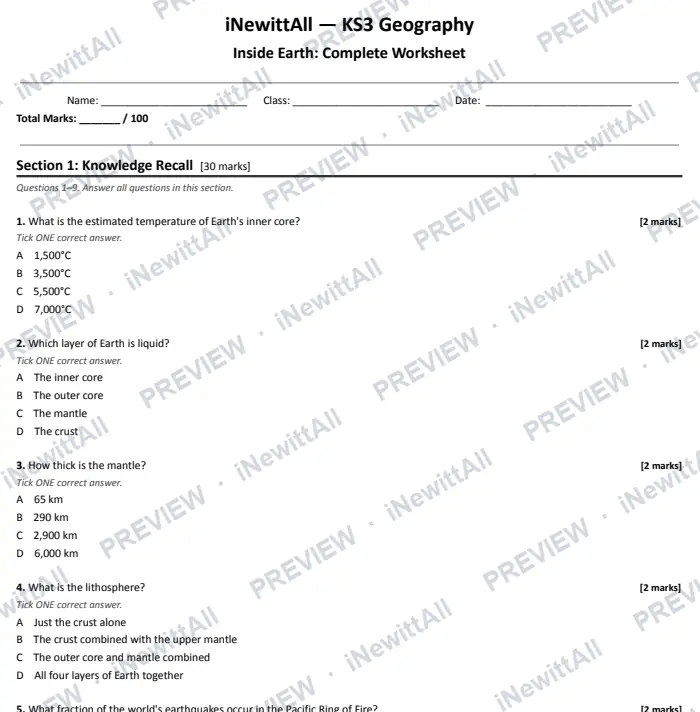
The top of page 1. The answer key is included when you buy.
£5 £6
The full worksheet and the extension pack together, with both answer keys.
Instant download with full answer keys. Print as many copies as your class needs.
£3
£3
£5 £6
Tick it off to track your progress. It's saved on this device. See my revision →
Students watch the video and do the quiz. They get a result card to paste back to you, showing their first try and best score.
This lesson's quiz questions on one sheet, with the answer key on page 2.
The quiz in big text for your classroom screen, one question at a time. Or build a 5-question Do Now starter from lessons your class has already done.
You're welcome to embed the video and link these resources in Google Classroom, Stile, Canvas, Compass or any other school platform. No need to ask.
Everything here is written to the KS3 curriculum for students aged 11–14. Print freely for the classes you teach.
No spam, unsubscribe anytime. You must be 13 or over to sign up.