KS3 Geography › What makes a geographer?

KS3 Geography › What makes a geographer?
These are the points the worksheet questions are built around.
Geography comes from two Greek words: "geo" meaning Earth, and "graphy" meaning writing — so geography literally means "writing about the Earth." It's the study of Earth's landscapes, people, places, and environments, and it splits into three main types that work together to build a complete picture of the world: physical, human, and environmental geography.
Physical geography is the study of Earth's natural features and processes — essentially everything that would still exist even without humans. This includes rivers and coasts, which shape valleys, waterfalls, and cliffs; volcanoes and earthquakes, caused by the movement of tectonic plates, huge pieces of Earth's crust that slowly shift, collide, and pull apart; weather and climate (weather being day-to-day conditions, climate being the average pattern over many years); glaciers, which carve valleys as they move and are melting faster due to climate change; and ecosystems and biomes — an ecosystem being all the living and non-living things in an area working together, and a biome being a large area sharing similar climate, plants, and animals, such as deserts, grasslands, or tundra.
Human geography studies how societies, cultures, and economies differ around the world — essentially how people live within the natural world physical geography describes. Key topics include population (why numbers grow or shrink in different places), migration (the movement of people from one place to another, whether by choice or forced by war, disaster, or persecution), cities and urban patterns (why cities often develop near natural harbours, rivers, or fertile farmland), development and globalisation (why some countries are wealthier than others, and how economies change over time), and resources and conflict (how resources like food, water, and energy are distributed, and how competition for them can cause conflict).
Environmental geography sits between the other two, studying the relationship between people and the environment — how humans impact nature, and how nature impacts humans back. This has become especially important due to climate change: long-term changes in global temperature and weather patterns, caused primarily by human activity like burning fossil fuels, leading to rising temperatures, melting ice, and extreme weather. Other key topics include waste and pollution (plastic in oceans, chemicals in rivers, air pollution in cities) and deforestation and habitat destruction — cutting down forests destroys the homes of plants and animals and can affect the whole planet's climate; the Amazon rainforest alone stores billions of tonnes of carbon and helps make its own rain. (It's often said to make 20% of our oxygen, but that's a myth: the forest uses up almost all the oxygen it makes.) Environmental geography isn't just about identifying these problems, though — it's also about finding solutions, such as sustainability (using resources without harming the environment for future generations) and renewable energy.
These three types of geography constantly overlap rather than existing in separate boxes. A river itself is physical geography. People building a city beside it, using it for transport and drinking water, is human geography. That same river flooding because of climate change, or becoming polluted by nearby factories, is environmental geography. The same pattern applies to farming: soil and weather are physical geography, decisions about what to grow are human geography, and the environmental impact of pesticides or sustainable farming practices is environmental geography. Geographers often use a Venn diagram to show this overlap, since many real-world topics — like climate change — sit right where all three types connect.
In short: geography is the study of Earth and how people interact with it, made up of three overlapping types. Physical geography studies natural features and processes, human geography studies how people live and organise themselves, and environmental geography studies the relationship — and often the tension — between the two, which is why understanding all three together gives the fullest picture of how the world actually works.
These are the words that appear as key term cards in the video — worth knowing cold before the test.
Short clips from this lesson. Good for a quick refresh before a test.
Swipe sideways to see more →
Revising for a test? Key terms, objectives and quiz questions on one printable page.
The 3 questions from the video, one at a time. See if you caught them.
1. Which best describes the focus of human geography?
Why: Human geography looks at people, including societies, cultures and economies. Rock formations and plate tectonics belong to physical geography.
2. Why is environmental geography seen as the bridge between physical and human geography?
Why: Environmental geography links the two. It studies how people change nature and how nature affects people's lives.
3. A geographer studies how fast an Arctic glacier is melting because of rising global temperatures. Which branch of geography is this?
Why: Glaciers and rising temperatures are part of the natural world, and it is human activity that is warming the planet. So this fits physical or environmental geography.
Score: 0 out of 3 —
Want more practice? Try the 60-second Quiz Challenge →
One page with a full answer key. Enough to check the lesson landed, and to see how the questions are written before you buy anything.
Get the free worksheet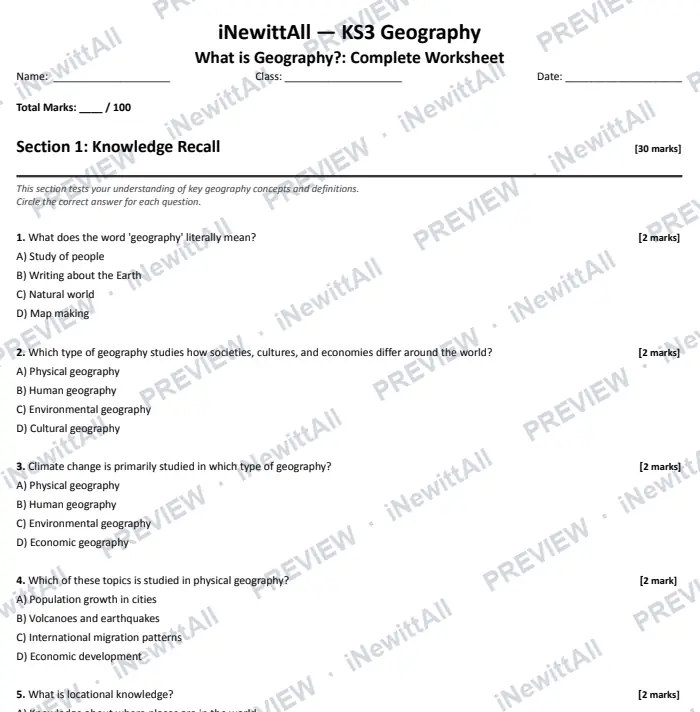
The top of page 1. The answer key is included when you buy.
£5 £6
The full worksheet and the extension pack together, with both answer keys.
Instant download with full answer keys. Print as many copies as your class needs.
£3
£3
£5 £6
Tick it off to track your progress. It's saved on this device. See my revision →
Students watch the video and do the quiz. They get a result card to paste back to you, showing their first try and best score.
This lesson's quiz questions on one sheet, with the answer key on page 2.
The quiz in big text for your classroom screen, one question at a time. Or build a 5-question Do Now starter from lessons your class has already done.
You're welcome to embed the video and link these resources in Google Classroom, Stile, Canvas, Compass or any other school platform. No need to ask.
Everything here is written to the KS3 curriculum for students aged 11–14. Print freely for the classes you teach.
 Next lessonLocational Knowledge of the World
More in this unit: What makes a geographer?
No spam, unsubscribe anytime. You must be 13 or over to sign up.