KS3 Geography › Natural resources

KS3 Geography › Natural resources
These are the points the worksheet questions are built around.
A natural resource is any material or substance found in the natural environment that humans can use to meet their needs — food crops, timber, coal and oil, fish, solar power, even the water we drink. These all existed before humans, who simply learned to use them.
Not everything counts as a natural resource, though. A mobile phone isn't one, since it's manufactured — but the metals and minerals inside it are. And a natural resource doesn't have to be completely untouched by humans to still count: managed forests, fish farms, and reservoirs are all still natural resources, even though people have shaped them.
Resources split into two main groups. Renewable resources naturally replenish themselves — solar energy, wind, fish stocks, and forests will keep coming back if managed well. Fast-growing softwood trees, for example, can be ready to cut after about 20 to 40 years. Non-renewable resources, like coal, oil, and iron ore, took millions or billions of years to form and, once used up, cannot be replaced. Iron ore formed billions of years ago when iron dissolved in ancient seas, settled on the ocean floor, and was compressed by geological forces into rock — a process nothing like the few decades it takes a tree to regrow.
Natural resources aren't shared equally around the world. Over half of all farmed food is produced by just five countries — China, the US, India, Brazil, and Indonesia. Just ten countries control over 80% of the world's oil reserves. And over 70% of the world's cobalt — a key ingredient in phone, laptop, and electric car batteries — comes from a single country, the Democratic Republic of the Congo.
This uneven distribution matters because when a resource is concentrated in only a few places, the whole world depends on those places staying stable. Conflict, natural disasters, or political decisions to cut supply can cause prices to spike, and it's usually ordinary people who feel that impact most. Many countries import resources they can't produce enough of themselves — the UK imports pineapples because its climate doesn't suit growing them, but countries also import more when their economies have shifted toward higher-wage industries like finance and technology instead of farming or mining, or when a large, wealthy population creates demand that outpaces what the country could produce alone.
You might assume that resource-rich countries would automatically be wealthy, but often the opposite happens — a pattern known as the natural resource trap, or resource curse. When a country sells large quantities of a valuable resource, money floods into that one sector while other industries like manufacturing, finance, and services struggle to compete for workers and investment. Governments may not distribute that wealth fairly, and large foreign corporations often extract the resource while taking most of the profit out of the country. There's also a historical layer to this: many resource-rich nations were colonised, with resources extracted by foreign powers for centuries, leaving behind weak institutions and unequal systems that persist today.
In short: natural resources are materials from the environment that humans use, split into renewable and non-renewable types, and distributed very unevenly around the world. That uneven distribution affects prices and trade, and having abundant resources doesn't guarantee a country's wealth — without fair governance and a diversified economy, even resource-rich nations can leave their populations behind.
These are the words that appear as key term cards in the video — worth knowing cold before the test.
Short clips from this lesson. Good for a quick refresh before a test.
Swipe sideways to see more →
Revising for a test? Key terms, objectives and quiz questions on one printable page.
The 3 questions from the video, one at a time. See if you caught them.
1. Which of the following is a non-renewable resource?
Why: Iron ore takes millions of years to form, so once it has been mined it can't be replaced in our lifetime. Wind never runs out, and timber and fish can be replaced if they are managed well.
2. Why might a country import more food than it exports?
Why: A country imports more food than it exports when it can't grow enough for everyone. This can be because it has a big population, because people are wealthy enough to buy a lot, or because the climate isn't good for growing crops.
3. Which best explains the natural resource trap?
Why: Some countries rich in resources stay poor because the money goes to a few people or to foreign companies, and other industries get neglected. That is called the natural resource trap.
Score: 0 out of 3 —
Want more practice? Try the 60-second Quiz Challenge →
One page with a full answer key. Enough to check the lesson landed, and to see how the questions are written before you buy anything.
Get the free worksheet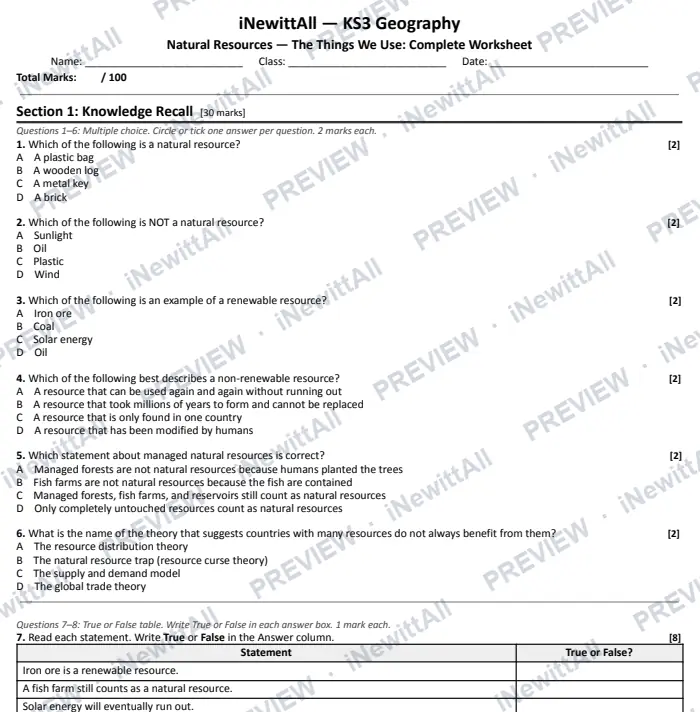
The top of page 1. The answer key is included when you buy.
£5 £6
The full worksheet and the extension pack together, with both answer keys.
Instant download with full answer keys. Print as many copies as your class needs.
£3
£3
£5 £6
Tick it off to track your progress. It's saved on this device. See my revision →
Students watch the video and do the quiz. They get a result card to paste back to you, showing their first try and best score.
This lesson's quiz questions on one sheet, with the answer key on page 2.
The quiz in big text for your classroom screen, one question at a time. Or build a 5-question Do Now starter from lessons your class has already done.
You're welcome to embed the video and link these resources in Google Classroom, Stile, Canvas, Compass or any other school platform. No need to ask.
Everything here is written to the KS3 curriculum for students aged 11–14. Print freely for the classes you teach.
No spam, unsubscribe anytime. You must be 13 or over to sign up.