KS3 Geography › The Middle East

KS3 Geography › The Middle East
These are the points the worksheet questions are built around.
A natural resource is anything that comes from the Earth without human influence that people can use — oil, gas, water, minerals, sunlight, and forests are all examples. Some natural resources are renewable, meaning they can be replaced naturally over time, like wind or sunlight. Others are non-renewable, meaning that once used up, they're gone for good — coal, oil, and gas all fall into this category, and the Middle East sits on top of some of the largest non-renewable reserves on the planet.
Natural resources aren't spread evenly around the world. Distribution describes how something is spread out across a geographic area, and the distribution of oil and gas is highly uneven. Countries like Saudi Arabia, Kuwait, Iran, Iraq, and the United Arab Emirates sit on vast reserves, while others in the same region, like Yemen and Jordan, have very little.
Saudi Arabia is a clear example of oil's impact. In 2023, it produced 11.4 million barrels of oil a day, making it the second-largest producer in the world, behind only the United States (19.4 million barrels a day) and just ahead of Russia (11.1 million barrels a day). Saudi Arabia's economy — the way a country produces, uses, and manages money, jobs, goods, and services — had a GDP of $1.07 trillion in 2023, with nearly half of that coming from oil exports (selling goods or services to other countries).
Oil wealth has a real impact on people's lives. Money earned from exporting oil can be reinvested into roads, hospitals, schools, and jobs in transportation, extraction, refining, and management. Countries like Qatar and the UAE have used oil wealth to build some of the most modern cities in the world, including Doha and Dubai. The contrast is stark: Yemen had a GDP of just $21 billion in 2023, and Jordan around $51 billion, compared to Saudi Arabia's $1.07 trillion — a gap largely explained by oil.
However, relying heavily on oil carries serious risks. Oil prices fluctuate depending on global demand, and a country earning nearly half its income from oil exports is vulnerable if prices suddenly crash. Oil is also non-renewable, meaning reserves will eventually run out entirely, leaving countries needing another source of income.
In response, several Middle Eastern countries are pursuing economic diversification — adding variety to their economy rather than relying on a single resource. The UAE has become a global hub for tourism and business, investing in airlines, free trade zones, and even a Mars mission in 2020. Qatar has invested heavily in sport and media, hosting the FIFA World Cup in 2022 and developing Al Jazeera as a global news outlet.
Saudi Arabia's approach is Vision 2030, a national strategy launched in 2016 with three main aims: diversifying the economy away from oil, building major new projects to attract global investment, and implementing social and institutional reforms. Its most ambitious project is NEOM, a new city being built in the north-west of Saudi Arabia near the Red Sea, with four striking features: The Line, a long, narrow city with no cars, powered entirely by green energy; Oxagon, a high-tech industrial port partly floating on the sea; Trojena, a mountain resort where people can ski; and Sindalah, a luxury island with hotels, beaches, and yacht docks.
In short: oil and gas are distributed very unevenly across the Middle East, creating huge wealth gaps between oil-rich nations like Saudi Arabia and oil-poor ones like Yemen. That wealth has funded modern cities and infrastructure, but over-reliance on a non-renewable, price-volatile resource is risky — which is why countries like the UAE, Qatar, and Saudi Arabia (through projects like Vision 2030 and NEOM) are actively diversifying into tourism, sport, technology, and other industries to secure their futures beyond oil.
These are the words that appear as key term cards in the video — worth knowing cold before the test.
Short clips from this lesson. Good for a quick refresh before a test.
Swipe sideways to see more →
Revising for a test? Key terms, objectives and quiz questions on one printable page.
The 3 questions from the video, one at a time. See if you caught them.
1. What does the word distribution mean in geography?
Why: Distribution means how something is spread out across an area. For example, oil isn't spread evenly around the world.
2. What does it mean when a country imports a resource?
Why: Importing means buying goods or resources from another country. Selling them to another country is called exporting.
3. Which of the following is NOT one of the four features of NEOM?
Why: NEOM's four features are The Line, Oxagon, Trojena and Sindalah. The Grid isn't one of them.
Score: 0 out of 3 —
Want more practice? Try the 60-second Quiz Challenge →
One page with a full answer key. Enough to check the lesson landed, and to see how the questions are written before you buy anything.
Get the free worksheet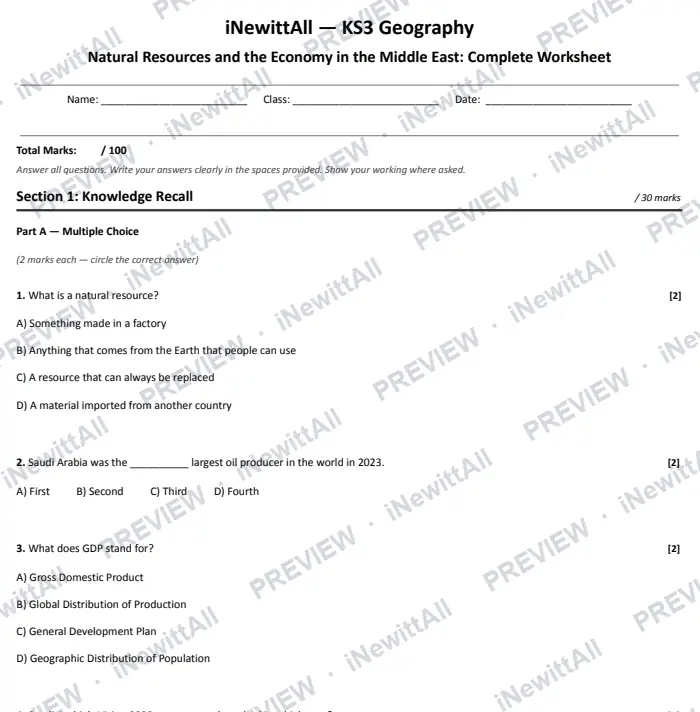
The top of page 1. The answer key is included when you buy.
£5 £6
The full worksheet and the extension pack together, with both answer keys.
Instant download with full answer keys. Print as many copies as your class needs.
£3
£3
£5 £6
Tick it off to track your progress. It's saved on this device. See my revision →
Students watch the video and do the quiz. They get a result card to paste back to you, showing their first try and best score.
This lesson's quiz questions on one sheet, with the answer key on page 2.
The quiz in big text for your classroom screen, one question at a time. Or build a 5-question Do Now starter from lessons your class has already done.
You're welcome to embed the video and link these resources in Google Classroom, Stile, Canvas, Compass or any other school platform. No need to ask.
Everything here is written to the KS3 curriculum for students aged 11–14. Print freely for the classes you teach.
No spam, unsubscribe anytime. You must be 13 or over to sign up.