KS3 Biology › Species and classification (differences between species)

KS3 Biology › Species and classification (differences between species)
These are the points the worksheet questions are built around.
Scientists have named over a million different species on Earth, with millions more still undiscovered. To make sense of this huge variety, they use classification — the process of sorting organisms into groups based on their features.
Organisms differ from each other in two main ways. Physical differences are things you can see: what an animal is covered in (fur, feathers, scales, or smooth moist skin), whether it has a backbone or a soft body, how many legs it has, and where its eyes are positioned. Behavioural differences are about what animals do: whether they're active during the day or night, whether they migrate or hibernate, whether they're predators or prey, and what they eat — herbivores eat only plants, carnivores eat only other animals, and omnivores eat both.
Classification uses seven levels, from the largest, broadest group down to the most specific: Kingdom, Phylum, Class, Order, Family, Genus, and Species (remembered with "King Philip Came Over For Good Soup"). The higher up this system you go, the more organisms are included in a group, but the fewer features they share. The further down you go, the fewer organisms there are, but the more features they share.
Taking the lion as an example: at Kingdom level, it's an animal, alongside millions of others. At Phylum level, it's a vertebrate — it has a backbone, which already rules out worms, insects and jellyfish. At Class level, it's a mammal — warm-blooded, giving birth to live young, and covered in fur — which rules out fish and birds. At Order level, it's a carnivore, ruling out animals like rabbits. At Family level, it belongs to Felidae, the cat family, narrowing things down to lions, tigers and domestic cats. At Genus level, it's Panthera, which includes lions and tigers but not domestic cats. Finally, at Species level, it's Panthera leo — just the lion. The group gets smaller at each level, while the similarities between the remaining organisms get greater.
Every living thing fits into one of five kingdoms: Animal, Plant, Fungi, Protist, or Bacteria. Even within a single kingdom there's huge variety — for example, some plants are evergreen, keeping their leaves all year, while others are deciduous, losing them in autumn.
A species is defined as a group of organisms with very similar features and genes that can reproduce with each other to produce fertile offspring — offspring that can go on to reproduce themselves. This is why horses and donkeys are classified as different species: although each can reproduce fertile young of their own kind, crossing a horse with a donkey produces a mule, which is infertile and cannot reproduce. Interestingly, dogs and wolves can breed together and produce fertile offspring, which technically makes them the same species.
Every species also gets a unique binomial name — a two-part Latin name made up of its genus followed by its species. Humans are Homo sapiens; the polar bear is Ursus maritimus and the brown bear is Ursus arctos, sharing the same genus but different species names. Strict rules apply when writing these names: the genus always starts with a capital letter, the species name is always lowercase, and the whole name is written in italics.
In short: classification sorts living things into seven levels, from broad kingdoms down to specific species, based on shared physical and behavioural features. A species is defined by the ability to produce fertile offspring, and every species is identified by a unique two-part binomial name.
These are the words that appear as key term cards in the video — worth knowing cold before the test.
Short clips from this lesson. Good for a quick refresh before a test.
Swipe sideways to see more →
Revising for a test? Key terms, objectives and quiz questions on one printable page.
The 3 questions from the video, one at a time. See if you caught them.
1. Which of the following is the correct definition of classification?
Why: Classification means sorting living things into groups based on the features they share. It makes it much easier to study them.
2. How does the biologist sort the sea creatures into two phyla?
Why: A backbone is a clear feature that splits animals into big groups. Animals with a backbone, like fish, go in one phylum, and animals without one, like jellyfish, go in another.
3. What can you tell about Panthera tigris from its binomial name?
Why: The first word of a binomial name is the genus. A lion is Panthera leo and a tiger is Panthera tigris, so they share a genus but are different species.
Score: 0 out of 3 —
Want more practice? Try the 60-second Quiz Challenge →
One page with a full answer key. Enough to check the lesson landed, and to see how the questions are written before you buy anything.
Get the free worksheet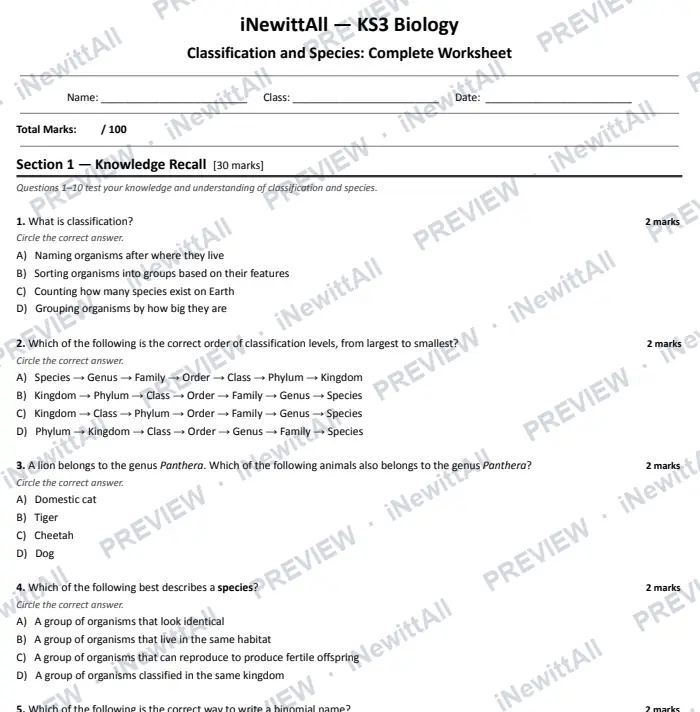
The top of page 1. The answer key is included when you buy.
£5 £6
The full worksheet and the extension pack together, with both answer keys.
Instant download with full answer keys. Print as many copies as your class needs.
£3
£3
£5 £6
Tick it off to track your progress. It's saved on this device. See my revision →
Students watch the video and do the quiz. They get a result card to paste back to you, showing their first try and best score.
This lesson's quiz questions on one sheet, with the answer key on page 2.
The quiz in big text for your classroom screen, one question at a time. Or build a 5-question Do Now starter from lessons your class has already done.
You're welcome to embed the video and link these resources in Google Classroom, Stile, Canvas, Compass or any other school platform. No need to ask.
Everything here is written to the KS3 curriculum for students aged 11–14. Print freely for the classes you teach.
No spam, unsubscribe anytime. You must be 13 or over to sign up.