KS3 Biology › Cells

KS3 Biology › Cells
These are the points the worksheet questions are built around.
A unicellular organism is a living thing made of just a single cell, which has to carry out all seven life processes entirely on its own — moving, sensing, taking in nutrients, releasing energy, removing waste, growing, and reproducing, all inside one microscopic bag of chemistry. What earns something the label "organism" isn't its size, but what it's capable of doing. Every bacterium is unicellular, along with some fungi (like yeast), protists (like amoeba) and algae. A cloudy smear of bacteria on a lab dish isn't one living thing — it's a colony of millions of separate organisms, each living independently.
Multicellular organisms are made of far more than one cell, but the key point isn't simply having lots of copies of the same cell — it's having lots of different types of cell. Skin cells form flat, tough sheets that keep the outside world out, while red blood cells are a completely different shape, built to carry oxygen through narrow vessels — same organism, same instructions, totally different cells. Plants do the same thing: leaf cells are packed with chloroplasts to trap sunlight, while root cells have none at all, since there's no light underground to capture.
Once there are different cell types, they can be organised into levels of structure. A tissue is a group of similar cells, in the same place, doing the same job — muscle cells lined up together form muscle tissue strong enough to squeeze food along the gut, and light-trapping cells in a leaf stack together into a tissue that captures sunlight for the whole plant.
Different tissues stacked together, each contributing to the same task, form an organ. The stomach is a clear example: lining tissue releases the chemicals that break food down, muscle tissue squeezes and churns it, and nerve tissue carries the signals that keep everything timed correctly. Organs aren't just an animal thing, either — a leaf is an organ too, built from a waxy outer coat, a light-trapping layer beneath it, and a lower surface that lets carbon dioxide in and oxygen out.
Organs working together on one major task form an organ system. Following food through the digestive system shows this clearly: it travels down a muscular tube into the stomach, the stomach breaks it apart, the small intestine absorbs useful particles into the blood, and the large intestine reclaims water — four organs, one system. Plants have systems too: the shoot system catches light and handles reproduction, while the root system anchors the plant and draws up water. Biology's structure stacks up in one clear ladder: cell, then tissue, then organ, then organ system, then the complete organism — and the human body is built from roughly 30 trillion cells this way.
Unicellular organisms manage everything with just one cell thanks to adaptations — features that help an organism function and survive. An amoeba, a yeast cell, and a bacterium all share a cell membrane controlling what enters and leaves, cytoplasm where chemical reactions happen, and DNA carrying the instructions for running the cell — though a bacterium's DNA floats loose in a loop rather than being kept inside a nucleus. Beyond that, their adaptations differ: yeast and bacteria have a tough cell wall that protects them and holds their shape, while an amoeba has no wall at all, which is exactly what lets it change shape, move, and wrap around food. Some bacteria grow a long tail-like structure they whip around to swim toward better conditions.
In short: unicellular organisms are single cells doing every life process alone, while multicellular organisms build up through levels of organisation — similar cells forming tissues, different tissues forming organs, and organs forming organ systems — right up to the complete organism. Meanwhile, single-celled life survives through adaptations like cell walls or the lack of one, each suited to that organism's particular way of living.
These are the words that appear as key term cards in the video — worth knowing cold before the test.
Short clips from this lesson. Good for a quick refresh before a test.
Swipe sideways to see more →
Revising for a test? Key terms, objectives and quiz questions on one printable page.
The 3 questions from the video, one at a time. See if you caught them.
1. What makes a single bacterial cell count as a living organism?
Why: A single bacterial cell is a whole organism because it carries out all seven life processes by itself. It doesn't need any other cells.
2. Roughly how many cells is an adult human body built from?
Why: An adult has about 30 trillion cells, and a trillion is a million million. Each cell is tiny, so an enormous number fit inside one body.
3. Is a blood vessel an organ, or is it a tissue?
Why: A blood vessel is made of several tissues, such as muscle and lining tissue, working together. Different tissues working together make an organ.
Score: 0 out of 3 —
Want more practice? Try the 60-second Quiz Challenge →
This lesson is a level in our game Keep the Cell Alive
One page with a full answer key. Enough to check the lesson landed, and to see how the questions are written before you buy anything.
Get the free worksheet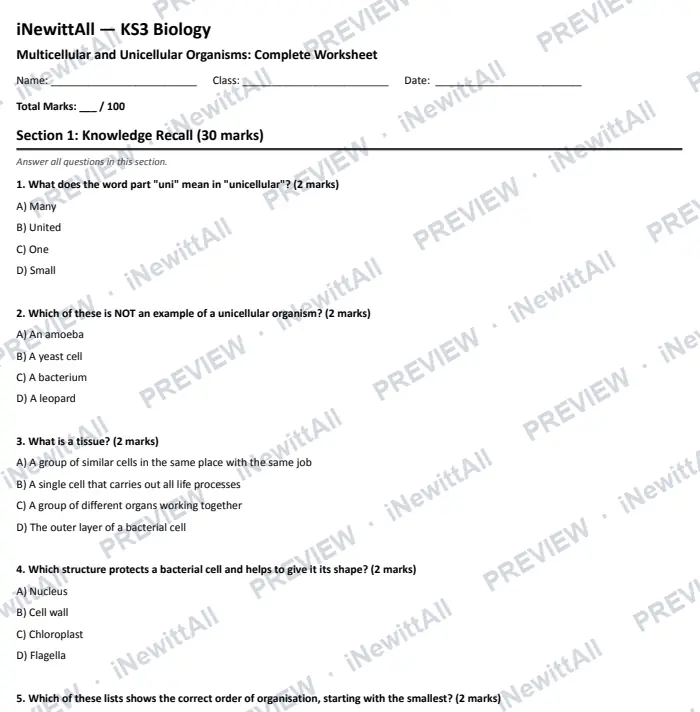
The top of page 1. The answer key is included when you buy.
£5 £6
The full worksheet and the extension pack together, with both answer keys.
Instant download with full answer keys. Print as many copies as your class needs.
£3
£3
£5 £6
Tick it off to track your progress. It's saved on this device. See my revision →
Students watch the video and do the quiz. They get a result card to paste back to you, showing their first try and best score.
This lesson's quiz questions on one sheet, with the answer key on page 2.
The quiz in big text for your classroom screen, one question at a time. Or build a 5-question Do Now starter from lessons your class has already done.
You're welcome to embed the video and link these resources in Google Classroom, Stile, Canvas, Compass or any other school platform. No need to ask.
Everything here is written to the KS3 curriculum for students aged 11–14. Print freely for the classes you teach.
No spam, unsubscribe anytime. You must be 13 or over to sign up.
