KS3 Biology › Climate change and biodiversity

KS3 Biology › Climate change and biodiversity
These are the points the worksheet questions are built around.
To feed the more than 8 billion people currently living on Earth, huge amounts of food need to be produced — and that requires agriculture: using land to raise farm animals, or to grow crops that either feed those animals or feed people directly.
The human population has grown at a staggering rate. Around 12,000 years ago, there were only about 4 million people on the entire planet. By the year 0, that had grown to roughly 190 million; by 1804, 1 billion; by 1928, 2 billion; by 1987, 5 billion; and by 2022, 8 billion. As the population has grown, so has the demand for food, and so has the amount of land needed for agriculture.
That growing demand for agricultural land is a major driver of deforestation — the removal of forest land, usually to convert it into farmland or housing. Forests aren't just collections of trees; they're rich, diverse habitats supporting thousands of interdependent species of plants, animals and fungi. When a forest is cleared to create farmland, all of those species lose their home. Instead of thousands of species, the same area might support just one — the crop being grown — plus perhaps a few weeds.
Palm oil is one of the clearest examples of this. It's found in many everyday products — not just crisps, pizza, doughnuts, biscuits, chocolate and ice cream, but also shampoo and body wash. Producing it involves clearing and burning tropical rainforest to make way for palm tree plantations, and millions of hectares of forest have been destroyed this way. The Sumatran orangutan is now critically endangered as a direct result, since the forest habitat it depends on has been destroyed to grow palm trees.
This habitat loss directly reduces biodiversity — the range of different species living within an ecosystem. A forest is one of the most biodiverse ecosystems on Earth: trees provide shelter and food for birds and insects, fallen leaves feed fungi and invertebrates, and pools of water become breeding grounds for frogs and dragonflies. Every species depends on others in some way, through food chains, pollination, or shelter. Removing a forest disrupts all of these connections at once, and species that can't survive in open farmland disappear — some permanently, through extinction.
There's a particular irony when it comes to pollinators — species like bees, butterflies, birds and bats, which are essential for allowing plants to reproduce by moving pollen between flowers. Without pollinators, many crops can't make the fruit and seeds we grow them for. So when forests are cleared to grow more crops, the very animals that make crop growing possible in the first place often lose their habitat in the process.
There are ways to help reverse this damage. Reforestation means growing trees on land no longer used for agriculture, allowing other species to gradually return as the forest re-establishes itself. Rewilding means allowing native plants and animals to return to sections of agricultural land, often around the edges of fields — something UK and EU governments have actively encouraged over the last 20 to 30 years. However, both strategies only restore a small fraction of what's been lost overall.
The single most powerful action, according to many scientists and conservationists, is changing what we eat. A large proportion of agricultural land is used not to grow food for people directly, but to raise animals. Eating less meat reduces demand for that land, which in turn reduces deforestation and frees up land that can be rewilded or reforested instead. Nobody needs to become vegetarian for this to make a difference — even a reduction in meat consumption has a significant impact.
In short: a fast-growing population needs more agricultural land, converting land for agriculture is a major cause of deforestation, deforestation destroys habitats and reduces biodiversity, and while reforestation and rewilding help repair some of this damage, changing diets — particularly eating less meat — is likely to have the single biggest impact.
These are the words that appear as key term cards in the video — worth knowing cold before the test.
Short clips from this lesson. Good for a quick refresh before a test.
Swipe sideways to see more →
Revising for a test? Key terms, objectives and quiz questions on one printable page.
The 3 questions from the video, one at a time. See if you caught them.
1. What does the term deforestation mean?
Why: Deforestation means cutting down trees to clear land, often for farming or building. Planting trees is the opposite.
2. The conversion of land to farmland has what effect on biodiversity?
Why: A farm usually grows just one crop, so far fewer species can live there than in a natural habitat. That means biodiversity goes down.
3. Which strategy is most likely to have the biggest impact on reducing habitat loss?
Why: Farming animals for meat needs huge areas of land for grazing and growing animal feed. If people eat less meat, less land is needed, so less habitat gets cleared.
Score: 0 out of 3 —
Want more practice? Try the 60-second Quiz Challenge →
One page with a full answer key. Enough to check the lesson landed, and to see how the questions are written before you buy anything.
Get the free worksheet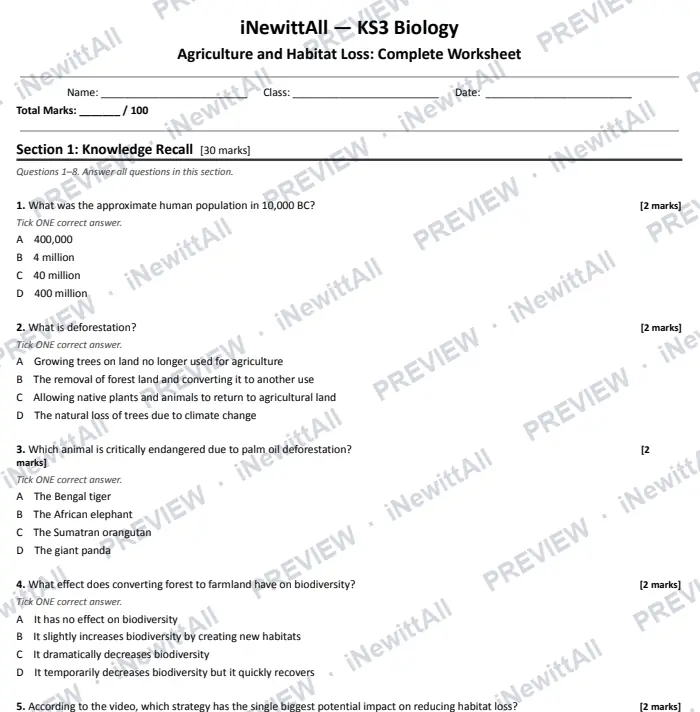
The top of page 1. The answer key is included when you buy.
£5 £6
The full worksheet and the extension pack together, with both answer keys.
Instant download with full answer keys. Print as many copies as your class needs.
£3
£3
£5 £6
Tick it off to track your progress. It's saved on this device. See my revision →
Students watch the video and do the quiz. They get a result card to paste back to you, showing their first try and best score.
This lesson's quiz questions on one sheet, with the answer key on page 2.
The quiz in big text for your classroom screen, one question at a time. Or build a 5-question Do Now starter from lessons your class has already done.
You're welcome to embed the video and link these resources in Google Classroom, Stile, Canvas, Compass or any other school platform. No need to ask.
Everything here is written to the KS3 curriculum for students aged 11–14. Print freely for the classes you teach.
 Next lessonDeforestation and the Carbon and Water Cycles
More in this unit: Climate change and biodiversity
No spam, unsubscribe anytime. You must be 13 or over to sign up.