KS3 Biology › Diet and exercise

KS3 Biology › Diet and exercise
These are the points the worksheet questions are built around.
Health isn't a simple switch between "well" and "sick" — it's a whole range, and where you sit on it can shift from one day to the next. There are two kinds of health working together. Physical health is the condition of your body, inside and out — your heart, lungs, digestive system and bones. Mental health is how you feel, think and act, covering your emotions, your ability to organise your thoughts and get through a normal day, and how you connect with the people around you.
Both kinds of health can be knocked off balance. Physically, things like an infection (such as flu), an allergy (such as hay fever), an injury, or a long-term condition like asthma or diabetes can all affect how you feel. Mentally, a stressful week, feeling lonely or cut off from people, or an upsetting event that stays with you can do the same. Crucially, physical and mental health are linked — when one dips, it often drags the other down with it.
Some of the clearest evidence for how health works comes from Blue Zones — specific places around the world, including areas of Japan, Italy, Greece, Costa Rica and the United States, where living to a hundred is genuinely normal. Despite living completely different lives, these communities share the same habits: moving naturally throughout the day (gardening, walking, taking the stairs), eating a varied, mostly plant-based diet, keeping a strong sense of purpose often well into old age, and staying closely connected to their community. None of this involves a gym or a strict diet plan — it's ordinary daily living, done consistently, protecting physical and mental health at the same time.
Because health is a range rather than a simple label, nobody is ever purely healthy or purely ill. Someone who looks fit and full of energy could still be carrying an illness that isn't visible, and having one illness doesn't erase everything else that's going well in someone's health. One useful measure of health is simply how well someone copes with daily life, both physically and emotionally.
Working out when something's genuinely wrong starts with knowing your own normal, which is personal — your body and mood naturally change over time, especially during puberty. A symptom is an unusual change away from that normal: a raised temperature, constant tiredness, unexplained weight loss, or feeling low for a long stretch. Importantly, these same changes can be completely harmless — exercise can raise your temperature, tire you out, and even reduce your weight, and that's a sign of being well, not ill.
What actually turns a change into a warning sign comes down to two things: how unusual the change is, and how long it lasts. A one-off bad mood that's gone by the end of the day is just a normal day, but a change that's genuinely unusual and persists is far more likely to be a real symptom. This is essentially what disease means — a persistent deviation from your normal appearance, the way your body functions, or how you behave. Symptoms aren't always visible, either — someone can look completely fine on the outside and still have a disease.
In short: health covers both physical and mental wellbeing, the two are closely linked, and health itself is a range rather than a fixed state. A symptom is an unusual, lasting change from your personal normal, and disease is a persistent deviation in appearance, function or behaviour — one that isn't always visible from the outside.
These are the words that appear as key term cards in the video — worth knowing cold before the test.
Short clips from this lesson. Good for a quick refresh before a test.
Swipe sideways to see more →
Revising for a test? Key terms, objectives and quiz questions on one printable page.
The 3 questions from the video, one at a time. See if you caught them.
1. Which of these is part of mental health?
Why: Mental health is about how you think and feel, including your emotions. Muscle strength, bone density and reaction time are all parts of physical health.
2. Which of these is NOT a normal part of getting older?
Why: Wrinkles, hearing loss and grey hair are common as people get older. A rash that won't go away isn't a normal part of ageing, so it should be checked by a doctor.
3. Someone is fit and smiling — are they definitely healthy?
Why: Health isn't always visible. Someone can look fit and happy but still have a hidden problem, like a disease with no symptoms yet or a worry they haven't shared.
Score: 0 out of 3 —
Want more practice? Try the 60-second Quiz Challenge →
One page with a full answer key. Enough to check the lesson landed, and to see how the questions are written before you buy anything.
Get the free worksheet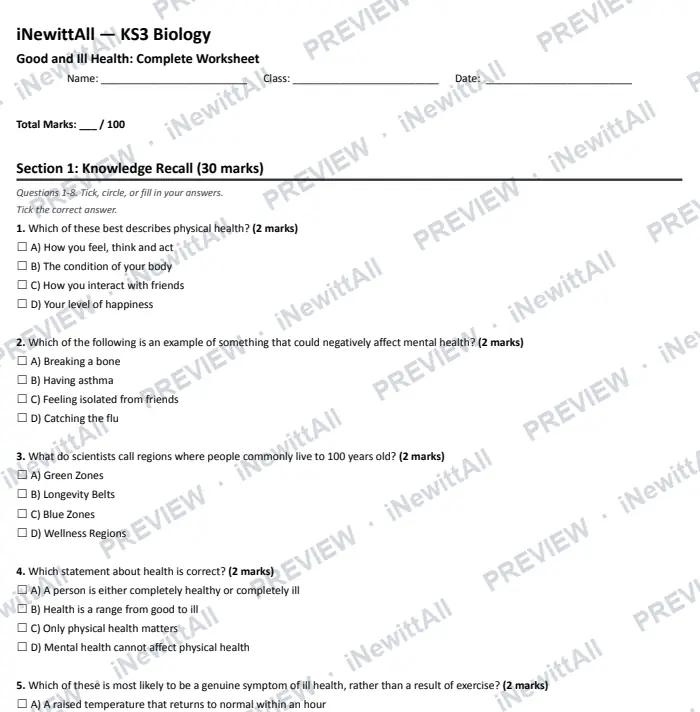
The top of page 1. The answer key is included when you buy.
£5 £6
The full worksheet and the extension pack together, with both answer keys.
Instant download with full answer keys. Print as many copies as your class needs.
£3
£3
£5 £6
Tick it off to track your progress. It's saved on this device. See my revision →
Students watch the video and do the quiz. They get a result card to paste back to you, showing their first try and best score.
This lesson's quiz questions on one sheet, with the answer key on page 2.
The quiz in big text for your classroom screen, one question at a time. Or build a 5-question Do Now starter from lessons your class has already done.
You're welcome to embed the video and link these resources in Google Classroom, Stile, Canvas, Compass or any other school platform. No need to ask.
Everything here is written to the KS3 curriculum for students aged 11–14. Print freely for the classes you teach.
 Next lessonBalanced Diet
More in this unit: Diet and exercise
No spam, unsubscribe anytime. You must be 13 or over to sign up.