KS3 Biology › Disease and drugs

KS3 Biology › Disease and drugs
These are the points the worksheet questions are built around.
A disease is a persistent deviation from a person's normal appearance, body function, or behaviour — persistent meaning ongoing rather than a one-off bad day, and deviation meaning something has genuinely changed from how that person normally looks, feels, or behaves. Diseases fall into two categories: infectious and non-infectious, and the key difference between them is enormous — one can spread between people, and one absolutely cannot.
Infectious diseases are caused by pathogens — microorganisms that cause disease and can be passed from one organism to another. There are four main types of pathogen: viruses, bacteria, fungi, and protists. Not every microorganism is a pathogen, though — some bacteria, for example, live in the gut and actually help keep the body healthy. Only the ones that cause disease are called pathogens.
Measles is a good example of a viral infectious disease. Its early symptoms (high temperature, sneezing, coughing, runny nose) look just like a common cold, and it's only after a couple of days that a distinctive rash appears. Measles spreads through the air, when an infected person coughs or sneezes and releases tiny droplets containing the virus, which others can then breathe in. It can be reduced through simple hygiene — using tissues, washing hands, staying away from school or work while infected — but the strongest protection is vaccination. The MMR vaccine protects against measles, mumps and rubella, and being vaccinated doesn't just protect the individual, it breaks the chain of transmission and protects everyone around them too.
Tuberculosis (TB) is caused by bacteria rather than a virus, mainly affecting the lungs, with symptoms including a persistent cough, high temperature, and loss of appetite. Because it's bacterial, TB can be treated very effectively with antibiotics — drugs that target and destroy bacteria specifically, though they don't work against viruses. A TB vaccine also exists for people at high risk, though it isn't routinely offered in the UK, where cases are relatively rare.
Infectious diseases don't only affect humans and animals — they affect plants too. Potato blight, caused by a fungus, spread rapidly across Ireland in the 1840s and destroyed the potato crop, which was the main food source for a huge portion of the population at the time. The consequences were catastrophic: around a million people died of starvation, and another million left Ireland. Treating fungal infections in plants is genuinely difficult — the main options are removing infected parts of the plant, or using a fungicide, a chemical that specifically targets and kills fungal infections, though these aren't always fully reliable.
Non-infectious diseases work completely differently — they cannot be spread between people at all. Instead, they're caused by two main things: lifestyle factors (diet, exercise, smoking, alcohol, and obesity) and genetics, where a faulty gene passed down through a family can make someone more likely to develop a certain condition. According to the World Health Organization, non-infectious diseases are the single biggest cause of death worldwide, killing around 41 million people a year — 74% of all global deaths — with the vast majority linked to lifestyle choices that could potentially be changed.
Certain risk factors, such as smoking, high blood pressure, obesity, and excessive alcohol use, significantly increase the chances of developing a non-infectious disease, without guaranteeing it. Conditions linked to obesity include coronary heart disease (where arteries supplying the heart become blocked), stroke (where blood flow to the brain is restricted), certain cancers such as bowel cancer, and type two diabetes, a condition where the body struggles to control blood sugar levels, with symptoms including excessive thirst, frequent urination, and slow-healing wounds. Left untreated, it can damage the eyes, heart and nerves, but it can be managed through diet, exercise, and maintaining a healthy weight.
It's worth understanding that non-infectious diseases disproportionately affect people living in poverty — not because of worse individual choices, but because ultra-processed food is often cheaper and more accessible than fresh, healthy food, and access to health education isn't equal either.
In short: infectious diseases are caused by pathogens (viruses, bacteria, fungi, or protists) and can spread between organisms, while non-infectious diseases cannot spread and are instead caused by lifestyle factors and genetics — and together, understanding both is essential, since non-infectious diseases alone account for the majority of deaths worldwide.
These are the words that appear as key term cards in the video — worth knowing cold before the test.
Short clips from this lesson. Good for a quick refresh before a test.
Swipe sideways to see more →
Revising for a test? Key terms, objectives and quiz questions on one printable page.
The 3 questions from the video, one at a time. See if you caught them.
1. Which of the following is a pathogen?
Why: A pathogen is a microorganism that causes disease, and a bacterium is one. A faulty gene, a lack of a vitamin and obesity can all cause ill health, but none of them are living organisms.
2. Tuberculosis is caused by which type of pathogen?
Why: Tuberculosis is caused by bacteria, which is why antibiotics can treat it. Antibiotics don't work on viruses, fungi or protists.
3. A person has high BMI, excessive thirst, and slow-healing wounds. What disease?
Why: High BMI, being very thirsty and wounds that heal slowly are all signs of type 2 diabetes, where the body can't control its blood sugar properly. It isn't caused by a pathogen, so you can't catch it.
Score: 0 out of 3 —
Want more practice? Try the 60-second Quiz Challenge →
One page with a full answer key. Enough to check the lesson landed, and to see how the questions are written before you buy anything.
Get the free worksheet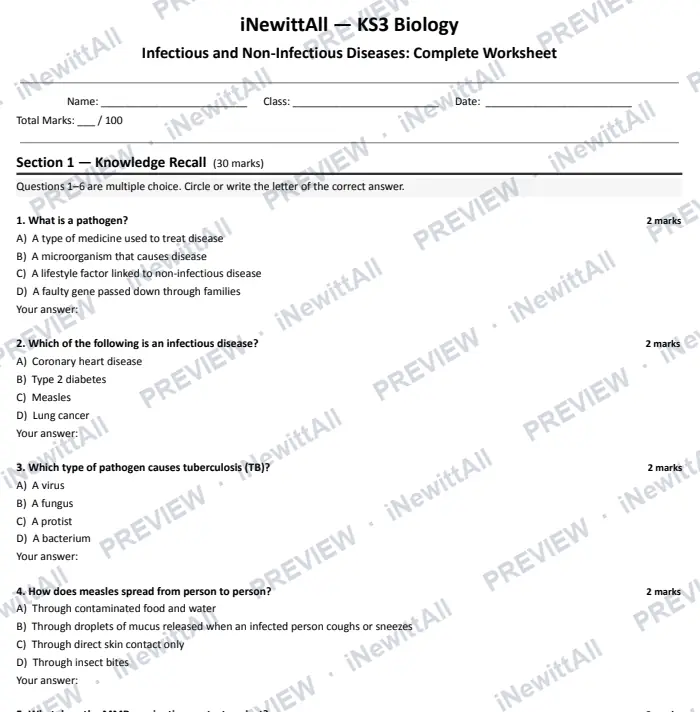
The top of page 1. The answer key is included when you buy.
£5 £6
The full worksheet and the extension pack together, with both answer keys.
Instant download with full answer keys. Print as many copies as your class needs.
£3
£3
£5 £6
Tick it off to track your progress. It's saved on this device. See my revision →
Students watch the video and do the quiz. They get a result card to paste back to you, showing their first try and best score.
This lesson's quiz questions on one sheet, with the answer key on page 2.
The quiz in big text for your classroom screen, one question at a time. Or build a 5-question Do Now starter from lessons your class has already done.
You're welcome to embed the video and link these resources in Google Classroom, Stile, Canvas, Compass or any other school platform. No need to ask.
Everything here is written to the KS3 curriculum for students aged 11–14. Print freely for the classes you teach.
No spam, unsubscribe anytime. You must be 13 or over to sign up.