KS3 Biology › Heredity and DNA

KS3 Biology › Heredity and DNA
These are the points the worksheet questions are built around.
To understand heredity, it helps to start with reproduction — the process by which living things make new living things, or offspring. Reproduction is one of the seven life processes every living organism carries out, remembered through the phrase MRS GREN, where the R stands for reproduction. Without it, no species could survive, since every individual eventually dies and offspring are how life continues.
When living things reproduce, their offspring are always the same kind — the same species — as their parents. A frog produces frogs, an oak tree produces oak trees, and a dog can never give birth to a cat. However, offspring don't always look like their parents straight away. A frog begins life as frogspawn, hatches into a tadpole that lives underwater and breathes through gills, and only later grows legs, loses its tail, and becomes an adult frog. A butterfly follows a similar pattern: egg, caterpillar, pupa, then butterfly. The rule isn't that offspring resemble their parents immediately — it's that they come to resemble them at some point in their life cycle.
The genetic material that controls inherited features is stored in the nucleus, the control centre inside a cell. Heredity is the process of passing features from parents down to their offspring through reproduction, and crucially, offspring inherit a mix of features from both parents, not just one. This is why someone might have their father's hair colour but their mother's eye shape.
Inherited features come in two types. Visible features are things you can see, like eye colour, ear shape, or fur colour. Invisible features are internal processes you can't see, but which are still passed down from parents to offspring. A cockapoo puppy — with a cocker spaniel for one parent and a poodle for the other — might inherit the floppy ears of one parent, the fur colour of the other, and a coat somewhere between the two: a genuine blend of both parents' features.
Brothers and sisters who share the same two parents are called siblings, and even though they share the exact same parents, they rarely look identical. That's because each sibling inherits a different combination of features from those two parents — one might get their mum's hair and dad's eyes, while another gets the opposite. This natural difference between individuals of the same species is called variation. The big exception is identical twins, who grow from the same fertilised egg, so they inherit exactly the same genes and look almost the same as each other.
In short: reproduction produces offspring of the same species as their parents, even if they only come to resemble them later in their life cycle. Heredity passes a mix of features from both parents to their offspring, and because each offspring inherits a different combination of those features, siblings look related but never identical, aside from identical twins — and that variation is what makes every individual unique.
These are the words that appear as key term cards in the video — worth knowing cold before the test.
Short clips from this lesson. Good for a quick refresh before a test.
Swipe sideways to see more →
Revising for a test? Key terms, objectives and quiz questions on one printable page.
The 3 questions from the video, one at a time. See if you caught them.
1. Where in a cell is the genetic material that controls features stored?
Why: The nucleus holds the DNA, which has the instructions for an organism's features. The cytoplasm, cell membrane and mitochondria don't store genetic material.
2. A tadpole looks nothing like its frog parents. Is it their offspring?
Why: A tadpole is the young form of a frog, so it is still their offspring. Many animals change shape as they grow up, like tadpoles becoming frogs.
3. Which of these is NOT a reason that siblings look different from each other?
Why: Siblings look different because each one gets a different random mix of genes from the same two parents. When they were born has no effect on that.
Score: 0 out of 3 —
Want more practice? Try the 60-second Quiz Challenge →
One page with a full answer key. Enough to check the lesson landed, and to see how the questions are written before you buy anything.
Get the free worksheet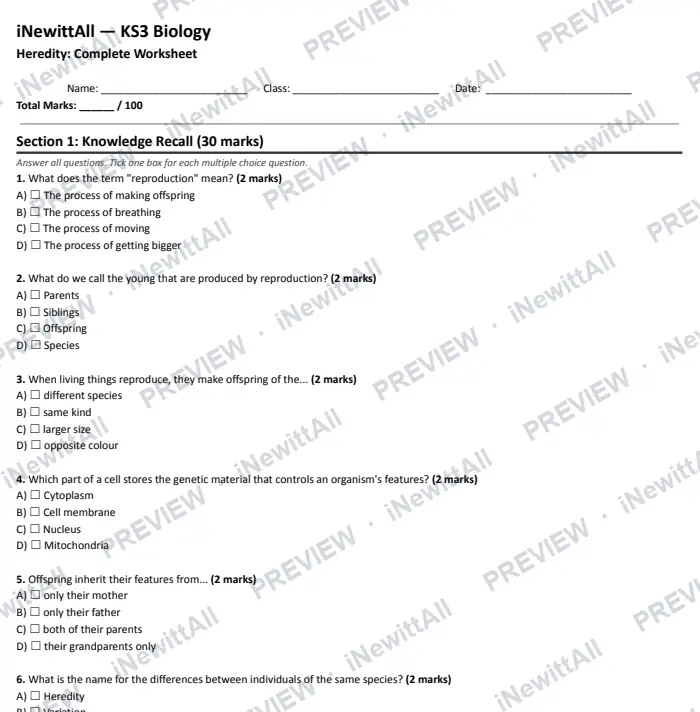
The top of page 1. The answer key is included when you buy.
£5 £6
The full worksheet and the extension pack together, with both answer keys.
Instant download with full answer keys. Print as many copies as your class needs.
£3
£3
£5 £6
Tick it off to track your progress. It's saved on this device. See my revision →
Students watch the video and do the quiz. They get a result card to paste back to you, showing their first try and best score.
This lesson's quiz questions on one sheet, with the answer key on page 2.
The quiz in big text for your classroom screen, one question at a time. Or build a 5-question Do Now starter from lessons your class has already done.
You're welcome to embed the video and link these resources in Google Classroom, Stile, Canvas, Compass or any other school platform. No need to ask.
Everything here is written to the KS3 curriculum for students aged 11–14. Print freely for the classes you teach.
No spam, unsubscribe anytime. You must be 13 or over to sign up.