KS3 Biology › Reproduction in plants

KS3 Biology › Reproduction in plants
These are the points the worksheet questions are built around.
Plants are producers — they make their own food from carbon dioxide, water and sunlight, through photosynthesis. Because plants sit at the start of every food chain, almost all life on Earth ultimately depends on them, which is exactly why plant reproduction matters.
Flowering plants reproduce sexually, which usually means two parent plants are involved in producing a seed (some plants can pollinate themselves). Each parent contributes DNA through their gametes, or sex cells, which combine to form the seed — a new plant's first stage of life, carrying DNA from both parents inside chromosomes within the nucleus of each gamete. This is different from asexual reproduction, where only one parent is involved.
In plants, gametes have their own names. The female gametes are called ova (singular: ovum). The male gametes are carried inside grains of pollen — the yellow dust sometimes seen on flowers.
The flower is the plant's entire reproductive system, and unusually, it contains both male and female organs in the same structure. The male part is the stamen, made up of the filament (a thin supporting stalk) and the anther, which produces and stores pollen. The female parts include the stigma, a usually sticky surface that pollen lands on; the style, a stalk that holds the stigma in position; and at the base, the ovary, which contains the ovules. The ovules are where the ova are produced, and the ovary protects them.
Every part of the flower has a specific reproductive job. The anther produces pollen. The ovules produce ova. The stigma collects pollen grains deposited during pollination. The style holds the stigma in place. The ovary protects the ovules. Even the petals have a role, despite often being thought of as purely decorative — they attract pollinators like bees, which carry pollen between flowers.
During sexual reproduction, pollen is deposited on the stigma, travels down through the style, and reaches the ovules, where fertilisation can take place. The result is two parents' DNA combined into one new seed.
In short: flowering plants reproduce sexually using two parents, each contributing DNA through gametes — pollen from the male anther, and ova from the female ovules. The flower itself contains both male organs (the stamen, made of the filament and anther) and female organs (the stigma, style, ovary and ovules) working together, with petals playing their own role in attracting the pollinators that make this whole process possible.
These are the words that appear as key term cards in the video — worth knowing cold before the test.
Short clips from this lesson. Good for a quick refresh before a test.
Swipe sideways to see more →
Revising for a test? Key terms, objectives and quiz questions on one printable page.
The 3 questions from the video, one at a time. See if you caught them.
1. In sexual reproduction in plants, how many parent plants are needed to produce a seed?
Why: Sexual reproduction usually needs two parents, one giving a male gamete (from pollen) and one giving a female gamete (egg cell). The seed is a mix of both parents' DNA. (Some plants can pollinate themselves, but most mix with another plant.)
2. Which part of the flower produces the male gametes?
Why: The anther is the part that makes pollen, and pollen carries the male gametes. The stigma, ovary and ovule are all female parts.
3. A student says the stigma produces pollen and the anther collects it. What has this student got wrong?
Why: The student has it the wrong way round. The anther produces the pollen and the stigma is the sticky part that catches it. The stigma is also a female part, not a male one.
Score: 0 out of 3 —
Want more practice? Try the 60-second Quiz Challenge →
One page with a full answer key. Enough to check the lesson landed, and to see how the questions are written before you buy anything.
Get the free worksheet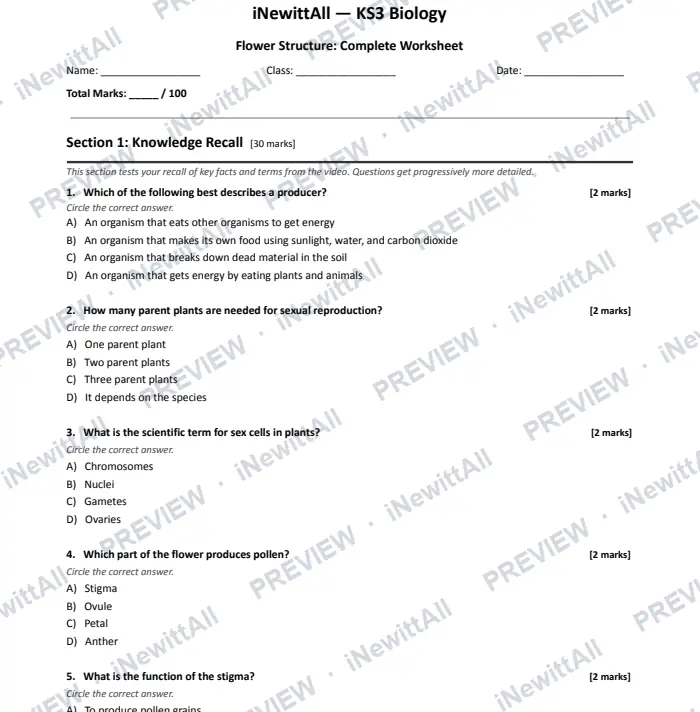
The top of page 1. The answer key is included when you buy.
£5 £6
The full worksheet and the extension pack together, with both answer keys.
Instant download with full answer keys. Print as many copies as your class needs.
£3
£3
£5 £6
Tick it off to track your progress. It's saved on this device. See my revision →
Students watch the video and do the quiz. They get a result card to paste back to you, showing their first try and best score.
This lesson's quiz questions on one sheet, with the answer key on page 2.
The quiz in big text for your classroom screen, one question at a time. Or build a 5-question Do Now starter from lessons your class has already done.
You're welcome to embed the video and link these resources in Google Classroom, Stile, Canvas, Compass or any other school platform. No need to ask.
Everything here is written to the KS3 curriculum for students aged 11–14. Print freely for the classes you teach.
 Next lessonPollination and Fertilisation
More in this unit: Reproduction in plants
No spam, unsubscribe anytime. You must be 13 or over to sign up.