KS3 Biology › Cells

KS3 Biology › Cells
These are the points the worksheet questions are built around.
Everything around us falls into one of three categories: living, dead, or never having been alive. A cat is living; a cooked chicken is dead, since it was once alive but no longer carries out life processes; a brick has never been alive, since it was never made through reproduction. All living things — animals, plants, fungi, even bacteria — share the same seven life processes, remembered with the acronym MRS GREN.
Movement means an organism moves itself, or parts of itself, from one place to another. This isn't limited to walking or swimming — sunflowers turn toward the sun, Venus flytraps snap shut on insects, and even bacteria move themselves toward food or away from harmful chemicals.
Reproduction is how living things make offspring, whether that's baby animals, plant seeds, bacteria splitting in two, or a mushroom releasing spores. Without it, no species could continue.
Sensitivity means living things can sense their surroundings and respond to them — feeling heat and moving away from it, a plant sensing light and growing toward it, or a frog detecting movement and catching its prey.
Growth doesn't just mean getting bigger. It also includes repairing damaged parts, like new cells healing a cut finger, or a plant growing new leaves to replace old ones. Growth happens at the cellular level even once an organism has stopped getting taller.
Respiration is not the same as breathing — it's a chemical reaction happening inside cells, where organisms break down food to release the energy stored inside it. That energy powers every other process, including movement, growth and reproduction. Even plants respire, despite making their own food through photosynthesis, because they still need to release the energy from that food to use it.
Excretion is the removal of waste substances produced by chemical reactions inside cells, which can become toxic if they build up. Humans excrete carbon dioxide when breathing out and urea in urine; plants excrete oxygen during photosynthesis.
Nutrition means taking in food or nutrients to fuel all the other life processes. Animals eat plants or other animals, plants make their own food using sunlight, water and carbon dioxide, fungi absorb nutrients from dead material, and bacteria take in chemicals from their surroundings.
Movement alone doesn't prove something is alive. A car moves, water flows, and wind blows a dead leaf across the ground, but none of these are living. For movement to count as a sign of life, two things must be true: the organism must move itself, rather than being moved by something else, and it must be moving to achieve something that helps it survive, like finding food or escaping danger. Movement can also be far too slow to notice happening in real time, like a pea plant climbing a fence over days or weeks.
Not every life process happens at every stage of an organism's life cycle, but all seven happen at some point. An acorn respires (and gets rid of the carbon dioxide this makes), senses moisture and temperature, and can grow into a seedling — but it doesn't move itself or reproduce until much later in the oak tree's life. Similarly, a chicken egg doesn't move or reproduce, but the chick that hatches from it does all seven processes. Something is alive if all seven processes occur at some point in its life cycle, not necessarily all at once.
This also explains the difference between dead and never having been alive. Something dead used to carry out all seven life processes but has reached the end of its life cycle, so those processes have permanently stopped — a dead leaf, a roast chicken, a fallen tree. Something that has never been alive was never made through reproduction and has never carried out life processes at all — a brick, a rock, water. A wooden table is dead, since it was made from a tree that was once alive, while a plastic table has never been alive, since plastic was never a living thing to begin with.
In short: all living things share seven life processes — Movement, Reproduction, Sensitivity, Growth, Respiration, Excretion, and Nutrition (MRS GREN). Movement only counts as a sign of life when an organism moves itself for a purpose that helps it survive, and something is alive if it carries out all seven processes at some point across its life cycle, even if not all at once.
These are the words that appear as key term cards in the video — worth knowing cold before the test.
Short clips from this lesson. Good for a quick refresh before a test.
Swipe sideways to see more →
Revising for a test? Key terms, objectives and quiz questions on one printable page.
The 3 questions from the video, one at a time. See if you caught them.
1. Which life process helps a plant grow toward sunlight?
Why: Sensitivity is detecting and responding to changes in the surroundings, such as light. A plant growing towards the light is doing this.
2. A car moves down the road. Why doesn't this prove the car is alive?
Why: A car moves because an engine and a driver push it along. A living thing moves by itself, using energy from its own body.
3. A seed doesn't move or reproduce. Does this mean it's not alive?
Why: A seed is alive but waiting to grow. Over its whole life cycle it will do all seven life processes, for example growing and reproducing when it becomes a plant.
Score: 0 out of 3 —
Want more practice? Try the 60-second Quiz Challenge →
This lesson is a level in our game Keep the Cell Alive
One page with a full answer key. Enough to check the lesson landed, and to see how the questions are written before you buy anything.
Get the free worksheet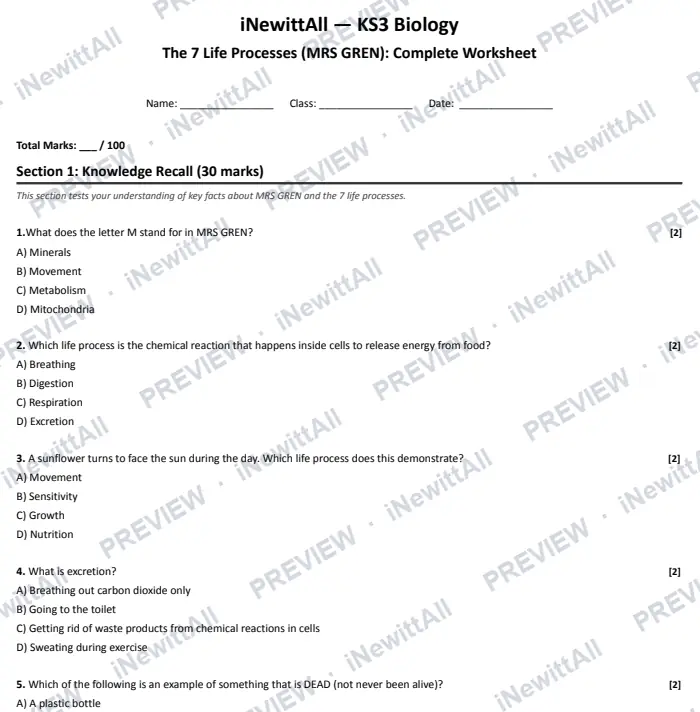
The top of page 1. The answer key is included when you buy.
£3
The full worksheet and the extension pack together, with both answer keys.
Instant download with full answer keys. Print as many copies as your class needs.
Free
£3
£3
Tick it off to track your progress. It's saved on this device. See my revision →
Students watch the video and do the quiz. They get a result card to paste back to you, showing their first try and best score.
This lesson's quiz questions on one sheet, with the answer key on page 2.
The quiz in big text for your classroom screen, one question at a time. Or build a 5-question Do Now starter from lessons your class has already done.
You're welcome to embed the video and link these resources in Google Classroom, Stile, Canvas, Compass or any other school platform. No need to ask.
Everything here is written to the KS3 curriculum for students aged 11–14. Print freely for the classes you teach.
 Next lessonAnimal Cell Structures and Their Functions
More in this unit: Cells
No spam, unsubscribe anytime. You must be 13 or over to sign up.