KS3 Biology › Human digestive system

KS3 Biology › Human digestive system
These are the points the worksheet questions are built around.
Your body is home to trillions of bacteria — in fact, scientists think there are roughly as many bacteria living in and on you as there are cells in your entire body. Bacteria are living organisms, found almost everywhere: on surfaces, in soil, in water, in the air, on your skin, and inside your body.
Bacteria are microorganisms — living things so small that you'd need a microscope just to see one. Each bacterium is unicellular, meaning it's made of just a single cell. Inside that one cell, a bacterium has a cell wall on the outside, which gives it shape and protects it, and cytoplasm filling the inside. Unlike our own cells, a bacterium's DNA isn't kept in a nucleus — instead, it floats freely inside the cytoplasm.
Despite their reputation, most bacteria are either harmless or genuinely useful. Some bacteria are pathogens — microorganisms that cause disease. Some types of E. coli cause food poisoning, C. difficile can infect the gut (often after a course of antibiotics), and Streptococcus pneumoniae causes pneumonia, a serious lung condition. But most bacteria don't harm us at all, and some are genuinely helpful: bacteria are used to make certain medicines, including antibiotics, and are involved in producing yoghurt, cheese, and even chocolate and coffee.
Inside your digestive system specifically, trillions of bacteria — collectively known as your gut flora — live in your stomach, small intestine, and large intestine, constantly helping your body digest food. The food you eat contains carbohydrates, proteins, and fats: large molecules that need breaking down into smaller ones before your body can absorb and use them. Your body makes some of the enzymes needed to do this, but not all of them — so your gut bacteria step in, producing enzymes your body can't make itself, which digest food that would otherwise pass through undigested.
Gut bacteria do three main jobs. First, they digest food your body can't break down alone. Second, they manufacture vitamins — including vitamin K, which your body needs but cannot produce on its own. Third, they protect you from harmful bacteria, by competing for food and space inside your gut. Because your gut flora is already established and using up the available resources, harmful bacteria struggle to get a foothold, get the nutrients they need, or multiply enough to make you ill.
However, gut bacteria can be damaged. Taking antibiotics — even though they're important for fighting infections elsewhere in the body — can wipe out gut flora as a side effect. Being unwell or eating a poor diet can also harm it. When gut bacteria are reduced, digestion becomes less efficient, some food goes undigested, and harmful bacteria find it easier to take hold, which can lead to pain and diarrhoea, and more serious problems if it continues long term.
You can look after your gut bacteria by eating a wide variety of fruit and vegetables, which provide the nutrients bacteria need to thrive, drinking probiotic drinks and yoghurts, which introduce beneficial bacteria into your gut, and eating fermented foods like kimchi or kombucha, which also support a healthy gut environment.
In short: bacteria are unicellular microorganisms, most of which are harmless or helpful rather than harmful. Inside your digestive system, gut flora digest food you can't break down yourself, manufacture vitamins your body needs, and protect you from harmful bacteria by competing for resources — which is why looking after your gut bacteria, through diet and probiotic foods, genuinely matters.
These are the words that appear as key term cards in the video — worth knowing cold before the test.
Short clips from this lesson. Good for a quick refresh before a test.
Swipe sideways to see more →
Revising for a test? Key terms, objectives and quiz questions on one printable page.
The 3 questions from the video, one at a time. See if you caught them.
1. Which of the following best describes bacteria?
Why: Bacteria are unicellular, which means each one is a single cell. They are microorganisms, so you need a microscope to see them, and they don't have a nucleus.
2. What is the role of enzymes produced by gut bacteria?
Why: Some gut bacteria make enzymes that break down food our own enzymes can't, such as some types of fibre. This gives us extra nutrients.
3. Which of the following can damage your gut flora?
Why: Antibiotics kill bacteria, including the helpful ones in your gut, so they can upset your gut flora. Fruit, vegetables and fermented foods help helpful bacteria to thrive.
Score: 0 out of 3 —
Want more practice? Try the 60-second Quiz Challenge →
One page with a full answer key. Enough to check the lesson landed, and to see how the questions are written before you buy anything.
Get the free worksheet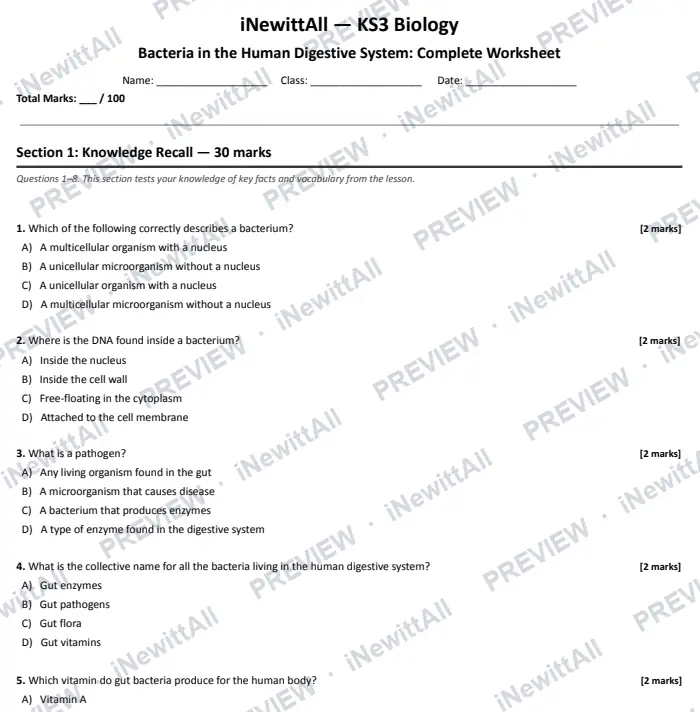
The top of page 1. The answer key is included when you buy.
£5 £6
The full worksheet and the extension pack together, with both answer keys.
Instant download with full answer keys. Print as many copies as your class needs.
£3
£3
£5 £6
Tick it off to track your progress. It's saved on this device. See my revision →
Students watch the video and do the quiz. They get a result card to paste back to you, showing their first try and best score.
This lesson's quiz questions on one sheet, with the answer key on page 2.
The quiz in big text for your classroom screen, one question at a time. Or build a 5-question Do Now starter from lessons your class has already done.
You're welcome to embed the video and link these resources in Google Classroom, Stile, Canvas, Compass or any other school platform. No need to ask.
Everything here is written to the KS3 curriculum for students aged 11–14. Print freely for the classes you teach.
 Next lessonAbsorption and Transport of Nutrients
More in this unit: Human digestive system
No spam, unsubscribe anytime. You must be 13 or over to sign up.