KS3 Biology › Climate change and living sustainably

KS3 Biology › Climate change and living sustainably
These are the points the worksheet questions are built around.
Strip away the atmosphere's warming influence and Earth would average roughly minus 18 degrees Celsius, a chill comparable to the inside of a domestic freezer. In reality the average is nearer 15 degrees. The 33 degree difference is produced by a small set of gases, and the puzzle is that they account for just a sliver of everything in the air.
The term borrows from the garden greenhouse, a structure with glass on its sides and roof. Sunshine heats the soil and the plants as well as the air inside, and the glass prevents that heated air from leaking away. The interior therefore stays warmer than the world outside, even on a cold spring morning, giving plants the temperature range in which they do best. Earth has an arrangement doing a comparable job on a planetary scale, keeping conditions suitable for living things. There is no glass roof over the planet, though, so a different mechanism has to be at work.
Surrounding the planet is the atmosphere, a blanket of gases. Two of them dominate: nitrogen at roughly 78% and oxygen, which people and animals breathe, at roughly 21%. Neither contributes to warming. The warming comes from a small group named the greenhouse gases, which raise the temperature of the atmosphere above what it would otherwise be. The ones to remember are water vapour, carbon dioxide and methane. Carbon dioxide features constantly in news stories, yet it forms just 0.04% of the atmosphere, or around four particles per ten thousand. The abundant gases play no part in warming, while a gas that is barely noticeable plays a large one.
The mechanism starts with the Sun. Its light travels through the atmosphere and heats the land and sea. That warmed surface radiates heat upwards, heading for space. On the way, greenhouse gases absorb a portion of this heat and redirect some of it downwards again. Because of this, heat takes longer to leave the planet, and the air and the ground end up at a higher temperature than they would without the gases. That slowing of heat loss is what is meant by the greenhouse effect.
One widespread misunderstanding pictures the atmosphere as a single solid shell, a pane of glass around the globe. It is not. The greenhouse gases are dispersed throughout the air, including the air in a person's lungs right now. The garden version and the planetary version also differ in how they operate. A greenhouse's glass chiefly stops the warm air from moving away, while the gases around Earth alter the speed at which heat departs. In both cases, though, a small quantity of gas is enough to lift the planet's temperature by 33 degrees, which raises the question of what extra gas would do.
Clues come from Antarctica, where scientists bring up long cylinders of ice known as ice cores. Over thousands of years, falling snow piled up and enclosed minute pockets of air, so each layer preserves a snapshot of the air from when it was laid down. Together the cores offer roughly 800,000 years of data on carbon dioxide. It rose and fell on its own accord, sitting lower during ice ages and higher during warmer periods. Amounts are given in parts per million, which counts how many of every million particles of air are carbon dioxide. Across that entire span the level never exceeded approximately 300, whereas at present it is above 420. The climb across the past six decades has been about a hundred times faster than any natural climb recorded earlier.
Nearly all of the additional carbon dioxide traces back to people. Fossil fuels, meaning coal, oil and gas, release it when they are burned, and discharges of greenhouse gases like this go by the name emissions. Many would assume that cars are the biggest culprit, but the top spot belongs to power stations generating electricity and heat. Transport, factories and agriculture follow. Cattle contribute methane, mainly through belching, and the sheer number of farm animals worldwide makes the total large. Felling forests adds to the problem, since trees that burn or decay give off carbon dioxide and there are fewer of them left to absorb it.
Adding greenhouse gases to the air sends additional heat back to the surface and slows the departure of heat into space even further. This strengthened version is called the enhanced greenhouse effect, and it is driving up the planet's average surface temperature. Overheating in a garden greenhouse can be solved by opening a vent, but a planet cannot be vented. The added gases linger, with carbon dioxide persisting for somewhere between decades and centuries, so the sole genuine remedy is to put less into the air to begin with. Practical steps include moving electricity generation to wind and solar, travelling on foot, by bike or by public transport, and cutting waste of food and energy. When large numbers of people adopt such habits together, emissions do drop.
In short: a thin sprinkling of gases, chiefly water vapour, carbon dioxide and methane, absorb heat rising from Earth's surface and return part of it, so heat leaves for space more gradually and the planet stays about 33 degrees warmer than it would be. Records from ice cores show carbon dioxide at its highest in about 800,000 years, largely because fossil fuels are burned, and this boost to the greenhouse effect is warming the planet.
These are the words that appear as key term cards in the video — worth knowing cold before the test.
Short clips from this lesson. Good for a quick refresh before a test.
Revising for a test? Key terms, objectives and quiz questions on one printable page.
The 3 questions from the video, one at a time. See if you caught them.
1. Which of these is NOT a greenhouse gas?
Why: Nitrogen is the most common gas in the air, but it doesn't help keep Earth warm.
2. Which is the biggest single source of greenhouse gases?
Why: Power stations making electricity and heat release more greenhouse gases than any other single source.
3. Why does more carbon dioxide make Earth's surface warmer?
Why: Carbon dioxide soaks up heat leaving the surface and sends some back down, so less escapes.
Score: 0 out of 3 —
Want more practice? Try the 60-second Quiz Challenge →
One page with a full answer key. Enough to check the lesson landed, and to see how the questions are written before you buy anything.
Get the free worksheet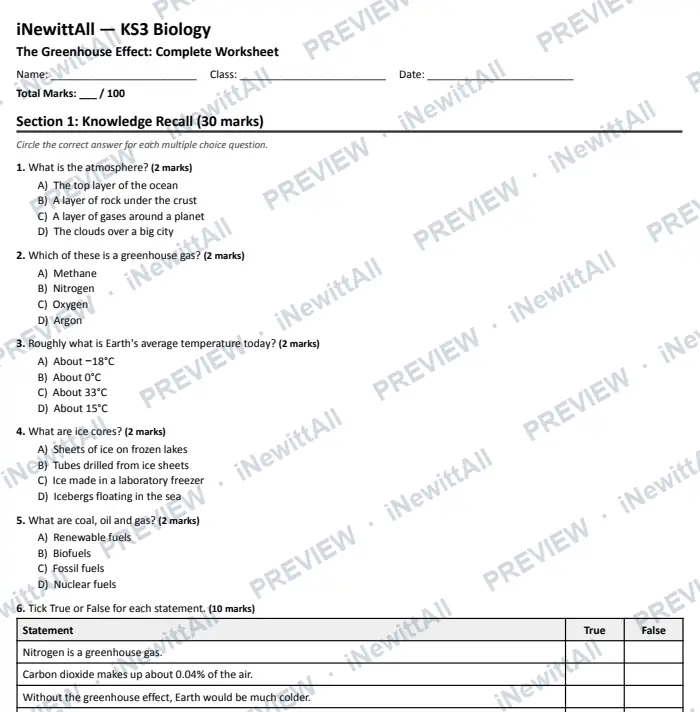
The top of page 1. The answer key is included when you buy.
£5 £6
The full worksheet and the extension pack together, with both answer keys.
Instant download with full answer keys. Print as many copies as your class needs.
£3
£3
£5 £6
Tick it off to track your progress. It's saved on this device. See my revision →
Students watch the video and do the quiz. They get a result card to paste back to you, showing their first try and best score.
This lesson's quiz questions on one sheet, with the answer key on page 2.
The quiz in big text for your classroom screen, one question at a time. Or build a 5-question Do Now starter from lessons your class has already done.
You're welcome to embed the video and link these resources in Google Classroom, Stile, Canvas, Compass or any other school platform. No need to ask.
Everything here is written to the KS3 curriculum for students aged 11–14. Print freely for the classes you teach.
No spam, unsubscribe anytime. You must be 13 or over to sign up.