KS3 Biology › Climate change and biodiversity

KS3 Biology › Climate change and biodiversity
These are the points the worksheet questions are built around.
Carbon is one of the most important elements on the planet — every living thing, from plants to animals to bacteria, is built from carbon-based molecules like carbohydrates, proteins and fats. Carbon doesn't stay still; it constantly moves between the atmosphere, living organisms, the soil, and deep underground, in a constant movement known as the carbon cycle. In the atmosphere, carbon mainly exists as carbon dioxide. Deep underground, it's locked away as fossil fuels — coal, oil and natural gas, formed from the remains of organisms that lived millions of years ago.
Animals can't absorb carbon directly from the air — we breathe carbon dioxide in and straight back out again, without keeping any of it. Plants are different. Through photosynthesis, plants (and other producers like algae) pull carbon dioxide out of the atmosphere and combine it with water to build glucose, which becomes the building blocks of the plant's body, its biomass. When animals eat plants, or eat other animals, that carbon passes along the food chain — meaning almost everything you've ever eaten contains carbon that was once floating in the atmosphere as carbon dioxide.
Forests are powerful carbon absorbers, removing around a quarter of all the carbon dioxide humans produce each year. When forests are cut down, that absorption stops, so carbon dioxide from burning fossil fuels builds up faster in the atmosphere, strengthening the greenhouse effect and accelerating climate change. Deforestation usually involves burning too, which releases all the carbon stored inside the trees straight back into the atmosphere — removing a carbon absorber and adding extra carbon dioxide at the same time.
As carbon dioxide levels rise, climate change brings more extreme weather. Heatwaves cause drought, and drought-stressed plants stop photosynthesising, meaning even less carbon dioxide gets removed from the air. Wildfires become more frequent, releasing yet more stored carbon. At the same time, climate change also drives heavier rainfall and flooding, which damages crops and threatens food security — reliable access to enough affordable, nutritious food.
Deforestation also disrupts the water cycle, which moves water constantly between the atmosphere, ground, rivers, oceans and living things through processes including precipitation (rain, snow and hail falling from the sky), surface runoff (water flowing downhill into rivers and oceans), and transpiration, where trees absorb water through their roots and release it into the atmosphere through their leaves. In a healthy forest, that released water vapour rises, forms clouds, and eventually falls as rain over farmland. When forests are cleared, transpiration stops, meaning less water enters the atmosphere and less rainfall reaches agricultural land — forcing farmers to irrigate artificially instead of relying on rain.
Deforestation can reduce rainfall and increase flooding at the same time. Tree roots, which can spread as wide underground as the canopy spreads above, bind soil together and help it absorb water. Without them, soil becomes loose and can't soak up rainwater properly, so when heavy rain does fall, it runs straight off the surface instead, increasing flooding. That floodwater washes away nutrient-rich topsoil, leaving behind dense, clay-like soil that absorbs even less water — making future flooding worse. Repeated flooding and topsoil loss damages food production and threatens food security further.
Reforestation — planting trees back — and legal protection of existing forests can help reverse these effects, protecting the carbon cycle, the water cycle, and food supplies all at once.
In short: deforestation disrupts the carbon cycle by removing trees that absorb carbon dioxide (and releases stored carbon if the trees are burned), which accelerates climate change and extreme weather. It also disrupts the water cycle by stopping transpiration, reducing rainfall over farmland, and weakening soil's ability to absorb water, increasing flooding and topsoil loss. Both effects threaten food security, but reforestation and forest protection can help reverse the damage.
These are the words that appear as key term cards in the video — worth knowing cold before the test.
Short clips from this lesson. Good for a quick refresh before a test.
Swipe sideways to see more →
Revising for a test? Key terms, objectives and quiz questions on one printable page.
The 3 questions from the video, one at a time. See if you caught them.
1. Which process allows trees and other producers to absorb carbon dioxide from the atmosphere and store it in their bodies?
Why: Photosynthesis is how plants make food from carbon dioxide, water and light. The carbon ends up stored in the plant. Respiration, combustion and decomposition all release carbon dioxide instead.
2. What happens to rainfall over lowland areas when forests are removed?
Why: Trees give off water vapour through their leaves, which helps to form clouds and rain. When the forest is removed there is less water vapour, so rainfall decreases.
3. A forest is cleared and heavy rain falls shortly after. Which TWO effects are most likely to happen to the soil?
Why: Without tree roots to hold it in place, heavy rain washes the good topsoil away. The soil left behind is hard and soaks up less water, which makes flooding more likely.
Score: 0 out of 3 —
Want more practice? Try the 60-second Quiz Challenge →
One page with a full answer key. Enough to check the lesson landed, and to see how the questions are written before you buy anything.
Get the free worksheet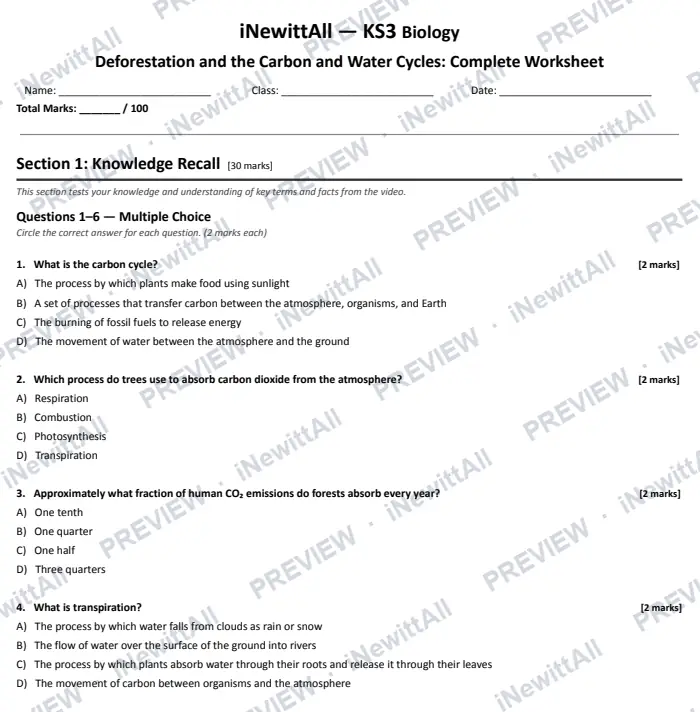
The top of page 1. The answer key is included when you buy.
£5 £6
The full worksheet and the extension pack together, with both answer keys.
Instant download with full answer keys. Print as many copies as your class needs.
£3
£3
£5 £6
Tick it off to track your progress. It's saved on this device. See my revision →
Students watch the video and do the quiz. They get a result card to paste back to you, showing their first try and best score.
This lesson's quiz questions on one sheet, with the answer key on page 2.
The quiz in big text for your classroom screen, one question at a time. Or build a 5-question Do Now starter from lessons your class has already done.
You're welcome to embed the video and link these resources in Google Classroom, Stile, Canvas, Compass or any other school platform. No need to ask.
Everything here is written to the KS3 curriculum for students aged 11–14. Print freely for the classes you teach.
More in this unit: Climate change and biodiversity
No spam, unsubscribe anytime. You must be 13 or over to sign up.