KS3 Biology › Breathing and respiration

KS3 Biology › Breathing and respiration
These are the points the worksheet questions are built around.
Breathing, gas exchange and cellular respiration are three separate processes, each happening in a different place — and keeping that location straight is the key to not mixing them up.
Breathing is simply the process in which air moves in and out of the lungs, a pair of organs in the chest where breathing happens. It's a mechanical process: air is physically moved from outside the body to inside it and back again, with nothing being made or burned. This is also why humans can't stay underwater indefinitely — there's no air down there to move into the lungs.
Air itself isn't mostly oxygen, as many people assume. Around 78% of air is nitrogen, a gas your body does nothing with at all — you breathe it in and straight back out, completely unchanged. Only about 21% of air is oxygen, and carbon dioxide makes up less than 1%. It's that 21% oxygen that your cells actually need.
Oxygen doesn't travel straight from your lungs to your cells — there's a step in between called gas exchange. Deep inside the lungs, airways branch repeatedly until they end in millions of tiny air sacs, each wrapped in blood vessels so thin that gases can pass straight through their walls. Gas exchange is the process of oxygen diffusing from the lungs into the blood, while carbon dioxide diffuses from the blood into the lungs at the same time, moving in the opposite direction. Diffusion simply means particles spreading from an area of high concentration to an area of low concentration — nothing pumps the gases across, they drift on their own.
Once oxygen is in the blood, it's delivered to cells throughout the body, where the real work happens. Inside almost every cell sit mitochondria — subcellular structures where cellular respiration takes place. Cellular respiration is a chemical process that uses sugar from food and oxygen from the blood to release energy for life processes like growing, moving, thinking and staying warm. It also produces carbon dioxide as a waste product, which travels back through the blood to the lungs to be breathed out.
This distinction can be demonstrated with a simple experiment: a burning candle placed in ordinary room air and another placed in air that's just been breathed out will both burn at first, but the candle in exhaled air goes out sooner. That's because exhaled air has less oxygen (some was used up by cellular respiration) and more carbon dioxide (produced as waste by cells). Importantly, the candle in exhaled air still burns for a while, showing that exhaled air isn't empty of oxygen — there's still plenty left, which is exactly why rescue breaths work in first aid.
In short: breathing happens in the lungs and moves air in and out of the body; gas exchange happens between the air sacs and blood vessels, swapping oxygen and carbon dioxide between air and blood; and cellular respiration happens inside mitochondria within cells, releasing energy from sugar and oxygen while producing carbon dioxide as waste. Three different processes, three different locations, three different jobs.
These are the words that appear as key term cards in the video — worth knowing cold before the test.
Short clips from this lesson. Good for a quick refresh before a test.
Swipe sideways to see more →
Revising for a test? Key terms, objectives and quiz questions on one printable page.
The 3 questions from the video, one at a time. See if you caught them.
1. Which gas makes up most of the air you breathe in?
Why: Air is about 78% nitrogen and only about 21% oxygen. Your body doesn't use the nitrogen, so you breathe it straight back out.
2. Which of these does NOT happen during gas exchange?
Why: Breaking sugar down to release energy is respiration, which happens inside cells. Gas exchange is just gases moving by diffusion between the air sacs and the blood.
3. A candle burns out faster in exhaled air. Why?
Why: Exhaled air has used up some of its oxygen, but there is still some left. So a candle keeps burning in it for a while, but goes out faster than it would in fresh air.
Score: 0 out of 3 —
Want more practice? Try the 60-second Quiz Challenge →
One page with a full answer key. Enough to check the lesson landed, and to see how the questions are written before you buy anything.
Get the free worksheet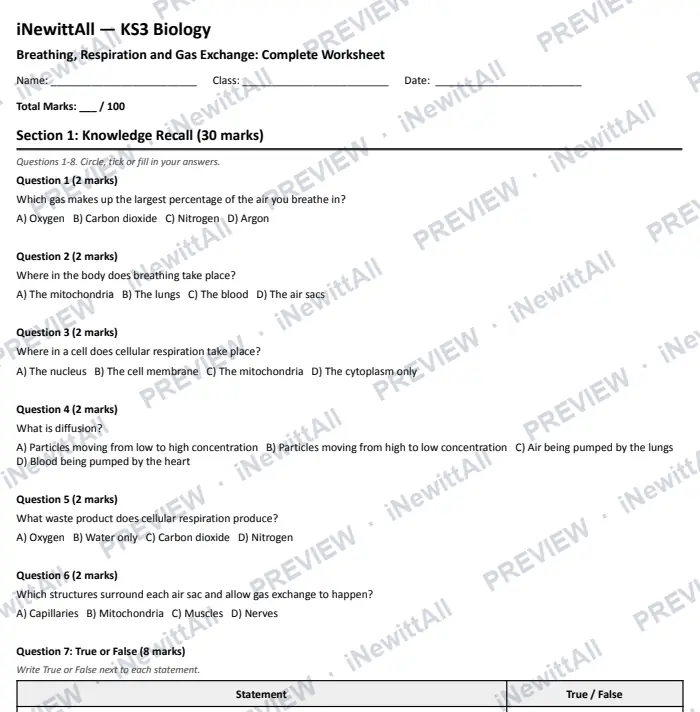
The top of page 1. The answer key is included when you buy.
£5 £6
The full worksheet and the extension pack together, with both answer keys.
Instant download with full answer keys. Print as many copies as your class needs.
£3
£3
£5 £6
Tick it off to track your progress. It's saved on this device. See my revision →
Students watch the video and do the quiz. They get a result card to paste back to you, showing their first try and best score.
This lesson's quiz questions on one sheet, with the answer key on page 2.
The quiz in big text for your classroom screen, one question at a time. Or build a 5-question Do Now starter from lessons your class has already done.
You're welcome to embed the video and link these resources in Google Classroom, Stile, Canvas, Compass or any other school platform. No need to ask.
Everything here is written to the KS3 curriculum for students aged 11–14. Print freely for the classes you teach.
No spam, unsubscribe anytime. You must be 13 or over to sign up.
