KS3 Geography › Globalisation

KS3 Geography › Globalisation
These are the points the worksheet questions are built around.
Globalisation is the process of the world becoming more interconnected — places, people and businesses becoming more linked to each other. Two or more things are interconnected when they're linked and have an impact on each other, meaning something happening in one place can affect somebody thousands of miles away. Importantly, globalisation is about connection, not wealth — a country can become far more connected to the rest of the world without becoming any richer.
An ordinary piece of clothing shows this well: cotton might be grown in one country, spun into fabric in another, stitched together in a third, then shipped to a shop somewhere else entirely. That whole journey is globalisation in action. Much of it runs on world trade — the global exchange of goods and services across national borders, happening constantly and in enormous volume every day.
Globalisation isn't a modern invention. Around two thousand years ago, the Silk Road linked Asia to Europe, with traders carrying silk, spices, metals and precious stones across thousands of miles. Goods weren't the only thing that travelled — ideas, languages, religions, technology and disease moved along those routes too, long before anyone had a word for globalisation. Ideas have always spread this way: traffic lights were first used in London in 1868, spread to the United States in the early 1900s, and can now be found in almost every country on Earth.
Globalisation has a difficult side to its history as well. When Christopher Columbus reached the Caribbean in 1492, it triggered an enormous exchange of people, animals, plants and diseases between continents, with huge consequences, especially for the people already living there. This was followed by an age of empire: right up until the 1950s, many countries were colonised, ruled by another nation that imposed its own laws, language, culture and religion. Colonised countries often lost parts of their own culture, had natural resources taken from them, and their people were oppressed — effects that didn't disappear at independence and are still being felt today.
Globalisation has entered a new phase thanks to transport and technology. Ships, planes and lorries move goods around the planet faster and more cheaply than ever, and the internet moves information almost instantly — a message that once took months to cross an ocean by ship now takes less than a second. This is also why transnational corporations, like Tesco and McDonald's, can run stores in dozens of countries at once, making them one of the clearest signs of a connected world.
Globalisation doesn't just move products around — it shapes the places we live in, often leading to a diverse society, with a wide variety of people, religions and cultures living side by side. This is visible on almost any high street: restaurants serving food from several continents, shops selling ingredients from around the world, signs in different languages, places of worship for different faiths, and buildings influenced by architecture from elsewhere.
In short: globalisation is the world becoming more interconnected, and it's been happening for thousands of years, from the Silk Road to the age of empire and colonisation, right through to today's transport and technology-driven connections. It brings both benefits, like diverse societies, and a difficult history, particularly around colonisation, whose effects are still felt today.
These are the words that appear as key term cards in the video — worth knowing cold before the test.
Short clips from this lesson. Good for a quick refresh before a test.
Swipe sideways to see more →
Revising for a test? Key terms, objectives and quiz questions on one printable page.
The 3 questions from the video, one at a time. See if you caught them.
1. What does globalisation actually mean?
Why: Globalisation is the world becoming more connected. People, goods, money and ideas move between countries more and more easily.
2. Which of these is NOT an example of globalisation?
Why: Growing vegetables in your own garden doesn't connect you to any other country. The other examples all link people, parts or products across different countries.
3. Roughly how long ago did the Silk Road trade routes begin?
Why: The Silk Road linked China and Europe about 2,000 years ago. Traders carried goods and ideas along it, so it is one of the earliest examples of globalisation.
Score: 0 out of 3 —
Want more practice? Try the 60-second Quiz Challenge →
One page with a full answer key. Enough to check the lesson landed, and to see how the questions are written before you buy anything.
Get the free worksheet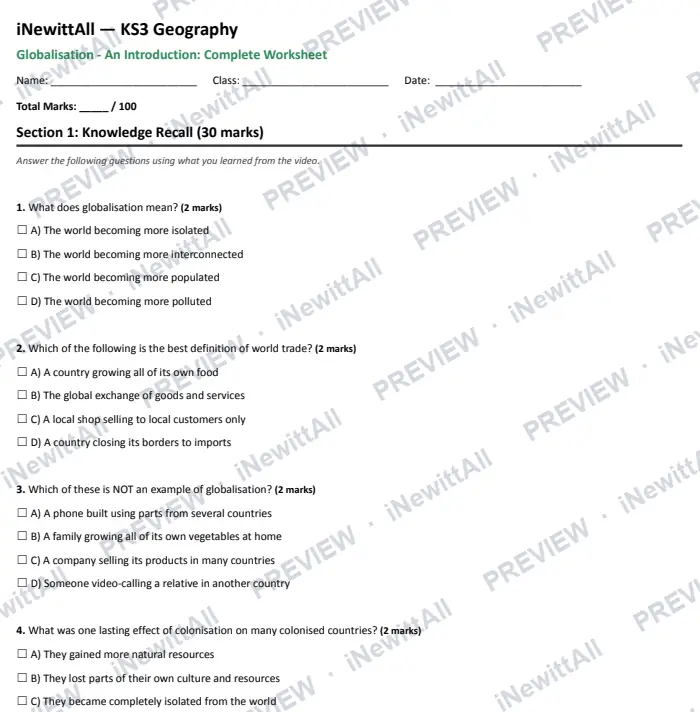
The top of page 1. The answer key is included when you buy.
£5 £6
The full worksheet and the extension pack together, with both answer keys.
Instant download with full answer keys. Print as many copies as your class needs.
£3
£3
£5 £6
Tick it off to track your progress. It's saved on this device. See my revision →
Students watch the video and do the quiz. They get a result card to paste back to you, showing their first try and best score.
This lesson's quiz questions on one sheet, with the answer key on page 2.
The quiz in big text for your classroom screen, one question at a time. Or build a 5-question Do Now starter from lessons your class has already done.
You're welcome to embed the video and link these resources in Google Classroom, Stile, Canvas, Compass or any other school platform. No need to ask.
Everything here is written to the KS3 curriculum for students aged 11–14. Print freely for the classes you teach.
No spam, unsubscribe anytime. You must be 13 or over to sign up.
