KS3 Geography › Anthropocene

KS3 Geography › Anthropocene
These are the points the worksheet questions are built around.
Earth is made up of four major physical systems, or spheres, each playing a vital role in keeping life on the planet going. The atmosphere is the layer of gases wrapping around the planet, providing oxygen and protecting us from space. The hydrosphere is all the water on Earth, including oceans, rivers, lakes, glaciers, groundwater and water vapour. The geosphere is the solid parts of Earth, including the crust, mantle, core, rocks, soil, mountains and landforms. The biosphere is every living thing on the planet, along with the ecosystems they form. These four spheres don't work in isolation — they constantly interact, so when humans change one, the others feel it too.
A major driver of change across all four spheres has been population growth. In 1800, the world population was around one billion; today it's over eight billion — an eightfold increase. More people means more demand for food, water, space and energy, which increases pressure on natural resources: more farmland (and therefore more deforestation), more water extracted from rivers and lakes, and more fossil fuels burned for energy. The amount of CO2 released into the atmosphere has increased even faster than the population, because each person now uses far more energy, and this pressure makes Earth's physical systems more vulnerable to breakdown.
The single biggest turning point in human impact on Earth was industrialisation. Before it, most people lived in the countryside and farmed the land. From around the mid-1700s, factories emerged, mass production took hold, and millions of people moved to cities. Those factories ran on fossil fuels, releasing enormous amounts of carbon dioxide and other greenhouse gases — one of the main drivers of the climate change seen today. Industrialisation also polluted rivers and lakes with toxic waste, heavy metals and chemicals, while mining and quarrying tore up natural landscapes and forests were cleared at huge scale to make way for cities and farmland.
Each sphere has been affected differently. The atmosphere is impacted mainly by energy use — most of it still coming from burning fossil fuels for electricity, transport and industry — which drives climate change, extreme weather, and air pollution that's a serious health problem in many cities.
The hydrosphere is affected by growing demand for water from drinking, farming and industry, leading to over-extraction from rivers, lakes and underground aquifers, to the point where some rivers that once flowed year-round now run dry. Increased urbanisation covers more land in concrete, which stops rainwater soaking naturally into the ground and increases flooding, while pollution from homes and factories contaminates water sources and harms the ecosystems depending on them.
The geosphere is affected as more land is cleared for housing, roads and agriculture, often through deforestation, while mining and construction disturb natural landforms. This can cause soil erosion and desertification — where land gradually turns into desert because it becomes too hot and dry to support plants, often making that land unusable for farming, potentially permanently.
The biosphere is affected by habitat destruction from expanding cities and farmland, reducing biodiversity at what scientists describe as an alarming rate. Demand for food drives overfishing, large-scale farming and further deforestation, all disrupting ecosystems, while human-induced climate change shifts seasons, forces species to migrate, and in some cases drives them to extinction.
In short: Earth's four physical systems — the atmosphere, hydrosphere, geosphere and biosphere — are all interconnected, and human activity, especially population growth and industrialisation, has placed enormous pressure on all of them at once, from greenhouse gases and polluted rivers to eroded soils and shrinking habitats.
These are the words that appear as key term cards in the video — worth knowing cold before the test.
Short clips from this lesson. Good for a quick refresh before a test.
Swipe sideways to see more →
Revising for a test? Key terms, objectives and quiz questions on one printable page.
The 3 questions from the video, one at a time. See if you caught them.
1. Which sphere includes all the water on Earth?
Why: The hydrosphere is all the water on Earth. The atmosphere is the air, the geosphere is the rock and soil, and the biosphere is all living things.
2. Which human activity has most directly increased greenhouse gas emissions?
Why: Burning fossil fuels like coal, oil and gas releases huge amounts of carbon dioxide into the atmosphere. The other activities have effects too, but burning fuel is the biggest direct source.
3. Which sphere is most directly affected by habitat destruction and loss of biodiversity?
Why: The biosphere is all living things. Destroying habitats kills off plants and animals, so biodiversity falls.
Score: 0 out of 3 —
Want more practice? Try the 60-second Quiz Challenge →
One page with a full answer key. Enough to check the lesson landed, and to see how the questions are written before you buy anything.
Get the free worksheet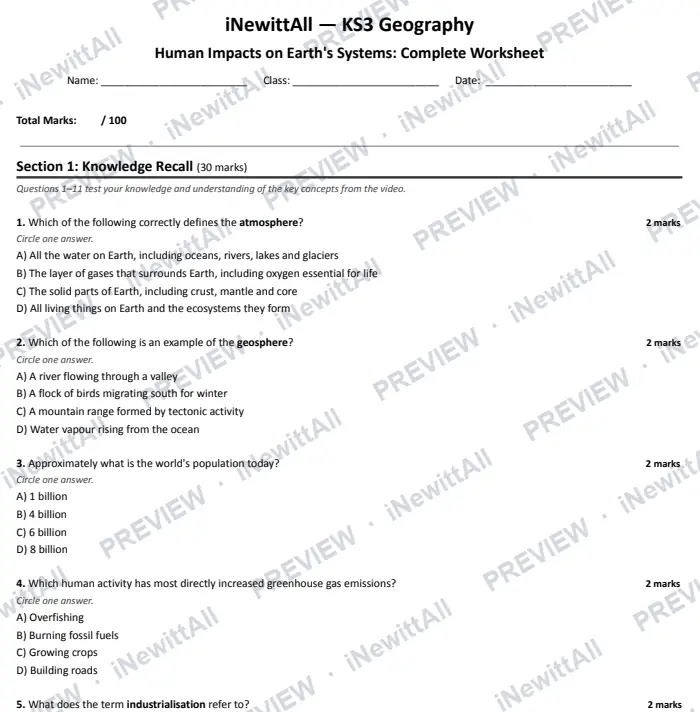
The top of page 1. The answer key is included when you buy.
£5 £6
The full worksheet and the extension pack together, with both answer keys.
Instant download with full answer keys. Print as many copies as your class needs.
£3
£3
£5 £6
Tick it off to track your progress. It's saved on this device. See my revision →
Students watch the video and do the quiz. They get a result card to paste back to you, showing their first try and best score.
This lesson's quiz questions on one sheet, with the answer key on page 2.
The quiz in big text for your classroom screen, one question at a time. Or build a 5-question Do Now starter from lessons your class has already done.
You're welcome to embed the video and link these resources in Google Classroom, Stile, Canvas, Compass or any other school platform. No need to ask.
Everything here is written to the KS3 curriculum for students aged 11–14. Print freely for the classes you teach.
No spam, unsubscribe anytime. You must be 13 or over to sign up.
