KS3 Geography › Population

KS3 Geography › Population
These are the points the worksheet questions are built around.
Population is simply the number of people living in a specific area, whether that's a city, a country, or the whole world. It changes based on two key measures: birth rate, the number of live births per thousand people per year, and death rate, the number of deaths per thousand people per year. When birth rate is higher than death rate, the population grows — this is called natural increase. When death rate is higher than birth rate, the population shrinks, called natural decrease.
Birth rates vary hugely around the world. Niger has one of the highest, at around 44 births per thousand people a year, while Japan has one of the lowest, at around 7. In low-income countries, birth rates tend to be higher partly because children are often expected to help support the family financially, and early marriage — which is more common in some countries — gives people more time to have children. In high-income countries, raising children is expensive, and access to family planning and contraception lets people choose when and whether to have children, both of which push birth rates down.
Death rates vary just as much, for different reasons. Lesotho has one of the highest death rates in the world, at 13.8 deaths per thousand people a year, while Qatar has one of the lowest, at 1.3. Poor healthcare and sanitation drive death rates up, since diseases spread more easily without clean water. War and natural disasters also raise death rates. An ageing population is another factor — wealthy countries like Italy and Germany have relatively high death rates simply because a large proportion of their population is elderly. Good healthcare, clean water, and stable, peaceful conditions all reduce death rates.
Looking at history, the world's population grew extremely slowly for most of human history. In the year 0, there were only around 190 million people worldwide; by 1700, that had risen to about 600 million — an increase of just over 400 million across seventeen centuries. This was because, even though birth rates were high in ancient times, death rates were roughly as high too, due to widespread disease, minimal healthcare, and the risk of a bad harvest. With birth and death rates roughly matching, natural increase existed but was tiny.
Everything changed after the 1800s. Healthcare improved dramatically, vaccines were developed and rolled out, sanitation improved, and diets got better, making people more resistant to disease. All of this drove death rates down sharply, while birth rates stayed high — creating a widening gap between the two that caused the population to explode. It took all of human history until 1927 to reach 2 billion people, just 33 more years to reach 3 billion in 1960, and only 15 more years to reach 4 billion in 1975. By 1900, the population was 1.65 billion; by 2022, it had reached 8 billion.
Population growth isn't expected to continue forever, though. As countries develop economically, education improves, more women enter the workforce, and family planning becomes more widely available, birth rates fall. The world's population is expected to reach 9 billion by around 2037, but growth will keep slowing after that, with the global population predicted to peak around 2080 before gradually beginning to decrease.
In short: population is driven by the balance between birth rate and death rate, both of which vary enormously around the world based on income, healthcare, family planning, and stability. The population grew slowly for most of history because high death rates cancelled out high birth rates, but the population explosion after 1800 — caused by falling death rates alongside still-high birth rates — pushed the world from 1.65 billion to 8 billion in just over a century. Growth is now slowing as birth rates fall globally, with the population expected to peak around 2080.
These are the words that appear as key term cards in the video — worth knowing cold before the test.
Short clips from this lesson. Good for a quick refresh before a test.
Swipe sideways to see more →
Revising for a test? Key terms, objectives and quiz questions on one printable page.
The 3 questions from the video, one at a time. See if you caught them.
1. Which of the following is a reason for a HIGH birth rate?
Why: In poor families, some children might not survive and children can help earn money, so families often have more of them. High income, late marriage and family planning usually lead to lower birth rates.
2. What was the main reason the world's population grew so rapidly after 1800 AD?
Why: From about 1800, healthcare, clean water and sanitation improved. Far fewer people died, especially babies, while birth rates stayed high, so the population shot up.
3. What does NATURAL INCREASE mean?
Why: Natural increase means more babies are being born than people are dying. It doesn't include people moving into or out of the country.
Score: 0 out of 3 —
Want more practice? Try the 60-second Quiz Challenge →
One page with a full answer key. Enough to check the lesson landed, and to see how the questions are written before you buy anything.
Get the free worksheet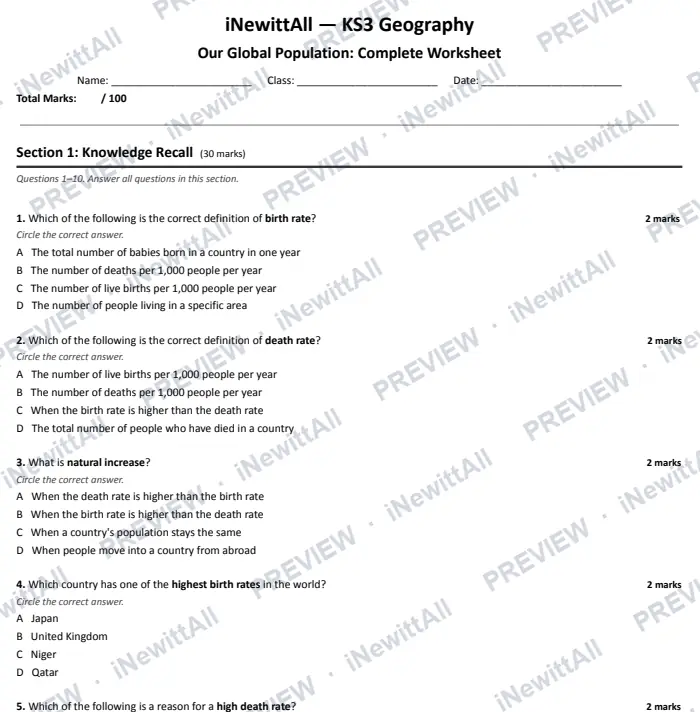
The top of page 1. The answer key is included when you buy.
£5 £6
The full worksheet and the extension pack together, with both answer keys.
Instant download with full answer keys. Print as many copies as your class needs.
£3
£3
£5 £6
Tick it off to track your progress. It's saved on this device. See my revision →
Students watch the video and do the quiz. They get a result card to paste back to you, showing their first try and best score.
This lesson's quiz questions on one sheet, with the answer key on page 2.
The quiz in big text for your classroom screen, one question at a time. Or build a 5-question Do Now starter from lessons your class has already done.
You're welcome to embed the video and link these resources in Google Classroom, Stile, Canvas, Compass or any other school platform. No need to ask.
Everything here is written to the KS3 curriculum for students aged 11–14. Print freely for the classes you teach.
 Next lessonPopulation Density
More in this unit: Population
No spam, unsubscribe anytime. You must be 13 or over to sign up.