KS3 Geography › Population

KS3 Geography › Population
These are the points the worksheet questions are built around.
Roughly half of everyone alive today lives on just about 1% of Earth's land surface, while the other half is spread thinly across everything else — deserts, mountains, ice sheets, rainforest, and farmland. Population density is the measure that captures this: the number of people living in a set area, usually per square kilometre. It's simply people divided by space.
Density is often confused with distribution, but they're different things. Distribution is the pattern — how people are spread out across an area. Density is the count — how tightly packed people are in one particular spot. An area with lots of people packed closely together is described as densely populated, like a town or city; an area with very few people spread across a large space is sparsely populated, like open countryside.
People are not spread evenly across the planet. Four regions consistently show high density on a world map: Europe, eastern North America, eastern Asia, and southern Asia. India alone holds over a billion people in a country roughly a third the size of the United States. By contrast, northern Asia, the interior of Africa, much of South America, and Oceania remain sparsely populated — Australia is nearly the same size as the whole of Europe, yet has only around 26 million people, compared to Europe's 700 million-plus.
A country's size on its own tells you very little about its density — what matters is what the land can actually offer. This comes down to two types of factors: physical (natural) and human (made by people).
Physical factors include climate: crowded regions overwhelmingly sit in temperate and continental climates, where it's rarely extremely hot or cold and rainfall is reliable. The UK, with its mild climate, is one of Europe's more densely populated countries, while punishing heat in central Africa or extreme cold in northern Siberia leaves both regions close to empty despite their size.
Soil and water matter just as much. Fertile soil supports crops, and crops mean food, which is why river valleys and floodplains — where rivers deposit rich sediment over time — have attracted dense populations for thousands of years. Water can be even more decisive: Egypt is almost entirely desert, yet nearly its whole population is squeezed onto a narrow green strip along the River Nile, purely because that's where the water is. Natural resources like timber, water, fuel, and fertile ground work the same way, drawing people wherever they're found, since they support farming, industry, and daily life.
Human factors come down to jobs and transport. Work concentrates people quickly — wherever banking, finance, technology, tourism, or manufacturing jobs are, people follow. Transport links then multiply that effect: a motorway, railway, or airport doesn't just move people around, it widens the area someone can live in while still reasonably reaching their job, pulling settlement outward while also thickening it.
Density can shift dramatically even within a single city. London's centre has extraordinarily high density, which falls away through the suburbs and collapses entirely by the surrounding countryside. This is partly explained by a ring of motorways, three international airports, a national rail network, and an underground system moving millions of people daily — all layered on top of a huge concentration of jobs.
In short: population density measures how many people live in a given area, while distribution describes the pattern of where they live. Physical factors like climate, soil, and water determine where living is practical at all, while human factors like jobs and transport determine where it becomes genuinely attractive — and the two combine to create the uneven, sometimes extreme, patterns of crowding and emptiness seen across the world.
These are the words that appear as key term cards in the video — worth knowing cold before the test.
Short clips from this lesson. Good for a quick refresh before a test.
Swipe sideways to see more →
Revising for a test? Key terms, objectives and quiz questions on one printable page.
The 3 questions from the video, one at a time. See if you caught them.
1. What does population density actually measure?
Why: Population density measures how many people live in a set area, such as per square kilometre.
2. Which of these is NOT a physical factor affecting population density?
Why: Physical factors come from nature, like climate, soil and water. Railway networks are built by people, so they are a human factor.
3. Roughly what share of Egypt's land holds almost its entire population?
Why: Almost all Egyptians live along the River Nile, which covers only about 5% of the country. The rest is desert.
Score: 0 out of 3 —
Want more practice? Try the 60-second Quiz Challenge →
One page with a full answer key. Enough to check the lesson landed, and to see how the questions are written before you buy anything.
Get the free worksheet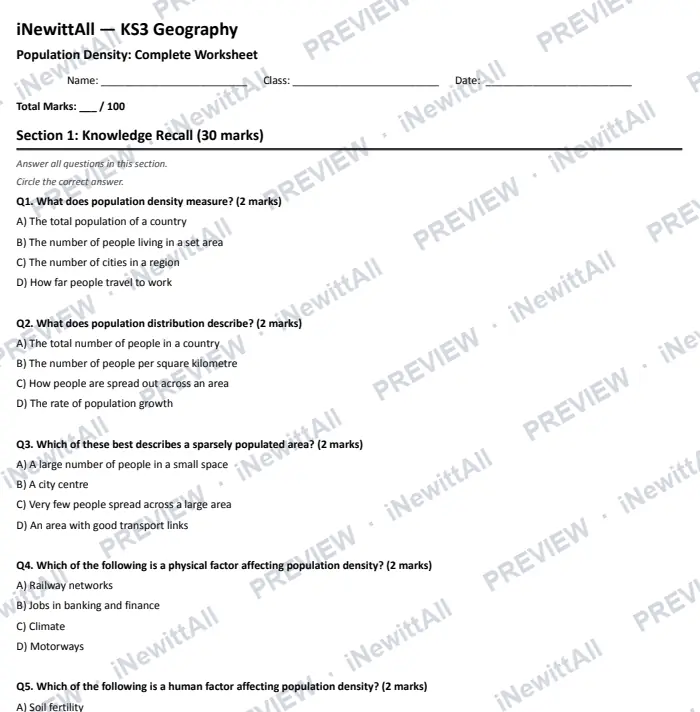
The top of page 1. The answer key is included when you buy.
£5 £6
The full worksheet and the extension pack together, with both answer keys.
Instant download with full answer keys. Print as many copies as your class needs.
£3
£3
£5 £6
Tick it off to track your progress. It's saved on this device. See my revision →
Students watch the video and do the quiz. They get a result card to paste back to you, showing their first try and best score.
This lesson's quiz questions on one sheet, with the answer key on page 2.
The quiz in big text for your classroom screen, one question at a time. Or build a 5-question Do Now starter from lessons your class has already done.
You're welcome to embed the video and link these resources in Google Classroom, Stile, Canvas, Compass or any other school platform. No need to ask.
Everything here is written to the KS3 curriculum for students aged 11–14. Print freely for the classes you teach.
More in this unit: Population
No spam, unsubscribe anytime. You must be 13 or over to sign up.