KS3 Biology › Human digestive system

KS3 Biology › Human digestive system
These are the points the worksheet questions are built around.
Enzymes are the reason a meal is digested in hours rather than years. An enzyme is a biological catalyst, meaning a substance made by living things that makes a chemical reaction happen faster while remaining unchanged itself. Every enzyme in the human body is a protein, and the body makes thousands of different types, each with its own particular job.
A helpful way to picture a catalyst is to imagine a boulder that has to be moved over a hill. Pushing it over the top is possible but takes a great deal of effort. A catalyst is like a tunnel dug through the hill: the boulder still ends up in the same place, but the journey is far easier and quicker. Large food molecules would eventually break apart without help, but at body temperature this would take years, whereas with enzymes it takes hours. Because an enzyme is not used up, it releases the molecule it has just split and moves straight on to the next one, and some can do this thousands of times every second. For that reason the body only needs a small amount of each one.
Enzymes can also be pictured as tiny pairs of scissors. Starch is a long chain of sugar molecules joined together, and an enzyme snips through the links to free the sugars one at a time. Ordinary scissors will cut paper, string and card alike, but an enzyme is much fussier: it works on only one type of molecule, and this depends on its shape. Each enzyme has a small, specially shaped region called the active site. The molecule it acts on is the substrate, and the substrate has to fit the active site exactly. This idea is known as the lock and key model, with the enzyme as the lock and the substrate as the key. The shapes of a starch-digesting enzyme and a protein do not match, so the starch enzyme cannot affect protein. This is described by saying that enzymes are specific.
Most digestive enzymes have names ending in the same way as amylase, so the name often reveals the job. There are three main groups. Carbohydrases break carbohydrates into sugars, and the best-known of them is amylase, which acts on starch. Proteases break proteins into amino acids. Lipases break lipids, or fats, into fatty acids and glycerol. The work of amylase can even be tasted: plain bread chewed for around a minute gradually turns sweeter, because amylase in saliva is cutting the starch into sugar.
Enzymes are not all made in one place. They are released at different points along the digestive system, so food is attacked again and again as it travels through. In the mouth, the salivary glands release amylase in saliva, which means starch digestion begins before the food is even swallowed. In the stomach, glands in the stomach wall release a protease that starts to break proteins down. The pancreas, a small organ tucked behind the stomach, is the main source: it makes carbohydrases, proteases and lipases and sends all three into the small intestine. The lining of the small intestine produces further enzymes to finish off whatever is left. By the end of the small intestine, almost every large food molecule has been turned into a small, soluble one that can be absorbed into the blood.
Enzymes are very sensitive to temperature. Each has an optimum temperature, at which it works fastest, and for human enzymes this is around 37 degrees Celsius, which is normal body temperature. When it is colder, molecules move more slowly and meet enzymes less often, so digestion slows down. When the temperature rises much above 40 degrees, the enzyme begins to change shape and its active site becomes distorted. Once the lock is warped, the substrate no longer fits and the enzyme stops working. The enzyme is then said to be denatured, and this is permanent, rather like an egg that can never be made runny again once it has been cooked. Biological washing powder shows the idea in everyday life. It contains proteases and lipases that digest food and grease stains, which is why it works well on a cool wash, whereas a very hot wash would denature the enzymes before they had cleaned anything.
The pH of the surroundings, which is a measure of how acidic or alkaline they are, matters just as much. Most enzymes in the body work best at around pH 7, which is neutral. The stomach protease is an exception, working best at about pH 2, which is strongly acidic and roughly as acidic as lemon juice. Amylase from saliva is different: once swallowed food reaches the stomach, the acid is too strong for it and it soon stops working. Starch digestion therefore pauses in the stomach and picks up again in the small intestine, where conditions are much less acidic.
In short: enzymes are protein catalysts that speed up digestion without being used up. Each one has an active site that fits just one substrate, like a lock and key. Carbohydrases, proteases and lipases digest carbohydrates, proteins and fats, and they are made in the mouth, the stomach, the pancreas and the small intestine. Every enzyme also has an optimum temperature and pH, and if it is pushed too far it is denatured for good.
These are the words that appear as key term cards in the video — worth knowing cold before the test.
Revising for a test? Key terms, objectives and quiz questions on one printable page.
The 3 questions from the video, one at a time. See if you caught them.
1. What happens to an enzyme after it breaks down a food molecule?
Why: Enzymes are catalysts, so they are never used up and simply move on to the next molecule.
2. Which of these does NOT make a protease?
Why: Saliva carries amylase for starch, but protein digestion only begins once food reaches the stomach.
3. A denatured enzyme is cooled back to 37 degrees. What happens?
Why: Denaturing changes the shape of the active site for good, so the substrate can never fit again.
Score: 0 out of 3 —
Want more practice? Try the 60-second Quiz Challenge →
One page with a full answer key. Enough to check the lesson landed, and to see how the questions are written before you buy anything.
Get the free worksheet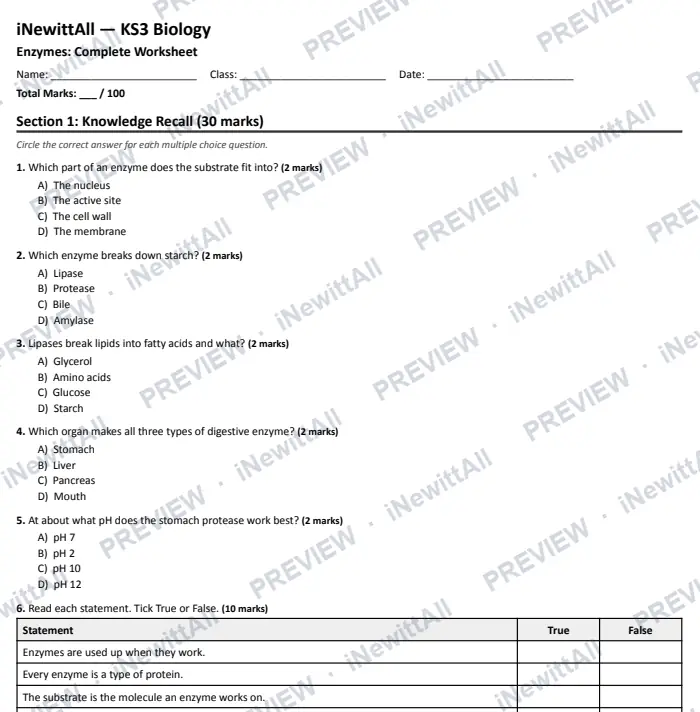
The top of page 1. The answer key is included when you buy.
£5 £6
The full worksheet and the extension pack together, with both answer keys.
Instant download with full answer keys. Print as many copies as your class needs.
£3
£3
£5 £6
Tick it off to track your progress. It's saved on this device.
You're welcome to embed the video and link these resources in Google Classroom, Stile, Canvas, Compass or any other school platform. No need to ask.
Everything here is written to the KS3 curriculum for students aged 11–14. Print freely for the classes you teach.
No spam, unsubscribe anytime.
