KS3 Biology › Human digestive system

KS3 Biology › Human digestive system
These are the points the worksheet questions are built around.
Food is fuel, but it's also the raw material the body uses to grow and repair itself. Since food can't be used directly, it has to be broken down into tiny nutrients small enough to be absorbed into the blood — a process called digestion, carried out by the digestive system, a tube roughly nine metres long running through the body.
Food always travels in one direction, through the same seven parts, in the same strict order: mouth, oesophagus, stomach, small intestine, large intestine, rectum, and anus.
Digestion begins in the mouth, which does three things at once: teeth cut and grind food into smaller pieces, the tongue rolls and mixes it, and salivary glands (a gland being any part of the body that makes and releases chemicals) release saliva to add water and soften the food, making it easier to swallow.
Once swallowed, food drops into the oesophagus, the tube connecting the mouth to the stomach. Rather than simply falling, it's pushed down by peristalsis — rings of muscle squeezing behind it, much like squeezing toothpaste through a tube. Peristalsis is powerful enough that food travels the right way even if someone were standing on their head, since it doesn't rely on gravity at all.
The stomach acts like a stretchy bag that holds food and works on it using hydrochloric acid — a strong chemical that helps break food apart and kills most of the germs that come in with it, making the stomach both a digestive organ and a first line of defence against bugs.
From the stomach, food moves into the small intestine, which despite its name is actually the longest part of the whole system, at around six metres coiled up inside the body. It's long and narrow on purpose, slowing food down to give the body time to finish digesting it and absorb every nutrient possible. Its walls are covered in millions of tiny finger-like bumps called villi, which create an enormous surface area, making nutrient absorption fast and efficient.
Two organs help out from the sidelines without food ever actually passing through them. The pancreas is a gland that makes digestive chemicals and releases them into the small intestine. The liver produces bile, which is also sent into the small intestine, where it breaks fat into tiny droplets — fat normally clumps together, much like oil and water refusing to combine — giving the fat-digesting enzymes far more surface to work on.
Whatever the small intestine can't digest or absorb — including fibre, which the body can't digest at all but still needs, since it bulks up waste and keeps everything moving smoothly — passes into the large intestine. As waste travels through the large intestine, water is pulled back out of it and returned to the blood, drying the waste out and firming it into faeces. This is stored in the rectum until it's ready to leave through the anus, a ring of muscle that controls the exit.
In short: digestion breaks food down into nutrients small enough to enter the blood, travelling in strict order through the mouth, oesophagus, stomach, small intestine, large intestine, rectum, and anus. Most digestion and absorption happens in the small intestine, the pancreas and liver contribute chemicals from the sidelines, and whatever's left over — including fibre — becomes faeces and leaves the body.
These are the words that appear as key term cards in the video — worth knowing cold before the test.
Short clips from this lesson. Good for a quick refresh before a test.
Swipe sideways to see more →
Revising for a test? Key terms, objectives and quiz questions on one printable page.
The 3 questions from the video, one at a time. See if you caught them.
1. Straight after the stomach, where does food go next?
Why: Food goes from the mouth to the oesophagus, stomach, small intestine and then large intestine. So after the stomach it goes into the small intestine, where most nutrients are absorbed.
2. Which of these does food NOT pass through?
Why: Food passes through the gut, but the pancreas isn't part of it. The pancreas sits beside the gut and sends enzymes into the small intestine.
3. Which part pulls water back out of your waste?
Why: The large intestine absorbs water from the waste. That makes the waste more solid, ready to leave the body.
Score: 0 out of 3 —
Want more practice? Try the 60-second Quiz Challenge →
One page with a full answer key. Enough to check the lesson landed, and to see how the questions are written before you buy anything.
Get the free worksheet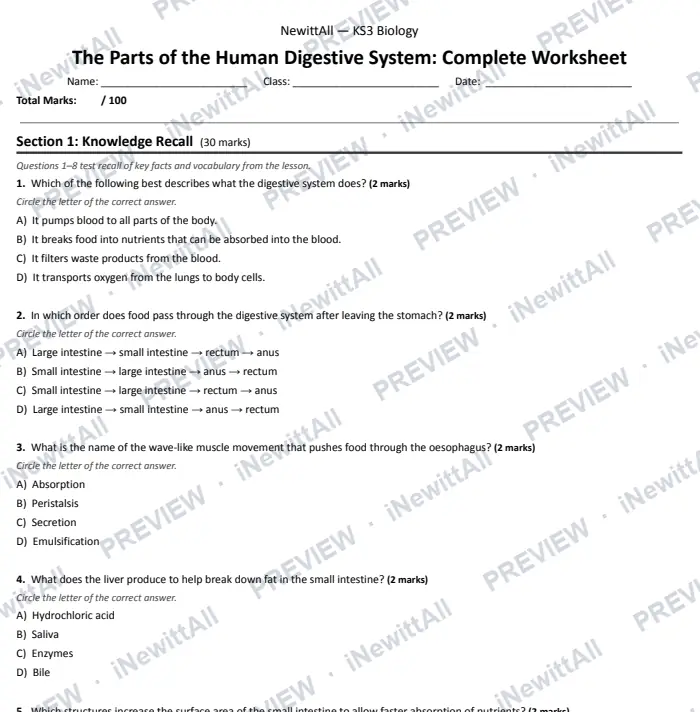
The top of page 1. The answer key is included when you buy.
£5 £6
The full worksheet and the extension pack together, with both answer keys.
Instant download with full answer keys. Print as many copies as your class needs.
£3
£3
£5 £6
Tick it off to track your progress. It's saved on this device. See my revision →
Students watch the video and do the quiz. They get a result card to paste back to you, showing their first try and best score.
This lesson's quiz questions on one sheet, with the answer key on page 2.
The quiz in big text for your classroom screen, one question at a time. Or build a 5-question Do Now starter from lessons your class has already done.
You're welcome to embed the video and link these resources in Google Classroom, Stile, Canvas, Compass or any other school platform. No need to ask.
Everything here is written to the KS3 curriculum for students aged 11–14. Print freely for the classes you teach.
No spam, unsubscribe anytime. You must be 13 or over to sign up.
