KS3 Biology › Human digestive system

KS3 Biology › Human digestive system
These are the points the worksheet questions are built around.
Although it might not seem like it, food sitting inside your digestive system hasn't actually entered your body yet. Your digestive system is really one long tube running through you, and food only truly becomes part of you once it's absorbed — small enough to pass through the wall of the small intestine and into your blood.
Before that can happen, food has to be digested. Digestion is the combination of mechanical and chemical processes that break large pieces of food down into small ones. This matters because food starts out as large, insoluble molecules — too big and unable to dissolve, so they can't pass through the intestine wall. Digestion turns them into small, soluble nutrients instead, such as glucose, amino acids and fatty acids, which are small enough and able to dissolve, so they can move.
Almost all of this digestion, and almost all of the absorption of nutrients, happens in the small intestine. It's long and narrow, so food travels through it slowly — and that slowness is deliberate. It gives enzymes time to finish digesting the food completely, and gives the body time to absorb every nutrient released.
The lining of the small intestine isn't smooth. It's covered in millions of tiny finger-like folds called villi, whose job is to increase surface area — the total area of a surface. Folding a surface dramatically increases its area without making the object itself any bigger, and that's exactly what villi do inside the small intestine: they increase its surface area by roughly forty times, meaning the intestine can be far shorter than it would otherwise need to be while still absorbing the same amount of food. More surface area also means more places for nutrients to cross at once, which increases the rate of absorption.
Nutrients cross into the blood by diffusion — the net movement of particles from an area of higher concentration to an area of lower concentration, down a concentration gradient. After a meal, the small intestine is packed with nutrients (a high concentration), while the blood on the other side has far fewer (a low concentration). That difference causes nutrients to move naturally into the blood, without the body needing to spend any energy pushing them. Because blood vessels sit extremely close to the surface of the small intestine wall, nutrients only have a very short distance to travel. A short distance, a steep concentration gradient, and an enormous surface area together are what make this absorption so efficient.
It's worth being clear that blood and the circulatory system aren't the same thing. Blood is the liquid; the circulatory system is the network it travels through — the heart plus all the blood vessels running around the body.
Blood itself is a mixture. Suspended in a straw-coloured liquid called plasma are red blood cells, white blood cells and platelets. Plasma makes up just over half the volume of blood and is mostly water, which is important because water is what allows nutrients to dissolve into it. Once nutrients cross the intestine wall, they dissolve into the plasma — glucose, amino acids, fatty acids, glycerol and vitamins — and are carried around the body, alongside waste products travelling in the other direction.
The heart pumps this nutrient-carrying plasma to every living cell in the body. When it arrives, the same process happens again in reverse: the blood becomes the high concentration, the cell the low concentration, so nutrients diffuse out of the blood and into the cell. Once inside, they're used for energy, growth and repair — glucose is broken down for energy, while amino acids are rebuilt into proteins that form new tissue.
In short: digestion breaks large insoluble food into small soluble nutrients, those nutrients diffuse down a concentration gradient from the small intestine into the blood (helped enormously by the huge surface area villi provide), and the circulatory system then carries those dissolved nutrients in the plasma to every cell in the body for energy, growth and repair.
These are the words that appear as key term cards in the video — worth knowing cold before the test.
Short clips from this lesson. Good for a quick refresh before a test.
Swipe sideways to see more →
Revising for a test? Key terms, objectives and quiz questions on one printable page.
The 3 questions from the video, one at a time. See if you caught them.
1. What are the tiny folds in the lining of the small intestine called?
Why: Villi are tiny finger-like folds lining the small intestine. They make its surface area much bigger, so more nutrients can be absorbed into the blood.
2. Nutrients diffuse into the blood because blood has what, compared to the gut?
Why: Diffusion moves particles from where there are lots of them to where there are fewer. After a meal the gut has lots of nutrients and the blood has fewer, so the nutrients move into the blood.
3. Which one of these is not dissolved in your blood plasma?
Why: Fibre can't be digested, so it stays in the gut and passes out as waste. Digested nutrients like glucose and amino acids are small enough to dissolve and be carried in the blood plasma.
Score: 0 out of 3 —
Want more practice? Try the 60-second Quiz Challenge →
One page with a full answer key. Enough to check the lesson landed, and to see how the questions are written before you buy anything.
Get the free worksheet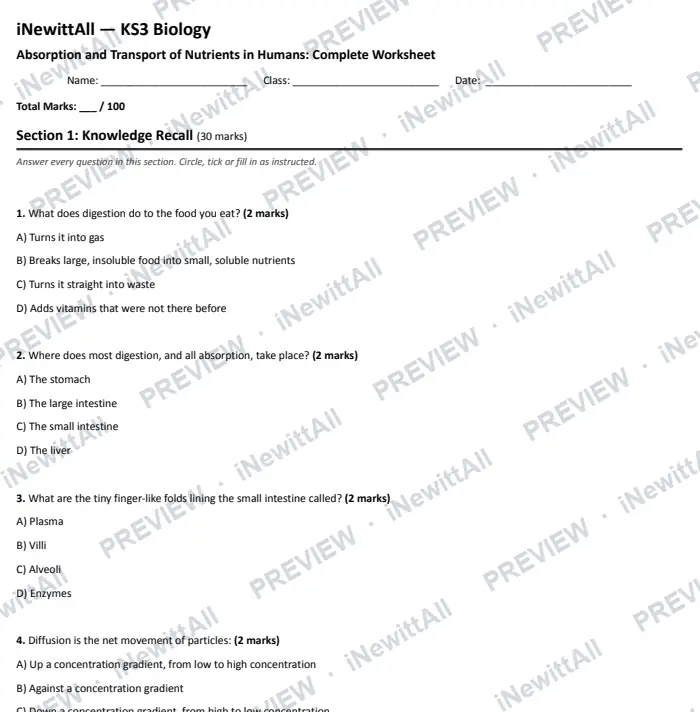
The top of page 1. The answer key is included when you buy.
£5 £6
The full worksheet and the extension pack together, with both answer keys.
Instant download with full answer keys. Print as many copies as your class needs.
£3
£3
£5 £6
Tick it off to track your progress. It's saved on this device. See my revision →
Students watch the video and do the quiz. They get a result card to paste back to you, showing their first try and best score.
This lesson's quiz questions on one sheet, with the answer key on page 2.
The quiz in big text for your classroom screen, one question at a time. Or build a 5-question Do Now starter from lessons your class has already done.
You're welcome to embed the video and link these resources in Google Classroom, Stile, Canvas, Compass or any other school platform. No need to ask.
Everything here is written to the KS3 curriculum for students aged 11–14. Print freely for the classes you teach.
No spam, unsubscribe anytime. You must be 13 or over to sign up.