KS3 Biology › Breathing and respiration

KS3 Biology › Breathing and respiration
These are the points the worksheet questions are built around.
An adult breathes in and out around 20,000 times a day, yet the lungs cannot pull in even one of those breaths on their own. They have no means of opening themselves up. Getting air inside depends on two things working together: muscles and pressure.
The organs that handle breathing form an organ system known as the gas exchange system, which is also called the respiratory system. It is a group of organs that work together to make breathing possible. Air enters through the nose and the mouth and then passes down the trachea, which is the correct name for the windpipe. Rings of cartilage run down the front of the trachea and keep it open, so the tube does not collapse while air is rushing through it.
Partway down the chest, the trachea divides into two tubes called bronchi, with one leading into each lung. A single one of these tubes is called a bronchus. Inside the lung, each bronchus branches again and again into ever narrower tubes called bronchioles, much like the twigs spreading out from the branches of a tree. At the very ends of the bronchioles are tiny air sacs called alveoli, and the lungs contain hundreds of millions of them. Every one of these parts is a tube or a sac, so none of them can pump air.
A common mistake is to think the heart helps with breathing, because it sits right between the two lungs. It does not. The heart pumps blood, belongs to a separate organ system called the circulatory system, and is not connected to the lungs by any air tubes.
The job of moving the lungs falls to two sets of muscles. The first is the diaphragm, a dome-shaped sheet of muscle lying underneath the lungs. The second is the intercostal muscles, which sit in the gaps between the ribs. The ribs make a protective cage around the lungs called the ribcage, and because the intercostal muscles are attached to it, they are able to move it. A muscle that contracts becomes shorter and pulls, while a muscle that relaxes lets go. Explaining how air actually gets inside needs one more idea: pressure.
Pressure can be pictured using a sealed box full of air. The air is made of tiny molecules moving in all directions, and each one that strikes a wall gives it a small push. All of those pushes added together make up the pressure. If the box is made larger while the amount of air inside stays the same, the molecules have more room, strike the walls less often, and the pressure falls. If the box is squashed smaller, there are more collisions and the pressure rises. So a larger volume means a lower pressure, and a smaller volume means a higher pressure. The rule that makes breathing work is that air always moves from a place of higher pressure to a place of lower pressure.
An empty plastic bottle shows this in action. Squeezing it forces air out of the top, and releasing it lets air rush back in as the bottle springs back into shape. Nothing sucks the air in: the bottle becomes bigger, the pressure inside falls, and the outside air pushes in. The chest relies on exactly the same idea around 20,000 times a day.
Breathing in is called inhalation. It begins when the intercostal muscles contract and pull the ribcage upwards and outwards. At the same moment the diaphragm contracts too, flattening out and moving downwards. Both changes make the chest larger, so the volume of the lungs increases. The pressure in the lungs then drops below that of the air outside, and air flows in through the nose and mouth to fill them. During a slow, deep breath, the ribs can be felt lifting and spreading outwards as the intercostal muscles work.
Breathing out is called exhalation, and it follows the same chain of events in reverse. The intercostal muscles relax, and the ribcage moves back downwards and inwards. The diaphragm relaxes as well and curves back up into its dome shape. The space in the chest gets smaller, so the volume of the lungs decreases, the pressure rises, and air is pushed back out. The key point is that each step depends on the one before it: the muscles change the volume, the volume changes the pressure, and only after that does the air move.
Because the inside of the chest cannot be watched during breathing, teachers often use the bell jar model. A glass bell jar represents the ribcage, two balloons inside it represent the lungs, the tube leading down to them represents the trachea, and a rubber sheet stretched across the bottom represents the diaphragm. Pulling the rubber sheet down increases the volume inside the jar, the pressure falls and the balloons inflate. Pushing the sheet back up reduces the volume, the pressure rises and the balloons go down. Like every model, it has limitations. The glass jar cannot move, whereas a real ribcage lifts up and out. Nothing in the model represents the intercostal muscles. The balloons are also hollow bags, while real lungs are spongy and packed with alveoli.
In short: the lungs cannot pull air in by themselves. Air travels from the nose and mouth through the trachea, bronchi and bronchioles to the alveoli, while the diaphragm and intercostal muscles do the moving. When they contract, the chest gets bigger, the volume goes up, the pressure goes down and air flows in. When they relax, the volume goes down, the pressure goes up and air flows out.
These are the words that appear as key term cards in the video — worth knowing cold before the test.
Revising for a test? Key terms, objectives and quiz questions on one printable page.
The 3 questions from the video, one at a time. See if you caught them.
1. Which of these is NOT part of the gas exchange system?
Why: The heart pumps blood, so it belongs to the circulatory system, not the gas exchange system.
2. As your chest gets bigger, what happens to the pressure in your lungs?
Why: A bigger space means the air molecules hit the walls less often, so the pressure goes down.
3. What actually makes air move into your lungs?
Why: Your muscles make your chest bigger, which drops the pressure, so air from outside flows in.
Score: 0 out of 3 —
Want more practice? Try the 60-second Quiz Challenge →
One page with a full answer key. Enough to check the lesson landed, and to see how the questions are written before you buy anything.
Get the free worksheet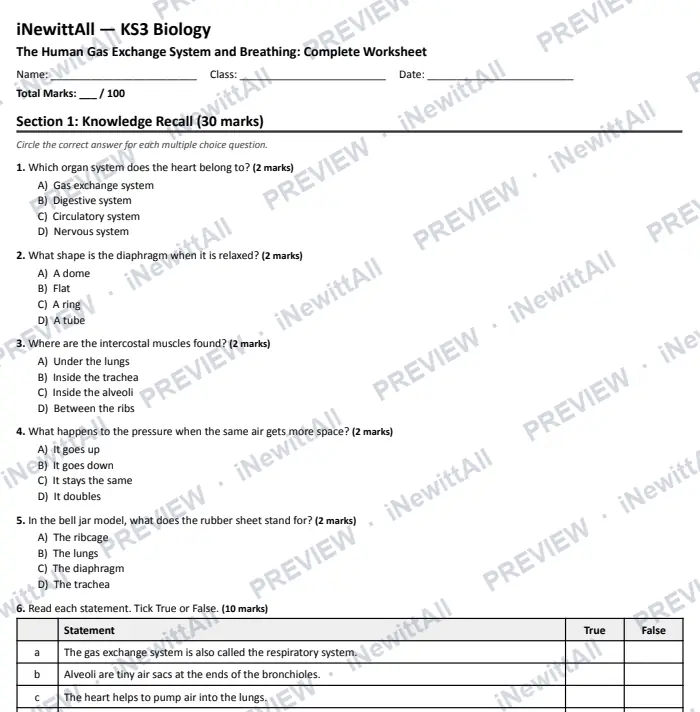
The top of page 1. The answer key is included when you buy.
£5 £6
The full worksheet and the extension pack together, with both answer keys.
Instant download with full answer keys. Print as many copies as your class needs.
£3
£3
£5 £6
Tick it off to track your progress. It's saved on this device. See my revision →
Students watch the video and do the quiz. They get a result card to paste back to you, showing their first try and best score.
This lesson's quiz questions on one sheet, with the answer key on page 2.
The quiz in big text for your classroom screen, one question at a time. Or build a 5-question Do Now starter from lessons your class has already done.
You're welcome to embed the video and link these resources in Google Classroom, Stile, Canvas, Compass or any other school platform. No need to ask.
Everything here is written to the KS3 curriculum for students aged 11–14. Print freely for the classes you teach.
More in this unit: Breathing and respiration
No spam, unsubscribe anytime. You must be 13 or over to sign up.