KS3 Geography › Coasts

KS3 Geography › Coasts
These are the points the worksheet questions are built around.
Coastal erosion is the wearing away and breaking down of rock, soil and sediment at the coast, followed by the movement of that broken material away from where it started. At the coast, the sea does this work — and a single wave does almost nothing to a cliff, but a coastline can be hit by roughly 8,000 waves in a single day. That relentless repetition, over time, is what turns solid rock into sand, through four distinct processes.
Hydraulic action is a purely physical process. When a wave slams into a cliff, air already trapped inside a crack in the rock gets violently compressed, then explodes back outwards as the wave pulls back and the pressure releases. Repeated thousands of times a day, this widens the crack into a fracture, then a fissure, then eventually a cave.
Abrasion works differently: waves pick up sand, shingle, pebbles and boulders and fire them at the cliff face, wearing it away like sandpaper on a huge scale. The heavier and more powerful the wave, the faster this happens — which is why coasts erode fastest during winter storms, with a single storm sometimes stripping away what would normally take a whole year.
Attrition is often misunderstood, because it doesn't touch the cliff at all. It's what happens to loose rock already in the water — pebbles and stones constantly colliding with each other, knocking off edges and corners so they become smaller, rounder and smoother over time. That's why beach pebbles are round while cliff rock is jagged: the same rock, just further along the same process.
Solution is chemical rather than physical. Seawater and rainwater are both very slightly acidic, and rocks like limestone and chalk — made of calcium carbonate — genuinely dissolve in that weak acid, disappearing into the water as invisible dissolved minerals rather than breaking apart physically. This means a chalk cliff can lose material even on a completely calm day with no waves at all.
All four processes concentrate their attack on one narrow band of cliff: the zone between high and low tide. This gets cut back into a hollow called a wave-cut notch. As the notch deepens, the rock above is left overhanging with nothing supporting it, until gravity causes it to collapse — the cliff line retreats a step backwards, and the process begins again on the newly exposed rock face. What's left behind at the base is a flat rocky ledge called a wave-cut platform, visible at low tide as the footprint of where the cliff used to stand.
Not every coastline retreats at the same rate. Two things decide this: rock type (hard igneous rock like granite might retreat only a few millimetres a year, while soft boulder clay can retreat whole metres) and wave energy, which depends on wind speed, how long the wind has been blowing, and the fetch — the distance of open water a wave has travelled across. The Holderness coast in East Yorkshire combines soft clay with hundreds of kilometres of open North Sea fetch, making it the fastest-eroding coastline in Europe, retreating around 2 metres a year — roughly 4 kilometres of lost land since Roman times, along with at least 29 villages.
Erosion doesn't only destroy — it also creates distinctive landforms. A crack in a headland, opened by hydraulic action and widened by abrasion, slowly becomes a cave. If that cave eventually cuts all the way through the headland, it becomes an arch, like Durdle Door in Dorset. When an arch's roof eventually collapses under its own weight, it leaves behind an isolated pillar of rock called a stack — the Old Man of Hoy in Orkney, at 137 metres tall, was once an arch.
In short: coastal erosion happens through four processes — hydraulic action, abrasion, attrition, and solution — three of which physically or chemically attack the cliff (attrition only affects loose rock already in the water). Rock type and wave energy determine how fast a coastline erodes, and the same processes that destroy cliffs also carve out caves, arches, stacks, wave-cut notches and wave-cut platforms along the way.
These are the words that appear as key term cards in the video — worth knowing cold before the test.
Short clips from this lesson. Good for a quick refresh before a test.
Swipe sideways to see more →
Revising for a test? Key terms, objectives and quiz questions on one printable page.
The 3 questions from the video, one at a time. See if you caught them.
1. Which process forces air into cracks in a cliff?
Why: In hydraulic action, waves crash into a cliff and force air into its cracks. The trapped air is squeezed and released again and again, which slowly weakens the rock.
2. Which of these does NOT wear away the cliff face?
Why: Attrition happens to the rocks and pebbles carried by the sea, which knock against each other and wear down. The cliff itself is worn away by abrasion, hydraulic action and solution.
3. How far has the Holderness coast retreated since Roman times?
Why: The Holderness coast is made of soft boulder clay, so it erodes fast. It has retreated about 4 kilometres since Roman times.
Score: 0 out of 3 —
Want more practice? Try the 60-second Quiz Challenge →
This lesson is a level in our game Coasts
One page with a full answer key. Enough to check the lesson landed, and to see how the questions are written before you buy anything.
Get the free worksheet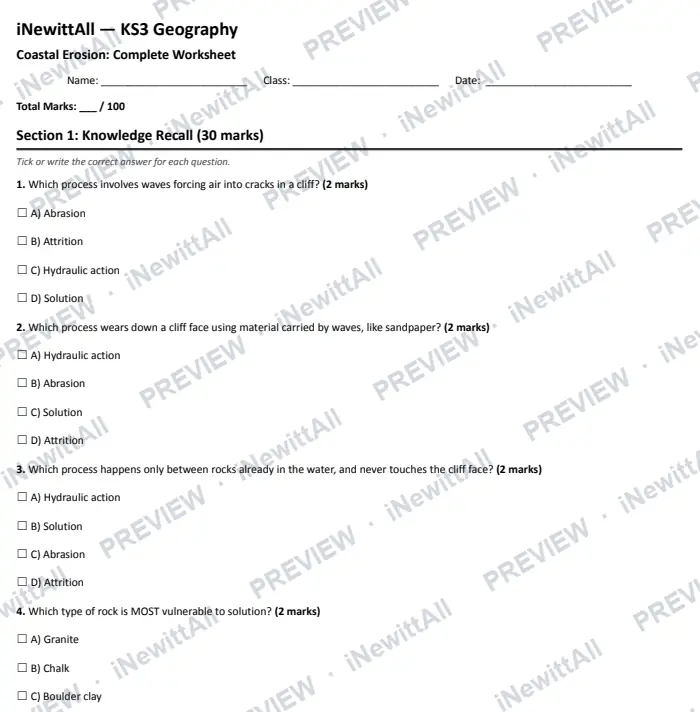
The top of page 1. The answer key is included when you buy.
£5 £6
The full worksheet and the extension pack together, with both answer keys.
Instant download with full answer keys. Print as many copies as your class needs.
£3
£3
£5 £6
Tick it off to track your progress. It's saved on this device. See my revision →
Students watch the video and do the quiz. They get a result card to paste back to you, showing their first try and best score.
This lesson's quiz questions on one sheet, with the answer key on page 2.
The quiz in big text for your classroom screen, one question at a time. Or build a 5-question Do Now starter from lessons your class has already done.
You're welcome to embed the video and link these resources in Google Classroom, Stile, Canvas, Compass or any other school platform. No need to ask.
Everything here is written to the KS3 curriculum for students aged 11–14. Print freely for the classes you teach.
More in this unit: Coasts
No spam, unsubscribe anytime. You must be 13 or over to sign up.