KS3 Geography › Coasts

KS3 Geography › Coasts
These are the points the worksheet questions are built around.
Nowhere in Britain is more than about 70 miles (112 kilometres) from the sea. A coastline is simply the boundary where solid ground meets the sea or ocean, but coastlines look very different depending on where you go. A beach is the area of land between the high tide mark and the low tide mark, and beaches can be made from different materials — golden sand, like in Cornwall or Devon, or shingle, smooth round pebbles and stones, like at Brighton. Other coastlines have no beach at all, instead featuring rocky outcrops or cliffs — steep rock faces worn back over thousands of years as waves erode their base, like the White Cliffs of Dover, which stand over 100 metres tall.
The UK is made up of Great Britain and the northern part of the island of Ireland, plus around 6,000 smaller islands, including the Shetlands, Orkneys, Isle of Wight, and Anglesey. It's surrounded by different bodies of water: the Atlantic Ocean to the west, the North Sea to the east, the Irish Sea between Britain and Ireland, and the English Channel to the south, connecting to France.
All of these islands add up to give the UK a remarkably long coastline — 12,429 kilometres in total. That's longer than Spain (4,964 km), France (3,427 km), and Italy (7,600 km) individually, largely because of all those islands, inlets, bays, and peninsulas, each adding a little more coastline.
Around 5.3 million people in England and Wales live in towns and villages along the coast. People choose to live there for several reasons: the natural beauty of ocean views and sunrises/sunsets; cleaner air from sea breezes, compared to inland cities; jobs created through tourism, since millions of visitors need hotels, restaurants, and shops; and the fishing industry — catching, processing, and selling fish and seafood — which has supported British coastal communities for centuries. Major fishing ports include Milford Haven in Wales, Newlyn in Cornwall, and Peterhead in Scotland.
Blackpool is a clear example of coastal tourism in action. It became popular during the Industrial Revolution in the 1800s, as workers sought a break from increasingly polluted, crowded cities. Blackpool Tower was built in 1894, modelled on the Eiffel Tower, and Britain's first electric tramway opened along its seafront in 1885 — trams that still run today. In 2022 alone, Blackpool received 22 million visitors, drawn by its long sandy beach, easy access by road and rail, plenty of accommodation, and attractions like the Pleasure Beach theme park and pier.
All of this tourist spending creates what's called the visitor economy — the overall financial boost and job creation that comes from money spent by tourists, supporting jobs in hotels, restaurants, transport, shops, and attractions right across a local community.
In short: the UK's coastline is remarkably varied and remarkably long, shaped by thousands of islands and surrounded by several distinct bodies of water. It supports two major industries — fishing and tourism — both of which provide jobs, income, and a reason for millions of people to live and work by the sea.
These are the words that appear as key term cards in the video — worth knowing cold before the test.
Short clips from this lesson. Good for a quick refresh before a test.
Revising for a test? Key terms, objectives and quiz questions on one printable page.
The 3 questions from the video, one at a time. See if you caught them.
1. Which of these is a natural material found on beaches?
Why: Sand and pebbles are natural materials, made when the sea and weather wear rocks down. Concrete, plastic and steel are made by people.
2. Which country has the LONGEST coastline?
Why: Out of these four countries the UK has the longest coastline. It is made up of thousands of islands, bays and inlets, and the more twists and turns there are, the longer the coast gets.
3. What are two main industries you'll find at the British coast?
Why: Fishing boats bring in fish from the sea, and visitors come to enjoy the beaches and seaside towns. Mining, farming, fashion and finance are mainly found inland.
Score: 0 out of 3 —
Want more practice? Try the 60-second Quiz Challenge →
This lesson is a level in our game Coasts
One page with a full answer key. Enough to check the lesson landed, and to see how the questions are written before you buy anything.
Get the free worksheet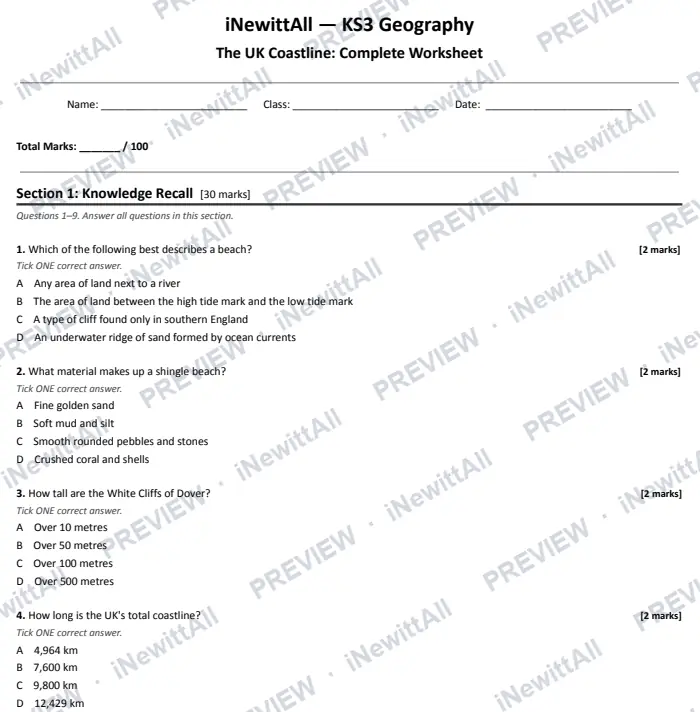
The top of page 1. The answer key is included when you buy.
£5 £6
The full worksheet and the extension pack together, with both answer keys.
Instant download with full answer keys. Print as many copies as your class needs.
£3
£3
£5 £6
Tick it off to track your progress. It's saved on this device. See my revision →
Students watch the video and do the quiz. They get a result card to paste back to you, showing their first try and best score.
This lesson's quiz questions on one sheet, with the answer key on page 2.
The quiz in big text for your classroom screen, one question at a time. Or build a 5-question Do Now starter from lessons your class has already done.
You're welcome to embed the video and link these resources in Google Classroom, Stile, Canvas, Compass or any other school platform. No need to ask.
Everything here is written to the KS3 curriculum for students aged 11–14. Print freely for the classes you teach.
No spam, unsubscribe anytime. You must be 13 or over to sign up.
