KS3 Geography › Coasts

KS3 Geography › Coasts
These are the points the worksheet questions are built around.
Waves and tides both involve moving seawater and both shape coastlines, but they're caused by completely different things.
Waves are the movement of energy across water, formed when wind blows across the surface of the sea or ocean, transferring energy into it. Without wind, there would be no waves at all — the sea would simply sit still.
Tides are the regular rise and fall of sea levels, happening about every 12 hours, twice a day, every day — regardless of whether it's windy, calm, or stormy. Tides have nothing to do with wind; they're caused by gravity, specifically the gravitational pull of the Moon. As the Moon orbits Earth, its gravity pulls on the ocean water, dragging it toward it and raising sea levels on the parts of Earth closest to the Moon — this is high tide, when water rises and covers the beach and shoreline. Low tide happens where the Moon's pull is weakest, as the water pulls back, the sea level drops, and features like rockpools (or even boats resting on mud) become visible.
Because tides are driven by predictable gravity rather than unpredictable wind, they follow a reliable pattern that can be forecast months in advance — unlike waves, which are far less predictable since they depend on the wind at any given moment.
Not all waves are the same size. Two things control this: the strength of the wind, and the fetch — the distance a wave has travelled across open water before reaching the shore. The greater the fetch, the bigger the wave, since it's had more distance to pick up energy. A wave that's travelled 8,000 kilometres across the open Atlantic will hit the shore far harder than one that's only travelled 200 kilometres across a small stretch of water, which is why some beaches face much bigger waves than others.
When a wave breaks on a beach, water rushes up the beach toward the land — this is called the swash. Gravity then pulls that water back down toward the sea, called the backwash. Every wave does both, but not equally.
Constructive waves have a strong swash and a weak backwash, meaning more material gets pushed up the beach than gets dragged back down. Over time, this deposits sand and sediment, building beaches up wider and larger. Destructive waves are the opposite: a weak swash paired with a very strong backwash means more material is dragged away than is pushed up, causing erosion and, over time, wearing beaches away or undercutting cliffs.
In short: waves are caused by wind and vary in size depending on wind strength and fetch, while tides are caused by the Moon's gravity and follow a predictable cycle of roughly 12 hours regardless of wind. When waves reach the shore, the balance between swash and backwash determines whether a beach builds up (constructive waves) or gets worn away (destructive waves).
These are the words that appear as key term cards in the video — worth knowing cold before the test.
Short clips from this lesson. Good for a quick refresh before a test.
Swipe sideways to see more →
Revising for a test? Key terms, objectives and quiz questions on one printable page.
The 3 questions from the video, one at a time. See if you caught them.
1. What causes tides?
Why: Tides are caused by the Moon's gravity pulling on the sea. Wind is what makes waves.
2. Which wind creates the largest waves?
Why: Fetch is how far the wind has blown across open water. Wind A has a fetch of 8,000 km, much longer than Wind B's 200 km, so it has more time to build big waves.
3. A beach is slowly getting wider — which wave type is responsible?
Why: Constructive waves have a strong swash and a weak backwash. They carry material up the beach and leave it there, so the beach gets wider. Destructive waves wear it away.
Score: 0 out of 3 —
Want more practice? Try the 60-second Quiz Challenge →
This lesson is a level in our game Coasts
One page with a full answer key. Enough to check the lesson landed, and to see how the questions are written before you buy anything.
Get the free worksheet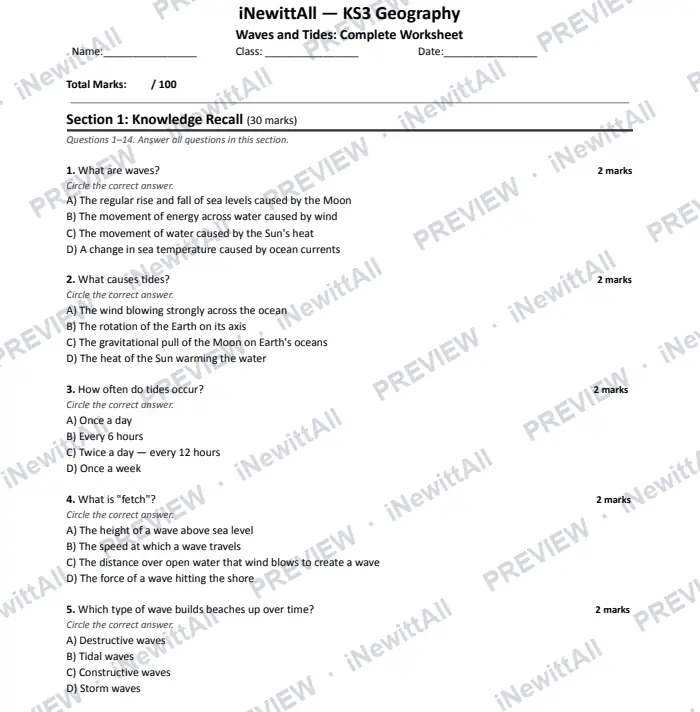
The top of page 1. The answer key is included when you buy.
£5 £6
The full worksheet and the extension pack together, with both answer keys.
Instant download with full answer keys. Print as many copies as your class needs.
£3
£3
£5 £6
Tick it off to track your progress. It's saved on this device. See my revision →
Students watch the video and do the quiz. They get a result card to paste back to you, showing their first try and best score.
This lesson's quiz questions on one sheet, with the answer key on page 2.
The quiz in big text for your classroom screen, one question at a time. Or build a 5-question Do Now starter from lessons your class has already done.
You're welcome to embed the video and link these resources in Google Classroom, Stile, Canvas, Compass or any other school platform. No need to ask.
Everything here is written to the KS3 curriculum for students aged 11–14. Print freely for the classes you teach.
No spam, unsubscribe anytime. You must be 13 or over to sign up.
