KS3 Geography › Natural resources

KS3 Geography › Natural resources
These are the points the worksheet questions are built around.
Energy use is far from equal around the world. In Chad, a country in the middle of Africa, the average person uses only around twenty kilowatt hours of electricity in a year. A single UK fridge gets through well over a hundred kilowatt hours in the same time. Explaining that gap starts with where electricity comes from.
Electricity is a form of energy, carried through wires by tiny charged particles on the move. It has to be made from an energy resource, and every energy resource belongs to one of two groups. Renewable resources, such as sunlight and wind, are topped up by nature over a short time, so they will not run out. Non-renewable resources, such as coal, took millions of years to form, and once they have been used they cannot be replaced quickly.
The solar panels seen on rooftops are photovoltaic panels, which change light from the Sun directly into electricity and have no moving parts. A second type of solar panel works differently: it uses the Sun's heat to warm liquid in pipes, giving a home hot water, and makes no electricity at all. Wind and water rely on turbines. Wind pushes a turbine's blades round, while in a hydroelectric power station it is flowing water that spins the turbine. In both cases the spinning turbine drives a generator, and the generator is what makes the electricity. The electricity then travels along the national grid, a network of cables and transformers that delivers power to homes and buildings.
Much of the world's electricity comes from fossil fuels: coal, oil and natural gas. These formed from the remains of living things from long ago. Coal comes mostly from ancient plants that grew on land, while oil and gas come from tiny plants and animals that lived in ancient seas. Buried beneath layer upon layer of mud and rock, those remains were slowly changed into fuel by heat and pressure. In a coal power station, the coal is burned to boil water, the steam spins a turbine, and a generator produces the electricity. Burning them releases carbon dioxide, a greenhouse gas that traps heat in the atmosphere and adds to global warming. The UK closed its last coal power station in 2024, yet coal still produces just over a third of all the electricity on Earth.
Oil is mostly refined into petrol and diesel for cars, buses and lorries, and natural gas is piped into homes, where most households in England and Wales burn it in a boiler to heat their radiators. Nuclear power does not fit neatly into either group. Nuclear power stations use a fuel called uranium and release energy by splitting its atoms apart, a process known as nuclear fission. The heat boils water into steam, which spins a turbine just as in a coal power station. Because nuclear power is so low in carbon, many people assume it is renewable, but it is not: uranium is mined from the ground and only a limited amount exists. It is not a fossil fuel either, since it does not come from ancient living things, and the splitting of the atoms itself gives off no carbon dioxide.
A map of energy use per person shows some countries using many times more than others. The United States, for example, is home to about four percent of the world's people but uses about sixteen percent of the world's energy. More developed countries use more energy, because energy powers factories, transport, technology, lighting, and the heating and cooling of buildings. Geographers measure development with the Human Development Index, a score from zero to one based on how long people live, how long they spend in education and how much income they have. Maps of the Human Development Index and of energy use match surprisingly well. The match is not perfect, but without energy, development itself becomes much harder.
Around seven hundred and thirty million people in the world have no electricity at home, and about eight in ten of them live in sub-Saharan Africa. In Chad, most people have no electricity at home, which is why the average is so low: it is not that people there choose to use less, but that most have none to use. Life without power means no electric light for homework after dark, nothing to keep food, medicines or vaccines cold, and far more difficulty running a shop, business or clinic. Many families depend on fuelwood instead. More than two billion people around the world still cook on open fires or simple stoves, burning wood, charcoal, crop waste or dung. The smoke from cooking with these fuels is linked to millions of deaths every year, and fires in the home also bring a real risk of burns.
In short: the average person in Chad uses less electricity than a UK fridge because most people there have no electricity at all, and how much energy a country can access is closely linked to how developed it is. Renewable resources such as solar, wind and hydroelectric power will not run out, while non-renewable resources took millions of years to form and will. Burning fossil fuels releases carbon dioxide, and nuclear power is non-renewable but not a fossil fuel. Meanwhile, millions of families still rely on fuelwood.
These are the words that appear as key term cards in the video — worth knowing cold before the test.
Revising for a test? Key terms, objectives and quiz questions on one printable page.
The 3 questions from the video, one at a time. See if you caught them.
1. Photovoltaic solar panels turn which of these into electricity?
Why: Photovoltaic panels turn light into electricity, not heat.
2. Which of these is NOT a fossil fuel?
Why: Uranium is a nuclear fuel mined from rock, not formed from ancient living things.
3. About 4% of people live in the United States. What share of energy do they use?
Why: The United States uses about 16% of the world's energy, around four times its share of people.
Score: 0 out of 3 —
Want more practice? Try the 60-second Quiz Challenge →
One page with a full answer key. Enough to check the lesson landed, and to see how the questions are written before you buy anything.
Get the free worksheet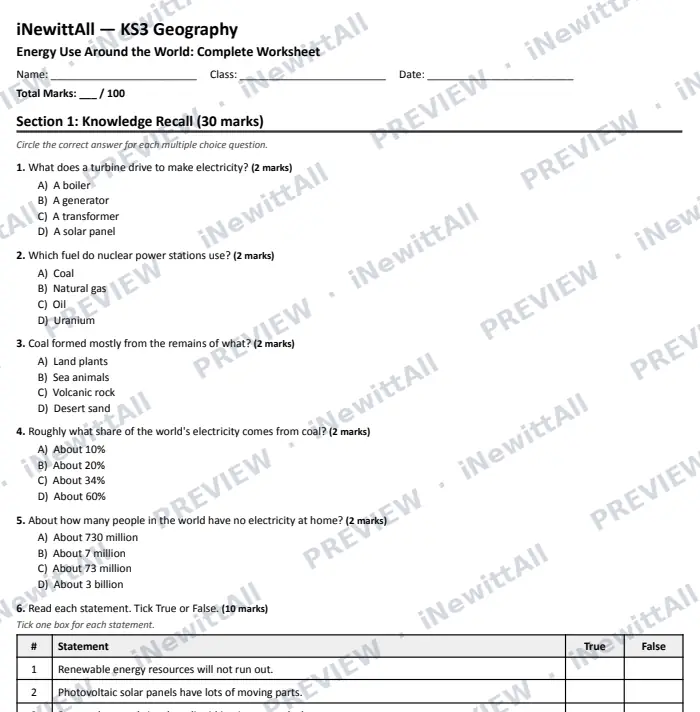
The top of page 1. The answer key is included when you buy.
£5 £6
The full worksheet and the extension pack together, with both answer keys.
Instant download with full answer keys. Print as many copies as your class needs.
£3
£3
£5 £6
Tick it off to track your progress. It's saved on this device. See my revision →
Students watch the video and do the quiz. They get a result card to paste back to you, showing their first try and best score.
This lesson's quiz questions on one sheet, with the answer key on page 2.
The quiz in big text for your classroom screen, one question at a time. Or build a 5-question Do Now starter from lessons your class has already done.
You're welcome to embed the video and link these resources in Google Classroom, Stile, Canvas, Compass or any other school platform. No need to ask.
Everything here is written to the KS3 curriculum for students aged 11–14. Print freely for the classes you teach.
More in this unit: Natural resources
No spam, unsubscribe anytime. You must be 13 or over to sign up.