KS3 Geography › Global inequalities and development

KS3 Geography › Global inequalities and development
These are the points the worksheet questions are built around.
Tourism is travel away from home for pleasure, not for work and not out of necessity, and it's one of the biggest industries on the planet. In a single year, the UK's tourism industry was worth almost £127 billion — nearly a tenth of everything the country earned — and supported more than 3 million jobs. For lower-income countries especially, tourism can be one of their single biggest sources of income.
There are two main types of tourism. International tourism is when people travel to other countries, while domestic tourism means travelling to places within your own country. A handful of countries consistently attract the most international tourists: France, Spain, the United States, China, Italy and Turkey. People travel for different reasons — some are drawn to cities for their history, culture and landmarks (like the crowds visiting the Eiffel Tower in Paris), while others are drawn to the physical environment, with coastlines being some of the most popular destinations for swimming, sunbathing and water sports. Popularity can also be revived: the seaside town of Margate had faded for years until a famous amusement park reopened and brought the crowds back.
Tourism wasn't always this big. Back in the 1950s, far fewer people went on holiday. Several changes arrived at once to change that: technology made travel faster, easier and cheaper; the internet made booking a holiday possible from home in minutes; improved workers' rights meant more people got paid time off; households had more spare money as families got smaller and more had two incomes; and media — television, magazines and advertising — constantly showed people beautiful, far-off places, creating the desire to visit them.
Almost every tourist destination follows the same pattern of rising, peaking, and then either declining or reinventing itself — a pattern captured by Richard Butler's tourism life cycle model, a simplified framework with seven stages. In the exploration stage, only a few adventurous visitors discover a place. In the involvement stage, locals start opening up to tourists. In the development stage, hotels, restaurants and big attractions appear, and visitor numbers shoot up. In the consolidation stage, tourism becomes the heart of the local economy. In the stagnation stage, visitor numbers stop growing and the place starts to feel tired and overcrowded. From there, a destination reaches a fork: either the decline stage, where visitors drift away to fresher destinations, or the rejuvenation stage, where the resort invests and reinvents itself to win crowds back.
Blackpool, a seaside town in north-west England, shows this cycle playing out in real life. It began with exploration, as fresh sea air and a long sandy beach drew visitors in. Development followed in the later 1800s, after the railway arrived in 1846, with hotels and grand attractions like the Winter Gardens (1878) appearing, making Blackpool one of Britain's favourite holiday spots. Decline set in once cheap package holidays abroad made guaranteed sunshine in places like Spain easily accessible, pulling crowds away from the British seaside. Blackpool's response was rejuvenation: in the year 2000, a £300 million regeneration project was launched to bring visitors back.
In short: tourism is travel for pleasure, split into international and domestic types, and it's grown enormously since the 1950s due to cheaper travel, the internet, paid holidays, more spare money, and media exposure. Nearly every destination follows Butler's seven-stage life cycle model, and Blackpool is a clear real-world example of a resort moving through exploration, development, decline, and ultimately rejuvenation.
These are the words that appear as key term cards in the video — worth knowing cold before the test.
Short clips from this lesson. Good for a quick refresh before a test.
Swipe sideways to see more →
Revising for a test? Key terms, objectives and quiz questions on one printable page.
The 3 questions from the video, one at a time. See if you caught them.
1. What does domestic tourism mean?
Why: Domestic tourism is when people take holidays in their own country. Visiting other countries is international tourism.
2. Which of these is NOT a reason tourism has grown since the 1950s?
Why: Tourism grew because travel got cheaper, the internet made booking easier and workers got paid holidays. A fall in wages would leave people with less money to spend, not more.
3. A resort is in decline. What does Butler's model say can happen?
Why: In Butler's model a resort can rejuvenate. It invests in new attractions or ideas, attracts visitors again and starts a new cycle of growth.
Score: 0 out of 3 —
Want more practice? Try the 60-second Quiz Challenge →
One page with a full answer key. Enough to check the lesson landed, and to see how the questions are written before you buy anything.
Get the free worksheet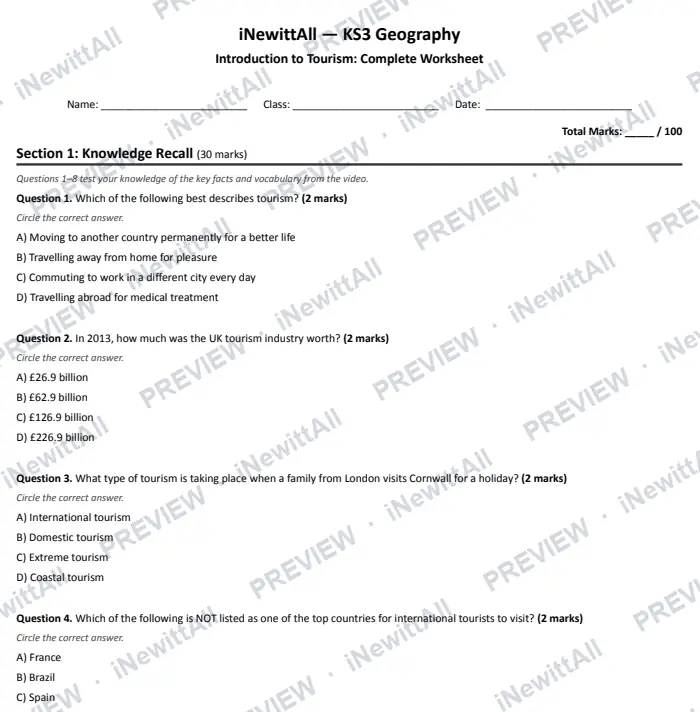
The top of page 1. The answer key is included when you buy.
£5 £6
The full worksheet and the extension pack together, with both answer keys.
Instant download with full answer keys. Print as many copies as your class needs.
£3
£3
£5 £6
Tick it off to track your progress. It's saved on this device. See my revision →
Students watch the video and do the quiz. They get a result card to paste back to you, showing their first try and best score.
This lesson's quiz questions on one sheet, with the answer key on page 2.
The quiz in big text for your classroom screen, one question at a time. Or build a 5-question Do Now starter from lessons your class has already done.
You're welcome to embed the video and link these resources in Google Classroom, Stile, Canvas, Compass or any other school platform. No need to ask.
Everything here is written to the KS3 curriculum for students aged 11–14. Print freely for the classes you teach.
 Next lessonTypes of Industry
More in this unit: Global inequalities and development
No spam, unsubscribe anytime. You must be 13 or over to sign up.