KS3 Geography › Forest biomes

KS3 Geography › Forest biomes
These are the points the worksheet questions are built around.
Forests matter for four main reasons. First, they provide habitats — the natural home of an animal, plant, or other living thing. Just ten square kilometres of tropical rainforest can support over 400 different species of birds alone, showing how much wildlife forests can pack in.
Second, forests help reduce global warming. During photosynthesis, tree leaves take in carbon dioxide from the air, and the carbon gets stored inside the tree while oxygen is released back into the atmosphere. Since human activity produces huge amounts of carbon dioxide that contributes to climate change, this carbon storage helps reduce the amount of CO2 in the atmosphere and slows global warming.
Third, forests are useful for humans directly. They provide food, medicines, and building materials, and they're used for recreation like walking, cycling, and horse riding. Spending time in forests has also been shown to improve both physical and mental health.
Fourth, forests help prevent flooding. When rain falls, leaves and branches get in the way of the raindrops, slowing the water down in a process called interception, and roots help the water soak into the soil. This means rainwater takes longer to reach rivers, making rivers less likely to overflow — fewer floods overall.
There are three main types of forest, each shaped by its climate and location. Tropical rainforests are found between the Tropic of Cancer and the Tropic of Capricorn, where it's hot all year round with heavy rainfall, producing tall trees and thick, permanently green forest. They're found across five continents — South America, Africa, Asia, Oceania, and parts of North America — with the Amazon rainforest and the rainforests of Southeast Asia among the most famous examples.
Temperate forests sit between the tropics and the polar regions, including the UK. Unlike tropical rainforests, temperate forests experience distinct seasons, and many trees drop their leaves in winter, although some stay green year-round.
Boreal forests, also called taiga, are found in cold regions further towards the poles — Northern Canada, Russia, Scandinavia, and parts of Alaska. They exist exclusively in the Northern Hemisphere, simply because there isn't enough land at the right latitude in the Southern Hemisphere. Most boreal trees are evergreen, keeping their leaves all year even through freezing cold winters.
Travelling from the equator toward the North Pole, you'd pass through the three forest types in order: tropical rainforest closest to the equator, then temperate forest, and finally boreal forest nearest the poles.
In short: forests provide habitats, store carbon to help slow global warming, offer resources and health benefits to people, and prevent flooding through interception. The three main forest types — tropical, temperate, and boreal — each occupy a distinct band of the world, determined by how close they are to the equator and the climate that comes with it.
These are the words that appear as key term cards in the video — worth knowing cold before the test.
Short clips from this lesson. Good for a quick refresh before a test.
Swipe sideways to see more →
Revising for a test? Key terms, objectives and quiz questions on one printable page.
The 3 questions from the video, one at a time. See if you caught them.
1. During photosynthesis, what do trees store inside them?
Why: Trees take in carbon dioxide during photosynthesis and use the carbon to make glucose and build wood. That stores carbon inside them, and they release the oxygen.
2. Where exactly are tropical rainforests located?
Why: Tropical rainforests grow in the hot, wet parts of the world between the Tropics, on either side of the equator.
3. If you walked from the equator to the North Pole, what order would you pass through forests?
Why: It's hottest at the equator, so you would start in tropical forest. As it gets cooler moving north you would pass through temperate forest, then very cold boreal forest.
Score: 0 out of 3 —
Want more practice? Try the 60-second Quiz Challenge →
One page with a full answer key. Enough to check the lesson landed, and to see how the questions are written before you buy anything.
Get the free worksheet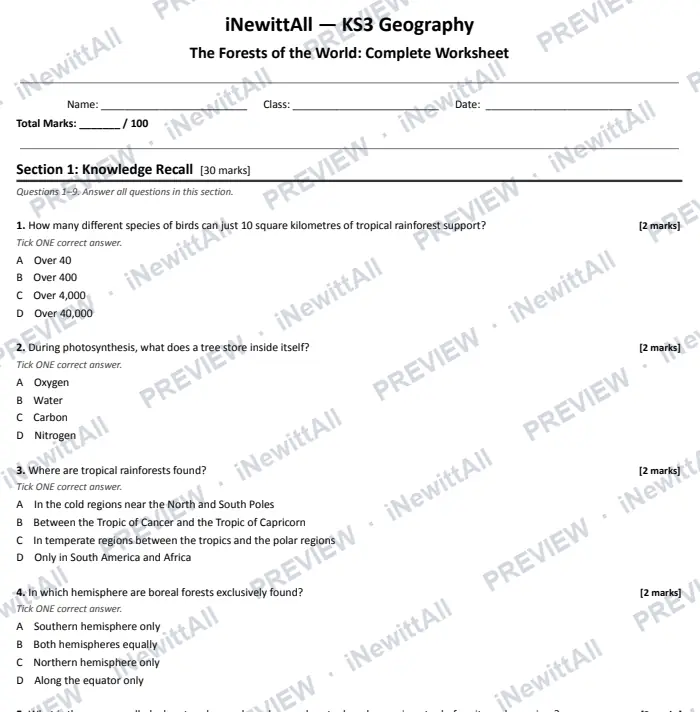
The top of page 1. The answer key is included when you buy.
£5 £6
The full worksheet and the extension pack together, with both answer keys.
Instant download with full answer keys. Print as many copies as your class needs.
£3
£3
£5 £6
Tick it off to track your progress. It's saved on this device. See my revision →
Students watch the video and do the quiz. They get a result card to paste back to you, showing their first try and best score.
This lesson's quiz questions on one sheet, with the answer key on page 2.
The quiz in big text for your classroom screen, one question at a time. Or build a 5-question Do Now starter from lessons your class has already done.
You're welcome to embed the video and link these resources in Google Classroom, Stile, Canvas, Compass or any other school platform. No need to ask.
Everything here is written to the KS3 curriculum for students aged 11–14. Print freely for the classes you teach.
No spam, unsubscribe anytime. You must be 13 or over to sign up.
