KS3 Geography › Forest biomes: why are forests so important?

KS3 Geography › Forest biomes: why are forests so important?
These are the points the worksheet questions are built around.
Only around six percent of the Earth's land is covered by tropical rainforest, but this small share supports about half of all plant and animal species worldwide. Two things account for such richness: the location of these forests, and the climate that goes with that location.
A tropical rainforest counts as a biome, meaning a large region in which the places share a similar climate, vegetation and wildlife. Climate should be kept distinct from weather: weather describes a single day, whereas climate is the typical weather of a place averaged across at least thirty years.
These forests form a belt around the middle of the globe, centred on the Equator, the imaginary line of latitude that circles the planet where it is widest. A second line, the Tropic of Cancer, runs to the north and a third, the Tropic of Capricorn, to the south; the zone between them is called the tropics, and tropical rainforest is found there. The Amazon in South America is by far the largest example. Others grow in Africa, Asia and Oceania, and in North America, chiefly Central America, which brings the total to five continents.
The heat at the Equator is explained by the Earth's curved surface, which means sunlight does not strike every place alike. A torch makes the point: held straight above a table it produces a small, intense circle of light, but tilted, the identical beam smears across a larger, dimmer area. At the Equator the Sun sits almost directly overhead, so the energy it delivers, called solar radiation, lands on a compact area. Towards the poles that same energy is dispersed over a far bigger area, which is why the tropics are warm throughout the year.
Manaus, a city in the heart of the Amazon, illustrates the resulting climate. Temperatures there average about twenty-seven degrees in each month, which exceeds a typical British summer's day, so winter simply does not occur. Rainfall totals more than two thousand millimetres a year, about twice the UK figure, and while a few months are wetter than the rest, heavy rain is a feature of every part of the year.
Rain is often associated with cold, grey weather, such as a British winter, yet in the rainforest warmth is what creates it. Strong sun drives huge quantities of water off the ground, rivers and trees as vapour. Warm, moist air then climbs, and as it rises it cools, so the vapour turns into tiny droplets that pile up into towering clouds and fall as downpours. This sequence is called convectional rainfall, and the hotter conditions become, the heavier the rain.
Plants need water and sunlight, and the rainforest provides both throughout the year because winter never interrupts growth. Vegetation therefore flourishes, producing a very dense forest that offers shelter and food to millions of species, from mammals, reptiles and insects to amphibians, fish and birds, as well as to people. The chain can be summarised as heat and heavy rain, then thriving plants, then dense forest, then habitats for huge numbers of species.
The forest is arranged in four layers, comparable to the storeys of a building. Starting at the base these are the forest floor, the understory, the canopy and, right at the summit, the emergent layer.
A small number of giant trees thrusting up beyond the forest roof make up the emergent layer. They reach such heights because they are competing for sunlight; sitting above the rest gives them the greatest amount of light for photosynthesis. The drawback is exposure to powerful winds and the sun's full heat, which explains why these trees are few and widely spaced. The record tree measured in the Amazon stands about 88.5 metres, similar to twenty double-decker buses piled on top of one another.
Beneath it is the canopy, roughly thirty metres above the ground, a dense, interwoven roof of leaves and branches. It is the busiest layer of the forest. Most of the foliage, fruit and nuts are produced here, which attracts most of the forest's animals, including birds, insects, monkeys and sloths, which may spend nearly all of their lives in it. So thick is the roof that rainwater may need about ten minutes to filter down to the ground.
Below that, the understory extends to around twenty metres. With the canopy blocking most sunlight, it stays surprisingly dark even at midday, and the small plants and young trees living there grow slowly as they wait for an opening to appear overhead.
The forest floor is blanketed with fallen leaves, known as leaf litter, and supports a vast population of decomposers, termites among them. These organisms break dead leaves down and turn them back into nutrients. The hot, wet conditions make the process quick, and the trees reabsorb the nutrients almost at once, leaving most of the goodness concentrated in the uppermost layer of soil.
In short: tropical rainforests are found on and around the Equator, within the zone bordered by the two tropic lines. Concentrated sunlight keeps the area hot all year, and the heat produces heavy convectional rain. Warmth and water allow plants to thrive, giving a dense forest with habitats for millions of species, arranged from top to bottom as emergent layer, canopy, understory and forest floor.
These are the words that appear as key term cards in the video — worth knowing cold before the test.
Revising for a test? Key terms, objectives and quiz questions on one printable page.
The 3 questions from the video, one at a time. See if you caught them.
1. Which of these continents has NO tropical rainforest?
Why: Europe sits too far north of the Equator, so it never gets hot enough for tropical rainforest.
2. How tall is the tallest tree ever measured in the Amazon?
Why: Emergent trees grow this tall to reach the sunlight above the rest of the forest.
3. What causes most of the rainforest's heavy rain?
Why: Heat evaporates lots of water, which rises, cools and condenses into rain clouds.
Score: 0 out of 3 —
Want more practice? Try the 60-second Quiz Challenge →
One page with a full answer key. Enough to check the lesson landed, and to see how the questions are written before you buy anything.
Get the free worksheet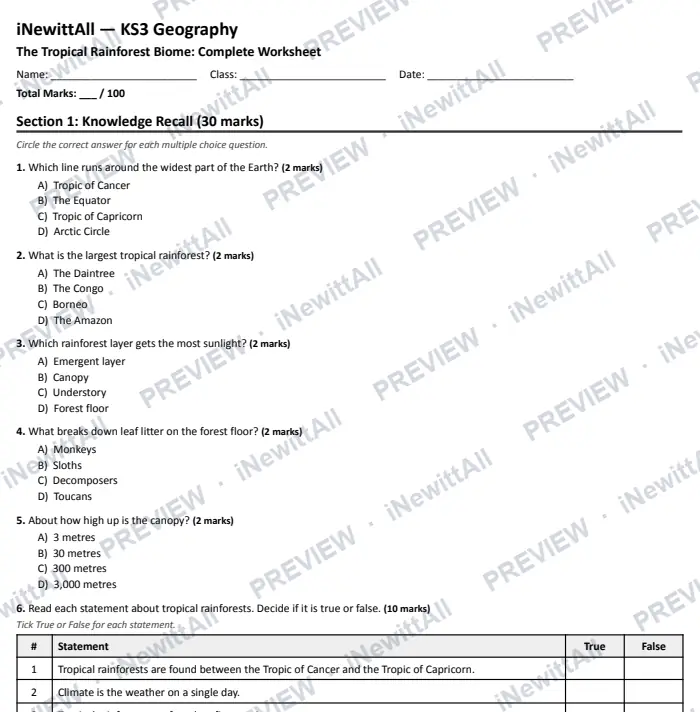
The top of page 1. The answer key is included when you buy.
£5 £6
The full worksheet and the extension pack together, with both answer keys.
Instant download with full answer keys. Print as many copies as your class needs.
£3
£3
£5 £6
Tick it off to track your progress. It's saved on this device.
You're welcome to embed the video and link these resources in Google Classroom, Stile, Canvas, Compass or any other school platform. No need to ask.
Everything here is written to the KS3 curriculum for students aged 11–14. Print freely for the classes you teach.
More in this unit: Forest biomes: why are forests so important?
No spam, unsubscribe anytime.