KS3 Geography › Rivers

KS3 Geography › Rivers
These are the points the worksheet questions are built around.
The hydrological cycle is the continuous movement of water between the ocean, land, rivers, and atmosphere, driven by two forces: the sun, which heats water and causes evaporation, and gravity, which pulls water back down to Earth. Globally, the cycle is a closed system — no new water ever enters it and none ever leaves. All the water on Earth today has always been here; it simply keeps moving, meaning the water in your glass could once have been part of a prehistoric ocean or glacier.
Water is stored in several places, in very different amounts. The oceans hold by far the most, around 97%. Ice caps and glaciers hold about 2.1%. Land — both rivers and lakes above ground, and groundwater below — holds around 0.9%. The atmosphere holds a tiny 0.001% at any given time. Since ocean water is salty, that 0.9% stored on land is essentially all that's accessible for drinking, farming, and everyday life.
Water moves between these stores through several transfers. Evaporation happens when the sun heats water on the ocean or land surface, turning it into water vapour that rises into the atmosphere — the warmer it is, the more evaporation occurs. As that vapour cools in the atmosphere, it turns back into liquid droplets through condensation. Once those droplets become too heavy to stay airborne, they fall back to Earth as precipitation — rain, snow, sleet, or hail. Water also moves from ice caps and glaciers into rivers and lakes through melting, and surface water eventually flows back to the ocean via rivers, completing the cycle.
Zooming into a smaller area reveals the local hydrological cycle — how water moves within a drainage basin, a smaller area of land that drains into a single river. Unlike the global cycle, the local cycle is an open system: water enters through precipitation and leaves through rivers flowing out to sea.
When precipitation falls, it takes several possible routes. Some lands on vegetation — leaves, branches, trees — and is caught before reaching the ground at all, a process called interception. Some of that intercepted water then evaporates straight back off the leaves, meaning less water ever reaches the ground, which matters for flooding. Plants also give off water vapour drawn up from their roots, through their leaves — this is transpiration.
Water that does reach the ground can either flow across the surface as surface runoff, heading downhill toward rivers, or soak into the soil through infiltration. Once infiltrated, water can flow slowly through the soil downhill as throughflow, or sink even deeper into the rock below through percolation. Once it reaches that deeper rock layer, it becomes groundwater, either stored underground or slowly moving through the rock as groundwater flow, eventually making its way back to a river or the sea.
This is also why planting trees can help reduce flooding: interception catches rainfall on leaves and branches, reducing how much water reaches the ground and, eventually, the rivers.
In short: the hydrological cycle moves water continuously around the planet, and globally it's a closed system — the same water recycled for millions of years, mostly stored in the oceans. Transfers like evaporation, condensation, precipitation, and melting move water between stores, while at a local level, water takes varied routes through a drainage basin — interception, surface runoff, infiltration, throughflow, and percolation — all eventually leading back to the sea.
These are the words that appear as key term cards in the video — worth knowing cold before the test.
Short clips from this lesson. Good for a quick refresh before a test.
Swipe sideways to see more →
Revising for a test? Key terms, objectives and quiz questions on one printable page.
The 3 questions from the video, one at a time. See if you caught them.
1. Is the global hydrological cycle an open system or a closed system?
Why: A closed system has nothing going in or out. The global water cycle is closed, because the same water keeps going round and round.
2. What do we call the process where water turns from a liquid into a gas due to heat?
Why: Evaporation is when heat turns liquid water into a gas, called water vapour. Condensation is the opposite, when vapour turns back into liquid.
3. When precipitation lands on vegetation and is caught before reaching the ground, what is this process called?
Why: Interception is when rain lands on leaves and branches instead of reaching the ground. It slows down how fast the water gets to the soil and rivers.
Score: 0 out of 3 —
Want more practice? Try the 60-second Quiz Challenge →
One page with a full answer key. Enough to check the lesson landed, and to see how the questions are written before you buy anything.
Get the free worksheet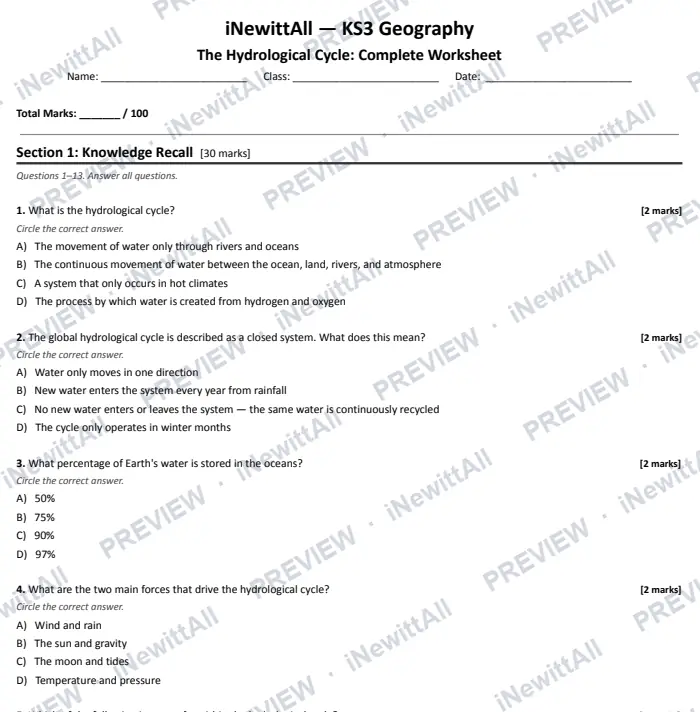
The top of page 1. The answer key is included when you buy.
£5 £6
The full worksheet and the extension pack together, with both answer keys.
Instant download with full answer keys. Print as many copies as your class needs.
£3
£3
£5 £6
Tick it off to track your progress. It's saved on this device. See my revision →
Students watch the video and do the quiz. They get a result card to paste back to you, showing their first try and best score.
This lesson's quiz questions on one sheet, with the answer key on page 2.
The quiz in big text for your classroom screen, one question at a time. Or build a 5-question Do Now starter from lessons your class has already done.
You're welcome to embed the video and link these resources in Google Classroom, Stile, Canvas, Compass or any other school platform. No need to ask.
Everything here is written to the KS3 curriculum for students aged 11–14. Print freely for the classes you teach.
No spam, unsubscribe anytime. You must be 13 or over to sign up.
