KS3 Geography › Weather and climate

KS3 Geography › Weather and climate
These are the points the worksheet questions are built around.
Climate zones are huge bands of the planet that all share roughly the same long-term climate, which is why a rainforest in Brazil and one in central Africa feel almost identical despite being thousands of miles apart. Climate itself is different from weather: weather is what's happening outside right now, while climate is the average of that weather over a long period, usually around 30 years, and it's mainly described using temperature and precipitation.
Mapped across the globe, climate zones form neat belts running east to west, mirroring each other above and below the Equator. There are four main zones. The equatorial zone sits right along the Equator, hot and wet, home to the great tropical rainforests. Just outside it lies the tropical and desert zone, still hot but bone dry, home to the world's biggest deserts. Further out is the temperate zone, mild and damp — where the UK sits. At the very top and bottom, near the poles, lies the polar zone, cold and dry.
This pattern exists because of latitude and the shape of the planet. Since Earth is a sphere, sunlight strikes the Equator almost directly, concentrating its energy on a smaller area, while it hits the poles at a much shallower angle, spreading the same energy over a far wider area — similar to shining a torch straight at a wall versus tilting it to create a fainter, wider smudge. This is why temperature generally decreases the further you travel from the Equator, and it's also why geographers group the world into three broad temperature bands — tropical, temperate, and polar — that line up closely with the four climate zones.
Latitude isn't the only factor, though. Altitude — height above sea level — matters too: temperature drops by roughly 1°C for every 100 metres climbed, which is why even mountains sitting right on the Equator can have snowy peaks. Mount Everest shows this clearly: its foot sits around -17°C, while its summit plunges to roughly -37°C.
Distance from the sea also plays a role, and not in the way most people expect. Water heats up and cools down slowly, acting like a giant storage heater that keeps nearby coastal land milder through winter, while places deep inland miss out on that effect and experience harsher winters.
Ocean currents add a further layer. These enormous moving rivers of water shift heat around the planet: warm currents bring milder air and extra rainfall to the coasts they pass, while cold currents bring cooler, drier air — a cold current along south-west Africa, for example, helps create a coastal desert by removing moisture from the air before it reaches land.
All of this explains why two places at a similar latitude can have very different climates. Glasgow and Moscow sit on almost the same line of latitude, yet Glasgow's winters are noticeably milder, because it sits beside the sea and is warmed by the North Atlantic Drift, a warm ocean current — while Moscow, stranded deep inland with no ocean nearby, has nothing to soften its cold winters.
In short: climate zones form because latitude determines how directly sunlight strikes different parts of the globe, creating a clear pattern of belts running from the Equator to the poles. Altitude, distance from the sea, and ocean currents then fine-tune that pattern further, which is why climate can vary so much even between places that share the same latitude.
These are the words that appear as key term cards in the video — worth knowing cold before the test.
Short clips from this lesson. Good for a quick refresh before a test.
Swipe sideways to see more →
Revising for a test? Key terms, objectives and quiz questions on one printable page.
The 3 questions from the video, one at a time. See if you caught them.
1. Why is it hotter at the Equator than at the Poles?
Why: Near the Equator sunlight hits the Earth almost straight on, so its energy is concentrated on a smaller area. Near the Poles the same sunlight is spread over a much bigger area, so it heats less.
2. What happens to temperature as you climb higher up a mountain?
Why: Air gets thinner and colder the higher you go. So the temperature falls as you climb a mountain.
3. Why are Glasgow's winters milder than Moscow's?
Why: Glasgow is near the sea and gets warm water from the North Atlantic Drift, which keeps its winters mild. Moscow is far from the sea, so its winters are much colder.
Score: 0 out of 3 —
Want more practice? Try the 60-second Quiz Challenge →
One page with a full answer key. Enough to check the lesson landed, and to see how the questions are written before you buy anything.
Get the free worksheet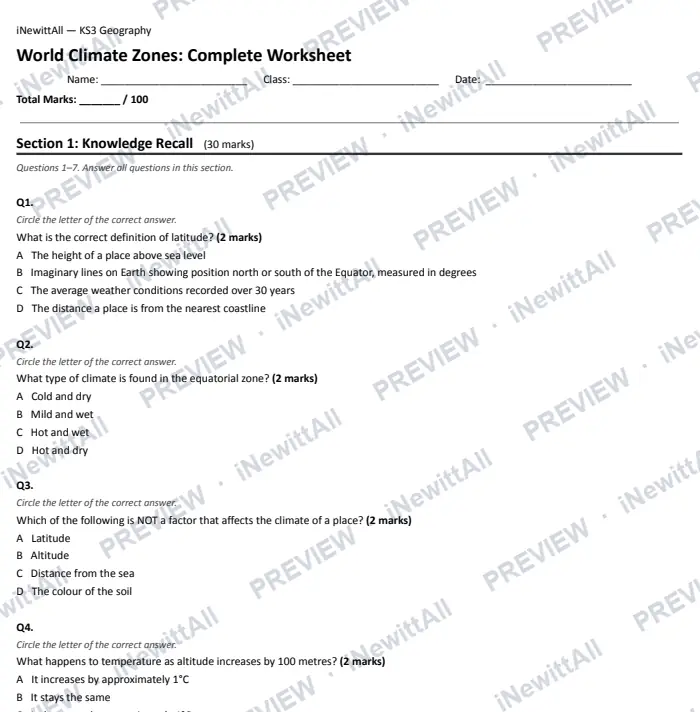
The top of page 1. The answer key is included when you buy.
£5 £6
The full worksheet and the extension pack together, with both answer keys.
Instant download with full answer keys. Print as many copies as your class needs.
£3
£3
£5 £6
Tick it off to track your progress. It's saved on this device. See my revision →
Students watch the video and do the quiz. They get a result card to paste back to you, showing their first try and best score.
This lesson's quiz questions on one sheet, with the answer key on page 2.
The quiz in big text for your classroom screen, one question at a time. Or build a 5-question Do Now starter from lessons your class has already done.
You're welcome to embed the video and link these resources in Google Classroom, Stile, Canvas, Compass or any other school platform. No need to ask.
Everything here is written to the KS3 curriculum for students aged 11–14. Print freely for the classes you teach.
 Next lessonThe UK's Climate
More in this unit: Weather and climate
No spam, unsubscribe anytime. You must be 13 or over to sign up.