KS3 Biology › Ecosystems

KS3 Biology › Ecosystems
These are the points the worksheet questions are built around.
All food can be traced back to sunlight. A bacon sandwich, for example, comes from a pig that ate crops, and those crops grew by capturing light from the Sun. A food chain is a way of showing that link from one living thing to the next, and it is built from the bottom up.
Every living thing needs food, because food is the fuel cells use to release energy for moving, growing and staying alive. There are two very different ways of getting it. Plants make their own. A plant works rather like a small factory: it takes in light from the Sun, water from the soil and carbon dioxide from the air, and converts them into food. This process is called photosynthesis, and any organism that makes its own food in this way is called a producer. Grass, wheat, cabbages and trees are all producers. Surprisingly, about half of all the food made by producers on Earth does not come from land plants at all but from algae — tiny living things drifting in the oceans, most of them too small to see without a microscope. Algae are where most food chains in the sea begin.
Animals cannot make food for themselves. A cow standing in sunshine all day would never produce a single mouthful of its own food, so animals must eat other living things instead. An organism that gets its food by eating other organisms is called a consumer. A rabbit eating grass is a consumer, a fox eating that rabbit is also a consumer, and so are humans. Following any meal backwards always ends at a producer: chicken comes from a bird fed on grain, and beef comes from a cow fed on grass. Without plants and algae, there would be no food for animals at all. Mushrooms are a common source of confusion. They grow out of the ground and never move, so they look like plants, but they cannot make their own food. Instead they feed on dead leaves and rotting wood, which means a mushroom is not a producer.
Once it is clear who makes food and who eats it, the two can be linked together. A food chain is a diagram that shows how food passes from one living thing to the next. A simple example is grass, then rabbit, then fox, with an arrow between each one. A common mistake is to read the arrow as "eats". It actually means "is food for": the grass is food for the rabbit, and the rabbit is food for the fox. The arrows therefore always point towards the organism doing the eating, showing the direction in which food travels. Every food chain begins with a producer, because producers make the food that everything else in the chain depends on.
Each consumer in a chain is named according to its position. In a British woodland, an oak tree is the producer. A caterpillar feeding on its leaves is the first consumer, called the primary consumer — primary simply means first. A blue tit that eats the caterpillar is the second consumer along, the secondary consumer. A sparrowhawk that hunts the blue tit is the third, the tertiary consumer. A great deal of food can move along a single arrow — one pair of blue tits can collect around ten thousand caterpillars to feed just one family of chicks.
Although a food chain shows a single caterpillar and a single blue tit, each name really stands for a whole population. A population is a group of organisms of the same type living in the same place, such as all the rabbits in one field or all the goldfish in one pond. This makes a food chain a model: a simpler way of showing something far more complicated. It does not show how many of each living thing there are, only how food flows between whole populations. Population sizes are always changing as animals are born, die, or move into and out of an area.
Because every population in a chain is linked by food, a change to one affects the others. In a field of wheat, mice feed on the grain and owls hunt the mice. When the farmer harvests the wheat, the mice suddenly have far less food, so their population drops as they starve or move elsewhere. With fewer mice to eat, the owls go hungry and their numbers fall too, so a change at the bottom of the chain ripples all the way to the top. This has happened for real in Britain. In the 1950s a deadly disease swept through the country and killed almost all of its rabbits. With hardly any rabbits grazing, grass and shrubs grew wild, while the animals that hunted rabbits, such as buzzards and stoats, struggled to find enough food. Fewer consumers meant more of the plants they fed on, and less food for the animals that fed on them.
In short: producers such as plants and algae make their own food by photosynthesis, while consumers must eat other organisms. A food chain shows how food passes from one population to the next, always starting with a producer, with arrows meaning "is food for". Consumers are primary, secondary or tertiary depending on their position, and because every population is linked by food, a change to any one of them is felt throughout the whole chain.
These are the words that appear as key term cards in the video — worth knowing cold before the test.
Revising for a test? Key terms, objectives and quiz questions on one printable page.
The 3 questions from the video, one at a time. See if you caught them.
1. Which of these is NOT a producer?
Why: A mushroom can't make its own food, so it feeds on dead material instead.
2. Which way do the arrows point in a food chain?
Why: The arrow means "is food for", so it points to whatever does the eating.
3. Cabbage, snail, thrush, hawk. If hawks increase, what happens to snails?
Why: More hawks eat more thrushes, so fewer thrushes are left to eat the snails.
Score: 0 out of 3 —
Want more practice? Try the 60-second Quiz Challenge →
One page with a full answer key. Enough to check the lesson landed, and to see how the questions are written before you buy anything.
Get the free worksheet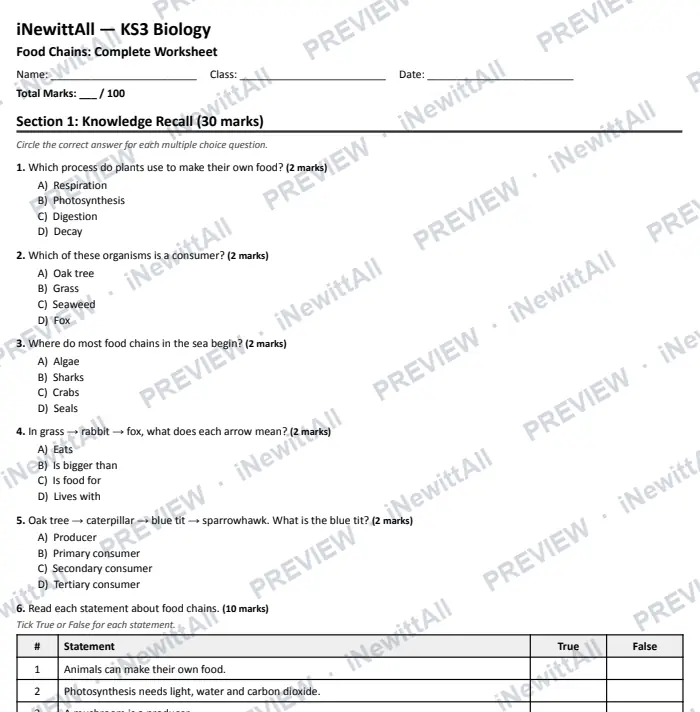
The top of page 1. The answer key is included when you buy.
£5 £6
The full worksheet and the extension pack together, with both answer keys.
Instant download with full answer keys. Print as many copies as your class needs.
£3
£3
£5 £6
Tick it off to track your progress. It's saved on this device. See my revision →
Students watch the video and do the quiz. They get a result card to paste back to you, showing their first try and best score.
This lesson's quiz questions on one sheet, with the answer key on page 2.
The quiz in big text for your classroom screen, one question at a time. Or build a 5-question Do Now starter from lessons your class has already done.
You're welcome to embed the video and link these resources in Google Classroom, Stile, Canvas, Compass or any other school platform. No need to ask.
Everything here is written to the KS3 curriculum for students aged 11–14. Print freely for the classes you teach.
No spam, unsubscribe anytime. You must be 13 or over to sign up.