KS3 Biology › Plant nutrition and photosynthesis

KS3 Biology › Plant nutrition and photosynthesis
These are the points the worksheet questions are built around.
Plants need food to grow and survive, just like animals do — but unlike animals, plants don't eat their food, they make it, through a process called photosynthesis. The word itself explains the idea: "photo" means light, and "synthesis" means to make, so photosynthesis literally means making with light.
Plants are producers — organisms that make their own food, unlike animals, which have to eat other things for energy. This food production happens inside plant cells, specifically in the leaves and other green parts of the plant above ground; the roots and soil play no part in the process itself.
Photosynthesis needs light because it's a series of chemical reactions, and those reactions need energy to run. Light is that energy source: when sunlight hits a leaf, energy transfers into the leaf cells and powers the reactions. Without light, there's no food production at all.
Like any chemical reaction, photosynthesis has reactants (the substances that go in) and products (the new substances that come out). The two reactants are water and carbon dioxide. Water is absorbed through the roots and travels up the stem into the leaves, while carbon dioxide is absorbed directly from the air through tiny pores in the leaves. The two products are glucose and oxygen. Glucose is a sugar, a type of carbohydrate, and it's the plant's food — transported around the plant to be used both as an energy source and as raw material to build new cells and tissues for growth. Oxygen is released back into the air through the leaves; a significant amount of the oxygen we breathe comes from this process happening in plants all around us.
The word summary to remember is: water plus carbon dioxide gives glucose and oxygen. A common mistake is thinking light counts as a reactant — it doesn't. Light isn't a substance and doesn't turn into a product; it simply provides the energy that powers the reaction.
A striking example of the scale involved: a large tree can produce around 10 kilograms of glucose through photosynthesis in a single sunny day. Every carbon atom in that glucose originally came from carbon dioxide gas in the air — meaning trees are, in a very real sense, building their own body mass out of thin air rather than out of the soil.
In short: photosynthesis is how plants make their own food, using light energy to power a reaction where water and carbon dioxide are turned into glucose and oxygen. It happens in the leaves and green parts of the plant, requires light to work at all, and explains why a growing plant gains far more mass from the air than it ever takes from the soil.
These are the words that appear as key term cards in the video — worth knowing cold before the test.
Short clips from this lesson. Good for a quick refresh before a test.
Swipe sideways to see more →
Revising for a test? Key terms, objectives and quiz questions on one printable page.
The 3 questions from the video, one at a time. See if you caught them.
1. Why will moving Izzy's houseplant next to the window help it grow bigger?
Why: More light gives the plant more energy for photosynthesis, so it makes more glucose. The plant uses that glucose to grow.
2. After 4 months, Lucas's plant is much bigger, but the mass of the soil is the same as when he started. Why did the plant's mass increase?
Why: A plant builds most of its mass from carbon dioxide taken from the air, which it turns into glucose and other materials in photosynthesis. The soil only supplies small amounts of minerals, so its mass hardly changes.
3. Which of these is NOT a product of photosynthesis?
Why: Photosynthesis uses up carbon dioxide and water, and it makes glucose (a sugar) and oxygen. So carbon dioxide goes in, and isn't a product.
Score: 0 out of 3 —
Want more practice? Try the 60-second Quiz Challenge →
One page with a full answer key. Enough to check the lesson landed, and to see how the questions are written before you buy anything.
Get the free worksheet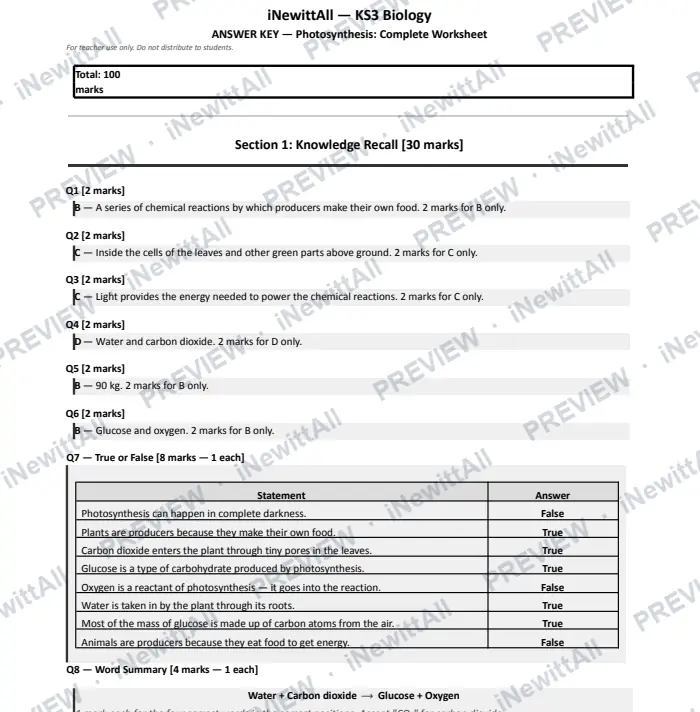
The top of page 1. The answer key is included when you buy.
£5 £6
The full worksheet and the extension pack together, with both answer keys.
Instant download with full answer keys. Print as many copies as your class needs.
£3
£3
£5 £6
Tick it off to track your progress. It's saved on this device. See my revision →
Students watch the video and do the quiz. They get a result card to paste back to you, showing their first try and best score.
This lesson's quiz questions on one sheet, with the answer key on page 2.
The quiz in big text for your classroom screen, one question at a time. Or build a 5-question Do Now starter from lessons your class has already done.
You're welcome to embed the video and link these resources in Google Classroom, Stile, Canvas, Compass or any other school platform. No need to ask.
Everything here is written to the KS3 curriculum for students aged 11–14. Print freely for the classes you teach.
 Next lessonPlant Adaptations for Photosynthesis
More in this unit: Plant nutrition and photosynthesis
No spam, unsubscribe anytime. You must be 13 or over to sign up.