KS3 Biology › Plant nutrition and photosynthesis

KS3 Biology › Plant nutrition and photosynthesis
These are the points the worksheet questions are built around.
Plants are living organisms, even though they don't move, eat, or breathe in the way animals do. Like any living thing, they grow, reproduce (through seeds and flowers), respond to their environment (a houseplant leaning slowly toward a window is responding to light), and excrete waste (releasing oxygen). Crucially, they also need food — for energy and to build new cells and tissues, just as animals do.
Plants take in four things from their surroundings, but it's important to understand that most of these are not actually food. Light is absorbed through the leaves, but it's energy, not food. Gases, especially carbon dioxide, are taken in through tiny holes in the leaves, too small to see without a microscope — again, not food. Water is absorbed through the roots and serves several purposes: it helps transport substances around the plant, and since plants have no skeleton, it keeps them rigid by filling their cells, much like a water balloon standing upright. Minerals, such as nitrogen, phosphorus, and potassium, are absorbed from the soil through the roots and help keep plants healthy — commercial "plant food" bottles are actually mineral supplements, working more like vitamins than food, since they don't provide energy.
None of light, gases, water, or minerals is food, because food must be a source of both energy and materials for growth. Instead, plants make their own food — they are producers, organisms that produce their own food rather than consuming other organisms. The food plants make is a carbohydrate, specifically a sugar called glucose, built by combining carbon dioxide from the air, water from the soil, and light energy from the sun, through a process called photosynthesis.
This matters far beyond the plant itself. Every food chain on Earth begins with a producer — usually a plant, but sometimes algae or certain bacteria. In a food chain like grass, cow, human, the grass is the producer, the cow is a consumer, and the human is a secondary consumer, since it's eating something that ate a plant. Because every food chain traces back to a producer, all the energy in the food any animal eats ultimately originated from a plant making its own food using sunlight.
Once made, glucose serves two purposes for the plant. First, it's a source of energy: plants break it down through cellular respiration to release the energy that powers growth, transporting water and minerals, and making new cells. Second, it's a source of raw materials: combined with minerals absorbed from the soil, glucose is used to build other substances the plant needs, including proteins, fats, and cellulose for cell walls. The same glucose molecule effectively serves as both fuel and construction material for the entire plant.
In short: plants are living organisms that need food like any other living thing, but rather than consuming it, they make it themselves through photosynthesis, combining carbon dioxide, water, and light energy into glucose. That glucose fuels the plant through cellular respiration and provides the building blocks for growth — and as the starting point of every food chain, it ultimately powers almost all other life on Earth too.
These are the words that appear as key term cards in the video — worth knowing cold before the test.
Short clips from this lesson. Good for a quick refresh before a test.
Swipe sideways to see more →
Revising for a test? Key terms, objectives and quiz questions on one printable page.
The 3 questions from the video, one at a time. See if you caught them.
1. Which of these statements about plants is correct?
Why: Plants are living things. They just move much more slowly than animals, and they carry out all the life processes, including making their own food.
2. An organism that makes its own food is called what?
Why: A producer makes its own food, as plants do by photosynthesis. Consumers eat other living things, and decomposers break down dead material.
3. Plants make their own food. This food is a type of what?
Why: Plants make glucose in photosynthesis, and glucose is a carbohydrate. They can later turn it into proteins and fats using minerals.
Score: 0 out of 3 —
Want more practice? Try the 60-second Quiz Challenge →
One page with a full answer key. Enough to check the lesson landed, and to see how the questions are written before you buy anything.
Get the free worksheet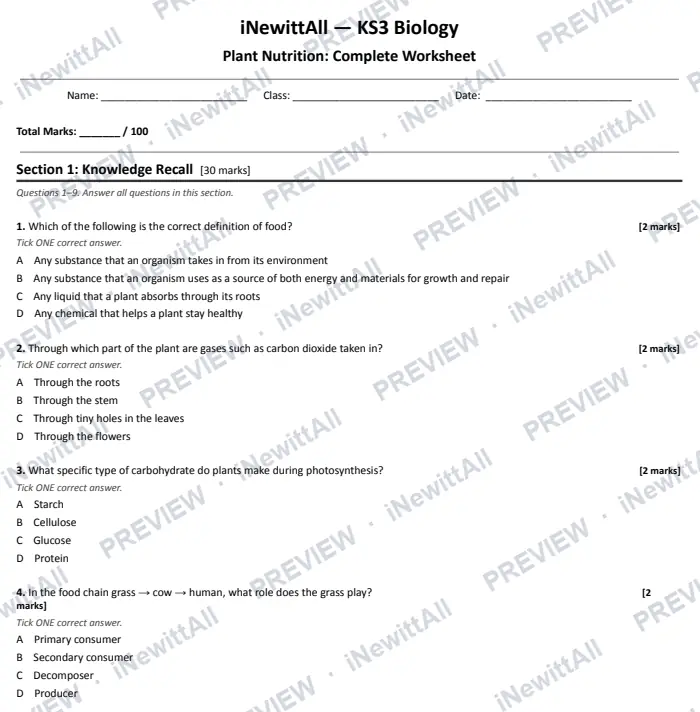
The top of page 1. The answer key is included when you buy.
£5 £6
The full worksheet and the extension pack together, with both answer keys.
Instant download with full answer keys. Print as many copies as your class needs.
£3
£3
£5 £6
Tick it off to track your progress. It's saved on this device. See my revision →
Students watch the video and do the quiz. They get a result card to paste back to you, showing their first try and best score.
This lesson's quiz questions on one sheet, with the answer key on page 2.
The quiz in big text for your classroom screen, one question at a time. Or build a 5-question Do Now starter from lessons your class has already done.
You're welcome to embed the video and link these resources in Google Classroom, Stile, Canvas, Compass or any other school platform. No need to ask.
Everything here is written to the KS3 curriculum for students aged 11–14. Print freely for the classes you teach.
 Next lessonPhotosynthesis
More in this unit: Plant nutrition and photosynthesis
No spam, unsubscribe anytime. You must be 13 or over to sign up.