KS3 Biology › Heredity and DNA

KS3 Biology › Heredity and DNA
These are the points the worksheet questions are built around.
Identical twins share almost exactly the same genetic material, which makes them useful for working out what genes control and what life changes. In 2015 NASA sent the astronaut Scott Kelly to the International Space Station for 340 days while his identical twin, Mark, stayed on Earth. When Scott returned he was about five centimetres taller than before. This raises the central question of the lesson: why can some features change during a lifetime while others are fixed, and which of them can be passed on to children?
Every feature an organism has arrives in one of two ways. Some features are inherited, meaning they are passed on from parents. Others are gained during life, and these come from two sources. The first is the environment, which is an organism's surroundings and the conditions it lives in, such as sunlight, water and the nutrients available. Plants show this clearly. A tomato plant with wilting leaves may not be getting enough water, and yellowing leaves can be a sign that nutrients are missing from the soil. The plant's genetic material has not changed, but its appearance has.
The second source is lifestyle, which is the things a person does and the choices they make, such as diet, exercise or having ears pierced. Someone who trains with weights every week builds bigger muscles. That is a real change to the body, but it was made by the person's life rather than by their parents.
This leads to the key rule: a feature gained during life cannot be passed on to children. Scars, tattoos, pierced ears and muscles built in the gym are all examples, and so is the language a person speaks, because it is learned from the people around them. None of these appear in the next generation, which is why a bodybuilder's baby is not born with large muscles.
What does travel from parent to child is genetic material, a chemical found inside cells that carries the instructions for building and running a living thing. In plant and animal cells it is kept in the nucleus. Bacteria have no nucleus, so their genetic material sits in the cytoplasm instead. During reproduction, genetic material is passed from parents to their offspring, and this passing on of features is called heredity. Offspring do not receive it all from one parent: about half comes from the mother and about half from the father, which is why a child can have one parent's eye colour and the other parent's hair colour.
Inherited features are not only the visible ones, such as eye colour, nose shape and whether hair is curly or straight. Genetic material also holds instructions for life processes, the jobs that keep an organism alive, such as growth, digestion and respiration, the process that releases energy in cells. Some inherited features cannot be seen at all. Blood group is set by the genes inherited from both parents, and no amount of exercise or healthy eating changes it. Natural eye colour is similar: coloured contact lenses alter how the eyes look, but they only sit on the surface, and the real eye colour underneath stays the same.
Many features do not fall neatly into one group because they come from both. Height is the clearest example. Genetic material sets roughly how tall a person could grow, but diet, especially during childhood, affects whether that height is reached, so a child without enough good food can end up shorter than their genes would have allowed. Skin colour works in a similar way: natural skin colour is inherited, but sunlight makes the skin produce more of a brown pigment called melanin, giving a tan. Natural hair colour is inherited, while dyeing it is a lifestyle choice. Plants show the same pattern. Some hydrangeas grow blue flowers in acid soil and pink flowers in alkaline soil, so the same plant with the same genetic material can look different depending on the soil. Chameleons are another example. They are often thought to change colour to blend into their background, but they mostly change colour to signal to other chameleons and to control their temperature. The ability to change colour is inherited, while the colour shown at any moment depends on mood and warmth.
This explains Scott Kelly's extra height. In space nothing presses down on the spine, so it stretches out, and after a short time back on Earth he returned to his normal height. His genetic material did not make him taller; his environment did, and that change could never be passed on.
In short: features are either inherited through genetic material or gained during life from the environment and lifestyle, and many come from both. Genetic material, kept in the nucleus of plant and animal cells and in the cytoplasm of bacteria, carries the instructions for features and life processes, with about half coming from each parent. Only features written into genetic material can be inherited, so scars, tattoos, learned language and changes like Scott Kelly's extra height stay with the individual and are never passed on.
These are the words that appear as key term cards in the video — worth knowing cold before the test.
Short clips from this lesson. Good for a quick refresh before a test.
Revising for a test? Key terms, objectives and quiz questions on one printable page.
The 3 questions from the video, one at a time. See if you caught them.
1. Which of these can't be passed on to offspring?
Why: A tattoo is added during someone's life, so it isn't in their genetic material.
2. How much of your genetic material came from your mum?
Why: You get about half of your genetic material from each parent, so you can share features with both.
3. Which of these is affected by both genetic material and lifestyle?
Why: Your genes set how tall you could grow, but your diet while growing affects how tall you get.
Score: 0 out of 3 —
Want more practice? Try the 60-second Quiz Challenge →
One page with a full answer key. Enough to check the lesson landed, and to see how the questions are written before you buy anything.
Get the free worksheet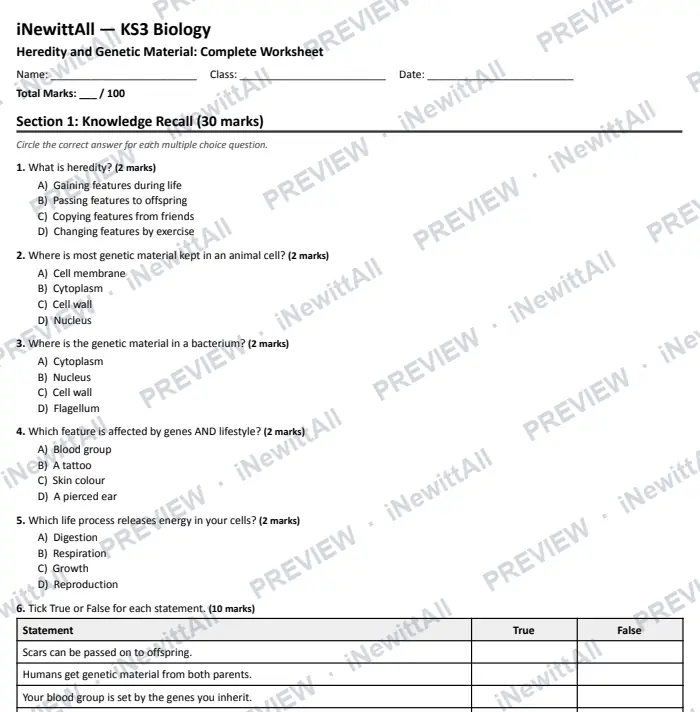
The top of page 1. The answer key is included when you buy.
£5 £6
The full worksheet and the extension pack together, with both answer keys.
Instant download with full answer keys. Print as many copies as your class needs.
£3
£3
£5 £6
Tick it off to track your progress. It's saved on this device. See my revision →
Students watch the video and do the quiz. They get a result card to paste back to you, showing their first try and best score.
This lesson's quiz questions on one sheet, with the answer key on page 2.
The quiz in big text for your classroom screen, one question at a time. Or build a 5-question Do Now starter from lessons your class has already done.
You're welcome to embed the video and link these resources in Google Classroom, Stile, Canvas, Compass or any other school platform. No need to ask.
Everything here is written to the KS3 curriculum for students aged 11–14. Print freely for the classes you teach.
More in this unit: Heredity and DNA
No spam, unsubscribe anytime. You must be 13 or over to sign up.