KS3 Geography › Rivers

KS3 Geography › Rivers
These are the points the worksheet questions are built around.
Rain from one storm does not reach a river at one speed. A drop landing on a road can be in a river within hours, while a drop sinking into a chalk field in parts of southern England may take decades to reach a stream. The difference comes down to the route the water takes once it lands, and the fast route is the one that causes rivers to flood.
Every drop lands in a drainage basin, the area of land drained by a river and its tributaries, which geographers study as a system. Anything that brings water into the basin counts as an input, and here that means precipitation, whether it falls as rain, snow, sleet or hail. Anything that takes water away counts as an output. Part of it evaporates, and part is released by plants through their leaves, a process called transpiration. Taken together, these two outputs are known as evapotranspiration. The river carries the rest away, usually to the sea. Because water crosses the edge of the basin both on the way in and on the way out, the basin is known as an open system. It is like a bath filling from the tap while the plug is out. That picture covers what goes in and out, but to explain the two raindrops the water has to be traced inside the basin, through its stores and flows.
A lot of rain hits leaves before it ever reaches the ground. Plants catching falling rain in this way is called interception. The leaves then act as a store, holding the water for a time. Some of it evaporates directly from the leaves and never reaches the ground at all. The rest gets down slowly, either by dripping through the leaves, called throughfall, or by trickling down the branches and trunk, called stemflow.
When water does reach the ground, it can go one of two ways. It may soak into the soil, which is infiltration. If it cannot get in, it moves across the ground instead, which is surface runoff. Water lying in puddles and ponds is held in another store, surface storage. Of every route, surface runoff is the fastest, flowing downhill and sometimes reaching a stream in just a few hours. This is the journey of the first, fast raindrop.
The second, slow raindrop goes underground. Water that has infiltrated is first held as soil moisture, which is a store. Some of that water then moves sideways and downhill through the soil towards the river, which is throughflow. Throughflow is the slower of the two because the water must work its way through tiny gaps instead of sliding across the top. The rest sinks out of the soil and down into the rock, which is percolation. Rocks such as chalk and sandstone contain many tiny spaces and can hold water rather like a sponge, and this water is called groundwater. Even this stored water is on the move: it creeps through the rock towards the river in a flow called groundwater flow, finally entering the river by seeping out through its bed and banks. This is the slowest route of all, and in chalk it can take decades. Every route ends in the river channel, itself a store, and water moving along it towards the mouth is channel flow.
Several things decide the route. One of the biggest is the state of the ground before the rain arrives. A long spell of wet days leaves the soil saturated, with every gap filled, so fresh rain has to run over the top. A downpour can do the same, because rain arriving faster than the soil takes it in simply runs off. Surprisingly, very dry ground can also cause runoff. A long period of hot weather bakes the soil hard, making it difficult for a heavy downpour to soak in, and the Met Office has warned that flash floods can follow when a heatwave breaks with heavy storms. Towns and cities are covered in hard surfaces such as tarmac, concrete and roofs, so a much larger share of their rain ends up as surface runoff. Water on steep slopes rushes downhill before it has time to infiltrate, ground without plants offers no interception, and rock matters too, as chalk lets water soak deep inside while granite lets very little through.
The route matters because it controls flooding. If most of the water takes the fast routes, a large amount arrives in the river within hours, more than the channel can carry away in time. The level climbs, and once the water spills over the banks a flood happens. If most of it takes the slow routes, the water is soaked up and held in the soil and rock, then released to the river over days, weeks or longer, so the level only climbs gently. That explains why building roads and houses over fields can increase flooding, and why some flood schemes plant trees above towns, since extra interception and infiltration push more of the rain onto the slow routes. The slow routes also matter in dry weather. During a summer with weeks of no rain, nothing is running off the land, yet most rivers carry on flowing, fed by groundwater seeping in through the bed and banks. Some of that water may have fallen as rain many months or even years before.
In short: a drainage basin is an open system with precipitation as its input and evapotranspiration and river flow as its outputs, while inside the basin water passes between stores along a series of flows. Rain that takes the fast route over the surface reaches a river within hours and can cause floods, while rain that takes the slow route through the soil and rock arrives gently over a much longer time and keeps rivers flowing through dry spells.
These are the words that appear as key term cards in the video — worth knowing cold before the test.
Revising for a test? Key terms, objectives and quiz questions on one printable page.
The 3 questions from the video, one at a time. See if you caught them.
1. What is it called when rainwater soaks into the soil?
Why: Infiltration is water soaking from the surface down into the soil.
2. Which of these is NOT a store in a drainage basin?
Why: Surface runoff is a flow that moves water over the ground, not a place where water is held.
3. After weeks with no rain, what mostly keeps a river flowing?
Why: With no runoff, groundwater seeping in through the bed and banks keeps the river flowing.
Score: 0 out of 3 —
Want more practice? Try the 60-second Quiz Challenge →
One page with a full answer key. Enough to check the lesson landed, and to see how the questions are written before you buy anything.
Get the free worksheet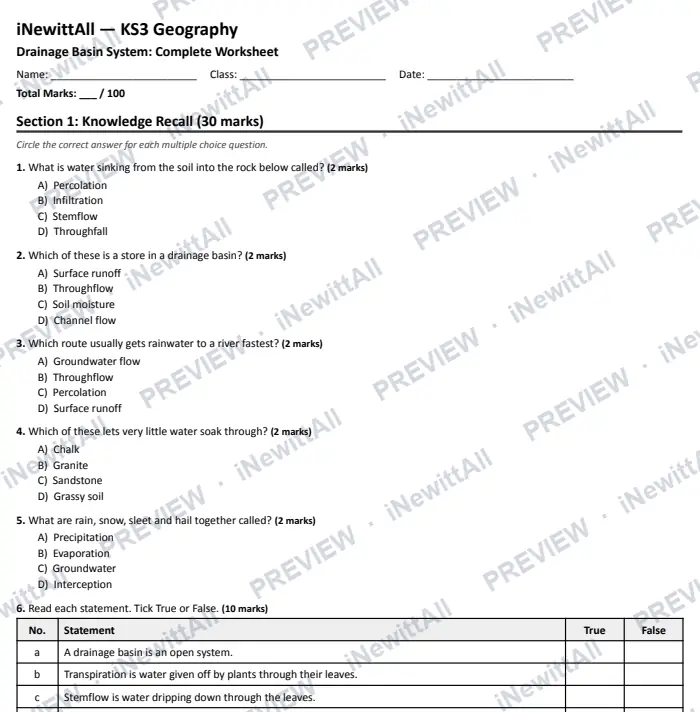
The top of page 1. The answer key is included when you buy.
£5 £6
The full worksheet and the extension pack together, with both answer keys.
Instant download with full answer keys. Print as many copies as your class needs.
£3
£3
£5 £6
Tick it off to track your progress. It's saved on this device. See my revision →
Students watch the video and do the quiz. They get a result card to paste back to you, showing their first try and best score.
This lesson's quiz questions on one sheet, with the answer key on page 2.
The quiz in big text for your classroom screen, one question at a time. Or build a 5-question Do Now starter from lessons your class has already done.
You're welcome to embed the video and link these resources in Google Classroom, Stile, Canvas, Compass or any other school platform. No need to ask.
Everything here is written to the KS3 curriculum for students aged 11–14. Print freely for the classes you teach.
No spam, unsubscribe anytime. You must be 13 or over to sign up.