KS3 Biology › Species and classification (differences between species)

KS3 Biology › Species and classification (differences between species)
These are the points the worksheet questions are built around.
Some animals seem to break the rules. Penguins have wings but cannot fly, bats fly but are not birds, and whales spend their entire lives at sea without being fish. Obvious features can mislead, so scientists need a dependable way to decide where an animal belongs. That tool is a classification key, a sequence of questions about the features an organism has, which leads step by step to the correct group. Grouping living things by their features is known as classification, and the science behind it is called taxonomy.
Classification works rather like boxes packed inside larger boxes. Living things are first placed in very broad groups, and each of these is split into smaller ones. There are seven main levels: kingdom, phylum, class, order, family, genus and species. A kingdom is the largest level, holding an enormous number of organisms that have little in common. Towards species, each group shrinks and its members have more features in common.
Plants and animals form two separate kingdoms. Plants are producers, since they make their own food, whereas animals are consumers, since they must eat other living things. The animal kingdom is divided again into vertebrates, which have a backbone, and invertebrates, which lack one. Penguins, bats and whales are all vertebrates, so the question is which vertebrate group each fits.
There are five main vertebrate groups. Mammals have hair or fur, and mothers produce milk to feed their young. Birds have a covering of feathers, and their eggs have hard shells. Mammals and birds are both warm-blooded, meaning their bodies hold a steady temperature. The other three groups are cold-blooded, so their body temperature rises and falls with the conditions around them. Reptiles have dry skin covered in scales, and most of them lay eggs with leathery shells on land. Amphibians, such as frogs and newts, have moist skin; most lay eggs coated in jelly in water, and their young use gills to breathe. Fish live in water and breathe using gills as well.
Picking the right feature is crucial. Nearly every mammal gives birth to live young, yet the platypus and the echidna lay eggs. They are still mammals, because they have hair and produce milk for their young. Checking the wrong feature would misplace them.
A classification key is made of questions that each have only two possible answers, most often yes or no. Each answer sends the user on to another question until a group is reached. A simple key asks first about wings, then feathers. The penguin has both, so it is a bird that happens to use its wings as flippers for swimming. The bat has wings but no feathers, and fur instead, so the key places it among the mammals. No other mammal can truly fly, and around one mammal species in every five is a bat. The whale has no wings, so it takes the other branch. It has no gills, since it breathes air through a blowhole on the top of its head, and it produces milk for its young, so it is a mammal too. Its watery home pointed the wrong way, but the key's questions did not.
Each question in a key must ask about a feature that can actually be checked and gives a clear answer. Asking whether an animal is big is unhelpful, because big has no fixed meaning, while asking whether it has feathers gives a straight yes or no. Every question should divide the animals into two sets, and each animal should follow just one path through the key. Wings and living in water look useful but are shared by animals from different groups, so the best questions use defining features instead, such as feathers for birds, and hair and milk for mammals.
With three more animals, a good opening question is whether an animal is warm-blooded or cold-blooded, which separates mammals and birds from the other groups. The ostrich is warm-blooded and flightless, but it has feathers and lays eggs with hard shells, so it is a bird, and the largest one living today. The dolphin, also warm-blooded, has no feathers, uses lungs to breathe air and feeds its young on milk, so it is a mammal, just as the whale is. The turtle is cold-blooded, uses lungs rather than gills, and has dry, scaly skin. Even though some turtles live almost entirely at sea, sea turtles still haul themselves onto beaches to lay leathery eggs, which makes the turtle a reptile. Judged on looks alone, any of them could be misplaced.
More than two million species have been named, and many more remain undiscovered. Giving each species a fixed place means scientists everywhere know exactly which one they mean. It also underpins conservation: to follow elephants in the wild or carry out a survey of a rainforest, scientists must know precisely which species live there and whether their numbers are growing or shrinking. A species placed in the wrong group becomes far harder to monitor and protect.
In short: classification arranges living things into seven main levels from kingdom to species, and vertebrates are divided into five main groups with their own features. A classification key uses two-answer questions about defining features, such as feathers, hair and milk, rather than appearance, which is how it shows that a penguin is a bird while a bat and a whale are mammals. Getting these groups right helps scientists understand life on Earth and look after it.
These are the words that appear as key term cards in the video — worth knowing cold before the test.
Revising for a test? Key terms, objectives and quiz questions on one printable page.
The 3 questions from the video, one at a time. See if you caught them.
1. Which feature do only birds have today?
Why: Bats have wings, turtles have beaks and mammals are warm-blooded, but only birds have feathers.
2. An armadillo is covered in hard, bony plates. Is it a reptile or a mammal?
Why: Armadillos have hair and feed their young on milk, so their armour doesn't make them reptiles.
3. Which of these animals is NOT a mammal?
Why: A penguin has feathers and lays hard-shelled eggs, so it's a bird, not a mammal.
Score: 0 out of 3 —
Want more practice? Try the 60-second Quiz Challenge →
One page with a full answer key. Enough to check the lesson landed, and to see how the questions are written before you buy anything.
Get the free worksheet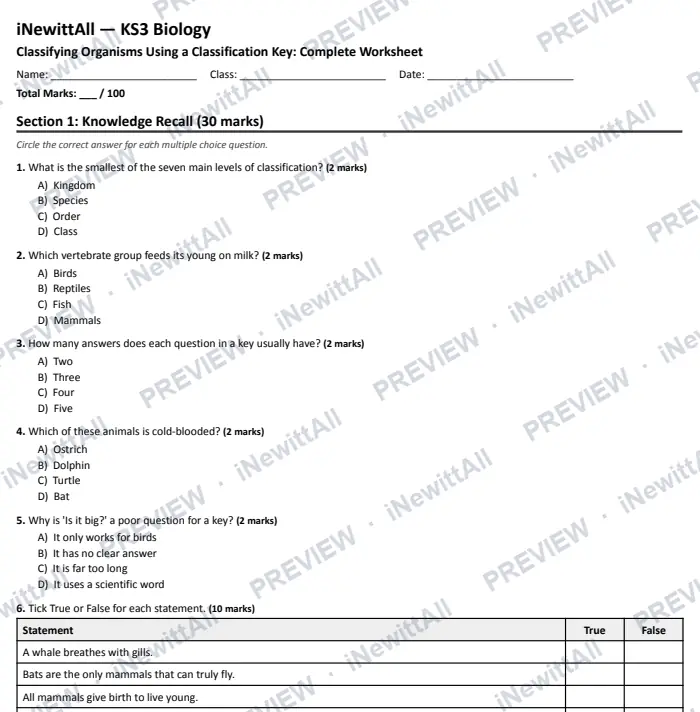
The top of page 1. The answer key is included when you buy.
£5 £6
The full worksheet and the extension pack together, with both answer keys.
Instant download with full answer keys. Print as many copies as your class needs.
£3
£3
£5 £6
Tick it off to track your progress. It's saved on this device. See my revision →
Students watch the video and do the quiz. They get a result card to paste back to you, showing their first try and best score.
This lesson's quiz questions on one sheet, with the answer key on page 2.
The quiz in big text for your classroom screen, one question at a time. Or build a 5-question Do Now starter from lessons your class has already done.
You're welcome to embed the video and link these resources in Google Classroom, Stile, Canvas, Compass or any other school platform. No need to ask.
Everything here is written to the KS3 curriculum for students aged 11–14. Print freely for the classes you teach.
More in this unit: Species and classification (differences between species)
No spam, unsubscribe anytime. You must be 13 or over to sign up.