KS3 Biology › Plant nutrition and photosynthesis

KS3 Biology › Plant nutrition and photosynthesis
These are the points the worksheet questions are built around.
Everything about a leaf's shape — how thin it is, how flat and wide it is, even the fact that it's green — is a plant solving one problem: how to catch as much light as possible, since a plant that can't catch light can't make food and can't survive. Photosynthesis happens mostly in the leaves, in the parts of a plant above ground, and needs three things: water, carbon dioxide, and energy from light.
A leaf looks like one flat sheet, but under a microscope it's built from thousands of tiny cells packed together, and photosynthesis actually happens inside those cells, not on the leaf's surface. Plant cells share several structures with animal cells: a nucleus (which controls the cell's activities and stores its genetic material), cytoplasm (the jelly-like substance where most chemical reactions happen), a cell membrane (controlling what moves in and out), and mitochondria (where respiration releases energy). But plant cells have three extra structures animal cells don't: a cell wall, which strengthens and protects the cell; a permanent vacuole, which stores cell sap and keeps the cell firm; and chloroplasts — the whole reason a plant can feed itself.
An adaptation is a feature that helps an organism function and survive, and a chloroplast is exactly that for a plant cell. Not every plant cell has them, though — root cells, for example, have a nucleus, mitochondria, a vacuole, a cell wall and a membrane, but no chloroplasts at all, since there's no light underground for them to use. A single leaf can contain many millions of chloroplasts (around half a million in every square millimetre), and they're not spread evenly — cells just beneath the top surface, facing the sky, contain far more than cells lower down, since that's where light arrives first and strongest.
Inside each chloroplast is chlorophyll, a green substance that absorbs light and provides the energy for photosynthesis's chemical reactions — which is why the whole process stops in the dark. Chlorophyll doesn't absorb all light equally: it absorbs red and blue light well, but reflects most green light back, which is why leaves look green to us — green is essentially the light energy the plant didn't want. This explains variegated houseplants, whose pale cream patches contain little to no chlorophyll and do almost no photosynthesis, leaving the dark green parts of the leaf to do most of the work. It also explains autumn colour change: as a tree prepares to drop its leaves, it breaks down chlorophyll and pulls useful material back into its branches, letting the orange and yellow pigments that were there all along finally show through.
Leaves are thin — around a tenth of a millimetre, about the thickness of paper — so that light can pass through every layer of cells rather than being absorbed entirely by the top layer, leaving lower layers in shadow. Leaves are also wide and flat to maximise surface area, since a bigger surface area facing the sky captures more light, which means more photosynthesis and more food. Since real leaves are irregular shapes, scientists estimate their surface area by laying them on a grid and counting squares that are at least half covered by leaf.
Being thin and being wide aren't two separate adaptations — they work together. The same number of cells arranged as a tall stack would bury most of them in shadow with only a small surface exposed to light; arranged instead as a flat, spread-out sheet, every cell gets a share of the light. That flat sheet is a leaf.
In short: leaves are shaped by the need to absorb as much light as possible. Chloroplasts (containing chlorophyll) are the adaptation that makes photosynthesis possible, only appearing where light can reach. Being thin lets light reach every layer of cells, and having a large surface area maximises how much light is caught in the first place — two sides of the same underlying solution.
These are the words that appear as key term cards in the video — worth knowing cold before the test.
Short clips from this lesson. Good for a quick refresh before a test.
Swipe sideways to see more →
Revising for a test? Key terms, objectives and quiz questions on one printable page.
The 3 questions from the video, one at a time. See if you caught them.
1. Which part is found in plant cells but not in animal cells?
Why: Chloroplasts contain the chlorophyll used for photosynthesis. Plant cells have them but animal cells don't. Both types of cell have a nucleus, mitochondria and a cell membrane.
2. Why do leaves look green to us?
Why: Chlorophyll absorbs red and blue light and reflects green light. The reflected green light reaches our eyes, so we see leaves as green.
3. Which of these is NOT an adaptation for absorbing light?
Why: Thin leaves, a large surface area and chloroplasts all help a leaf to absorb light. Mitochondria release energy, which isn't about absorbing light.
Score: 0 out of 3 —
Want more practice? Try the 60-second Quiz Challenge →
One page with a full answer key. Enough to check the lesson landed, and to see how the questions are written before you buy anything.
Get the free worksheet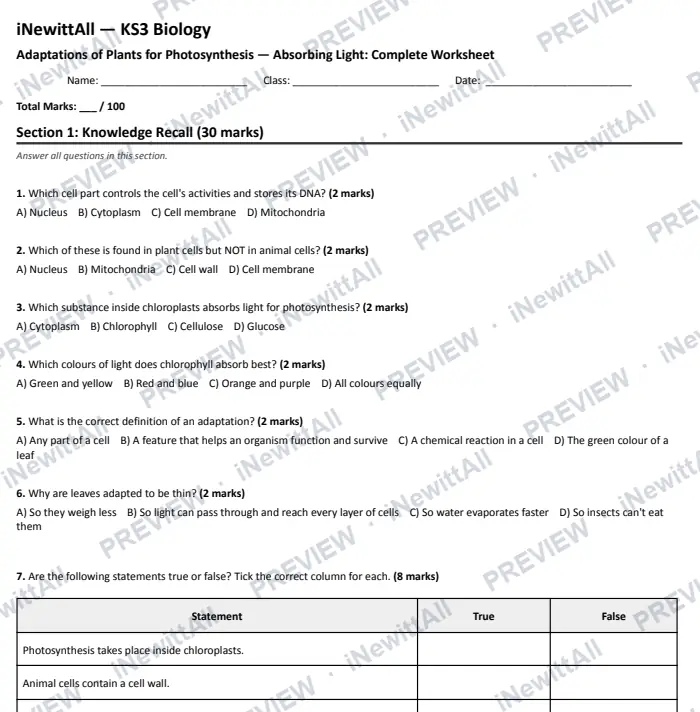
The top of page 1. The answer key is included when you buy.
£5 £6
The full worksheet and the extension pack together, with both answer keys.
Instant download with full answer keys. Print as many copies as your class needs.
£3
£3
£5 £6
Tick it off to track your progress. It's saved on this device. See my revision →
Students watch the video and do the quiz. They get a result card to paste back to you, showing their first try and best score.
This lesson's quiz questions on one sheet, with the answer key on page 2.
The quiz in big text for your classroom screen, one question at a time. Or build a 5-question Do Now starter from lessons your class has already done.
You're welcome to embed the video and link these resources in Google Classroom, Stile, Canvas, Compass or any other school platform. No need to ask.
Everything here is written to the KS3 curriculum for students aged 11–14. Print freely for the classes you teach.
More in this unit: Plant nutrition and photosynthesis
No spam, unsubscribe anytime. You must be 13 or over to sign up.