KS3 Biology › Cells

KS3 Biology › Cells
These are the points the worksheet questions are built around.
Plant cells have everything animal cells have, plus three extra structures that make them unique. The four shared structures are the nucleus, which acts as the cell's control centre, containing DNA and controlling the cell's activities; the cell membrane, a thin layer surrounding the cytoplasm that acts like a security guard, controlling which substances enter (for nutrition) and leave (as waste, through excretion); the cytoplasm, the jelly-like substance where the cell's chemical reactions happen; and mitochondria, the powerhouses of the cell, which use food as fuel to release energy through respiration — something every living thing does, from plants to bacteria.
Plant cells also have three structures animal cells don't. The cell wall is a tough outer layer made of fibres that gives the cell structure and support, keeping it rigid — like scaffolding around a building. It's separate from the cell membrane, which sits just inside it: the cell wall has tiny gaps that let substances pass through, while the membrane is the one that actually controls what enters and leaves.
Chloroplasts are bright green structures whose job is to trap sunlight so the plant can make its own food through photosynthesis — something animals can't do, since they have to eat food instead. Not every plant cell has chloroplasts, though. Only cells in the green parts of a plant, like leaves and stems, have them; root cells, buried underground with no access to light, don't need them at all.
The vacuole is a large structure in the middle of the cell, filled with a watery liquid called cell sap. When it's full, it pushes outward against the cell wall, keeping the cell firm — similar to inflating a balloon. When a plant doesn't get enough water, its vacuoles shrink, the cells become less firm, and the whole plant droops and wilts. Watering the plant lets the vacuoles refill, pushing against the cell walls again and helping the plant stand upright.
Plant cells don't all look the same, because different cells are adapted for different jobs. Root hair cells, found underground, have a long, thin extension that massively increases their surface area for absorbing water and minerals — and since they're underground, they have no chloroplasts. Palisade cells, found near the top surface of leaves, are packed with chloroplasts (sometimes making up around 70% of the cell) and arranged in columns to catch as much sunlight as possible. Xylem cells form continuous hollow tubes that carry water from roots to leaves; remarkably, they die during development, and their end walls break down completely to create unbroken pipes, while their thick walls help support the plant. Phloem cells, by contrast, stay alive and transport sugary water — the food made during photosynthesis — from the leaves to the rest of the plant.
Comparing cell types helps make sense of all this. Plant cells, animal cells, and fungi cells all share a nucleus, cell membrane, cytoplasm, and mitochondria. Animal cells lack a cell wall, a vacuole, and chloroplasts. Plant cells have all three of those extra structures. Fungi cells have a cell wall and a vacuole, just like plants, but no chloroplasts, since fungi absorb nutrients from their environment rather than making their own food through photosynthesis. If an animal cell somehow had a large vacuole like a plant cell, it would likely burst, since it lacks the strong cell wall needed to handle the pressure — which is why plant cells rely on the cell wall and vacuole working together.
Despite looking different from animal cells, plant cells are unmistakably living: they carry out respiration in their mitochondria, nutrition through chloroplasts making food and the cell membrane controlling what nutrients enter, and excretion as the cell membrane controls waste leaving the cell.
In short: plant cells share the nucleus, cell membrane, cytoplasm, and mitochondria with animal cells, but add a cell wall, chloroplasts, and a large vacuole. Different plant cells — like root hair, palisade, xylem, and phloem cells — are shaped very differently from each other because each is specialised for a different job, and together they show that plant cells carry out all the same essential life processes as any other living cell.
These are the words that appear as key term cards in the video — worth knowing cold before the test.
Short clips from this lesson. Good for a quick refresh before a test.
Swipe sideways to see more →
Revising for a test? Key terms, objectives and quiz questions on one printable page.
The 3 questions from the video, one at a time. See if you caught them.
1. Which best describes the structure and job of xylem cells in plants?
Why: Xylem cells die, and their end walls break down to form a continuous hollow tube. Water and minerals travel up through it from the roots to the leaves.
2. How do fungi cells differ from plant cells and animal cells?
Why: Fungi cells have a cell wall and a vacuole, like plant cells. But fungi don't photosynthesise, so they have no chloroplasts.
3. What would happen if an animal cell had a large, water-filled central vacuole like a plant cell?
Why: A plant cell has a strong cell wall that holds its shape when the vacuole is full. An animal cell doesn't, so a big water-filled vacuole would make it burst.
Score: 0 out of 3 —
Want more practice? Try the 60-second Quiz Challenge →
This lesson is a level in our game Keep the Cell Alive
One page with a full answer key. Enough to check the lesson landed, and to see how the questions are written before you buy anything.
Get the free worksheet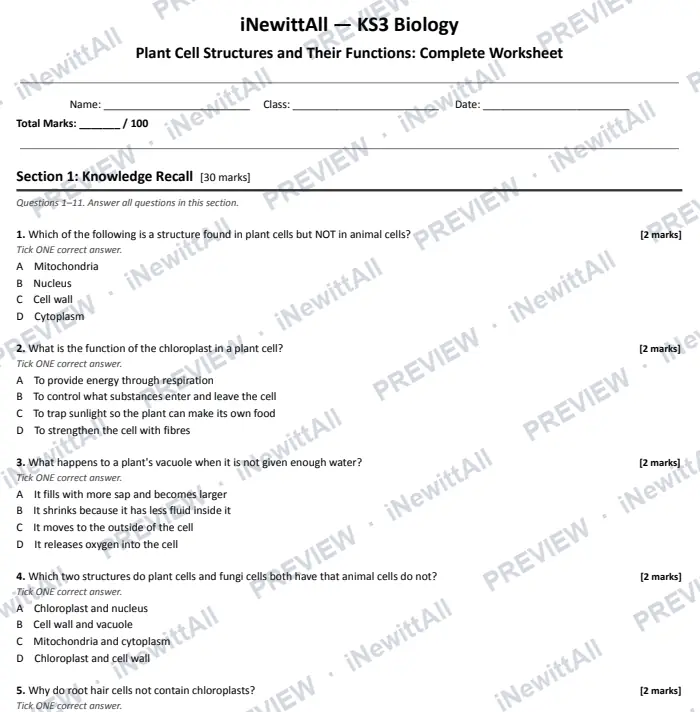
The top of page 1. The answer key is included when you buy.
£5 £6
The full worksheet and the extension pack together, with both answer keys.
Instant download with full answer keys. Print as many copies as your class needs.
£3
£3
£5 £6
Tick it off to track your progress. It's saved on this device. See my revision →
Students watch the video and do the quiz. They get a result card to paste back to you, showing their first try and best score.
This lesson's quiz questions on one sheet, with the answer key on page 2.
The quiz in big text for your classroom screen, one question at a time. Or build a 5-question Do Now starter from lessons your class has already done.
You're welcome to embed the video and link these resources in Google Classroom, Stile, Canvas, Compass or any other school platform. No need to ask.
Everything here is written to the KS3 curriculum for students aged 11–14. Print freely for the classes you teach.
 Next lessonMulticellular and Unicellular Organisms
More in this unit: Cells
No spam, unsubscribe anytime. You must be 13 or over to sign up.