KS3 Biology › Plant nutrition and photosynthesis

KS3 Biology › Plant nutrition and photosynthesis
These are the points the worksheet questions are built around.
Plants make their own food through photosynthesis, a process that turns water and carbon dioxide into glucose and oxygen. Glucose is a sugar, and it fuels the plant's growth and keeps it alive. The leaves carry out most of this work, so they depend on a steady supply of the right gases.
Water reaches a leaf from the roots, but carbon dioxide has to be collected from the surrounding air. Oxygen is left over as a waste product, and the leaf lets it escape into the air. Taking in one gas while giving out another is known as gas exchange, and a photosynthesising leaf is doing both jobs at the same moment.
The importance of carbon dioxide shows in greenhouses, where some growers deliberately raise the amount in the air around their crops. The plants can then photosynthesise faster, which means bigger plants and a bigger harvest.
The top surface of a leaf is covered with a waxy, waterproof coating. This keeps water in, but it does little to let gas through. The gas enters by another route: stomata, which are small holes in the leaf's surface. In many plants the majority sit on the underside. One leaf can carry thousands of them, and a microscope is needed to see them.
Behind each stoma lie air spaces in the gaps between the cells within the leaf. With a stoma open, the outside air links directly to this inner air, so carbon dioxide can pass in to the cells for photosynthesis and oxygen can pass out along the same route. This matters because carbon dioxide is scarce: it makes up only about 0.04 percent of the air, around four particles in every ten thousand. Thousands of open stomata give the leaf many entry points for collecting it.
Each stoma is flanked by a pair of guard cells, which change shape to open and close it. Taking in water makes the guard cells swell and curve away from each other, which opens the hole. Losing water makes them limp, and the hole shuts.
A plant cannot leave its stomata open all the time, because the holes let water out as well. The water leaves as water vapour, meaning water in its gas state. If a plant loses more water than it takes in, it wilts, and a long spell of this can kill it. Each plant therefore balances a trade-off: open stomata bring in carbon dioxide at the cost of water, whereas closed stomata protect the water supply but cut off the carbon dioxide.
The timing of that balance matters too. Photosynthesis needs light, so in most plants the stomata open by day, when carbon dioxide is in demand, and close at night, when there is no light and keeping water in is the priority. Many cacti reverse this pattern. The desert day is hot and dry enough that open stomata would waste a lot of water, so these cacti open them during the cooler night instead. They collect carbon dioxide in the dark, hold it in their cells, and make use of it in photosynthesis after sunrise. The challenge is the same as for other plants, but the solution is quite different.
No pump pulls air into a leaf. The gas moves by diffusion: particles spread out as a result of their random movement, constantly bumping around in all directions. Picture two neighbouring areas, one crowded with particles and one holding only a few. The difference between them is a concentration gradient. Particles travel both ways, but more cross from the crowded area to the emptier one than return, and this overall drift from high to low concentration is the net movement.
Inside a sunlit leaf, the cells keep using carbon dioxide for photosynthesis, so the air spaces hold less of it than the air outside. The net movement of carbon dioxide is therefore inward. The cells are also producing oxygen, so the inside holds more oxygen than the outside, and the net movement of oxygen is outward. No pushing or pulling is needed: as long as photosynthesis continues, both differences are maintained. The thinness of a leaf helps as well, because the gases have only a short journey, so carbon dioxide reaches the cells fast and oxygen leaves fast.
In short: gases pass in and out of a leaf through stomata, and diffusion supplies all of the movement. Carbon dioxide moves in because the cells keep using it, and oxygen moves out because the cells keep producing it. Guard cells open the stomata to let gases pass and close them to save water, and with the stomata shut the leaf cannot obtain the carbon dioxide required for making food.
These are the words that appear as key term cards in the video — worth knowing cold before the test.
Revising for a test? Key terms, objectives and quiz questions on one printable page.
The 3 questions from the video, one at a time. See if you caught them.
1. Which gas do leaves take in for photosynthesis?
Why: Leaves take in carbon dioxide from the air and use it in photosynthesis.
2. Which of these does NOT pass through open stomata?
Why: Glucose is food the plant makes and keeps inside itself, so it doesn't escape through the holes.
3. In a photosynthesising leaf, what is the net movement of carbon dioxide?
Why: The cells use up carbon dioxide, so there's less inside the leaf and more particles move in.
Score: 0 out of 3 —
Want more practice? Try the 60-second Quiz Challenge →
One page with a full answer key. Enough to check the lesson landed, and to see how the questions are written before you buy anything.
Get the free worksheet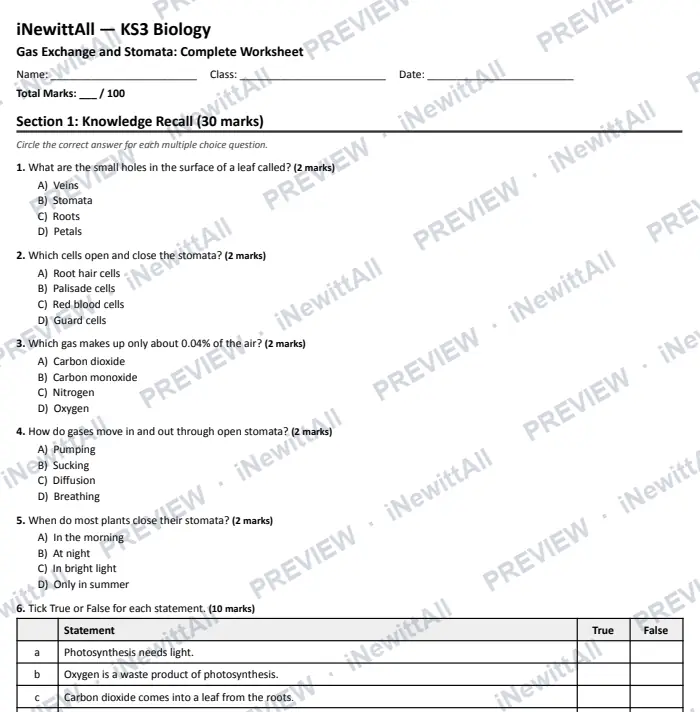
The top of page 1. The answer key is included when you buy.
£5 £6
The full worksheet and the extension pack together, with both answer keys.
Instant download with full answer keys. Print as many copies as your class needs.
£3
£3
£5 £6
Tick it off to track your progress. It's saved on this device. See my revision →
Students watch the video and do the quiz. They get a result card to paste back to you, showing their first try and best score.
This lesson's quiz questions on one sheet, with the answer key on page 2.
The quiz in big text for your classroom screen, one question at a time. Or build a 5-question Do Now starter from lessons your class has already done.
You're welcome to embed the video and link these resources in Google Classroom, Stile, Canvas, Compass or any other school platform. No need to ask.
Everything here is written to the KS3 curriculum for students aged 11–14. Print freely for the classes you teach.
More in this unit: Plant nutrition and photosynthesis
No spam, unsubscribe anytime. You must be 13 or over to sign up.